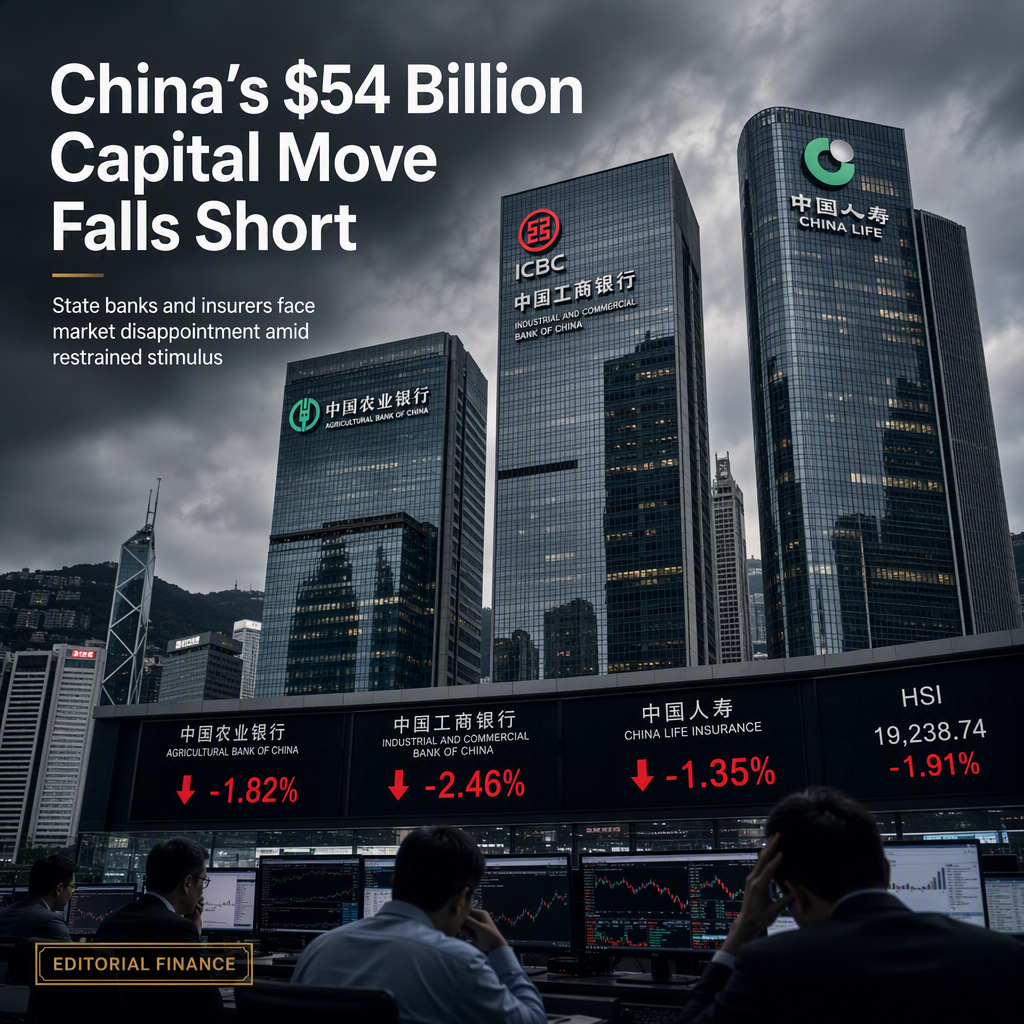
China's Ministry of Finance, in collaboration with the country's tobacco giant, announced a capital injection of 360 billion yuan ($53.6 billion) into three state-owned banks and five insurers, marking the first time that insurers have been included in such a recapitalization effort as solvency pressures spread within the financial system [1]. The move comes as Beijing seeks to foster economic growth with restrained stimulus, but the scale of the injection was smaller than market expectations, according to Citibank [1].
The recapitalization aims to provide a greater capital cushion for financial institutions, potentially enabling them to mobilize more resources in capital markets, including bond and equity purchases, as noted by Gary Ng, senior economist at Natixis [1]. Despite this, the market reacted negatively: Hong Kong-listed shares of the affected banks and insurers underperformed the broader market on Monday. The Hang Seng Index fell less than 1%, while Agricultural Bank of China and Industrial and Commercial Bank of China dropped 2.7% and 2.3%, respectively. China Taiping Insurance lost almost 4%, and People's Insurance Company of China and China Life Insurance each fell more than 2% [1].
This latest move builds on a 500 billion yuan capital injection into four major state banks last year and a March pledge to issue 300 billion yuan in special treasury bonds this year to replenish capital at large state lenders [1]. China's banking sector continues to face multiyear margin compression, with net interest margins falling to record lows this year as Beijing pushes lenders to keep credit cheap for struggling borrowers [1].
Looking forward, Beijing is preparing lenders to finance its next strategic investment cycle, particularly the massive capital requirements of AI and advanced technology, according to Han Shen Lin, China country director at The Asia Group [1]. The recapitalization package, while smaller than anticipated, is seen as a move to strengthen the banking system's shock absorbers using state capital [1].
CONCLUSION
China's $54 billion capital injection into state banks and insurers was smaller than markets expected, leading to declines in related Hong Kong-listed shares. While the move aims to bolster financial stability and prepare for future strategic investments, the restrained scale signals a cautious approach by Beijing and suggests limited immediate relief for market concerns.