
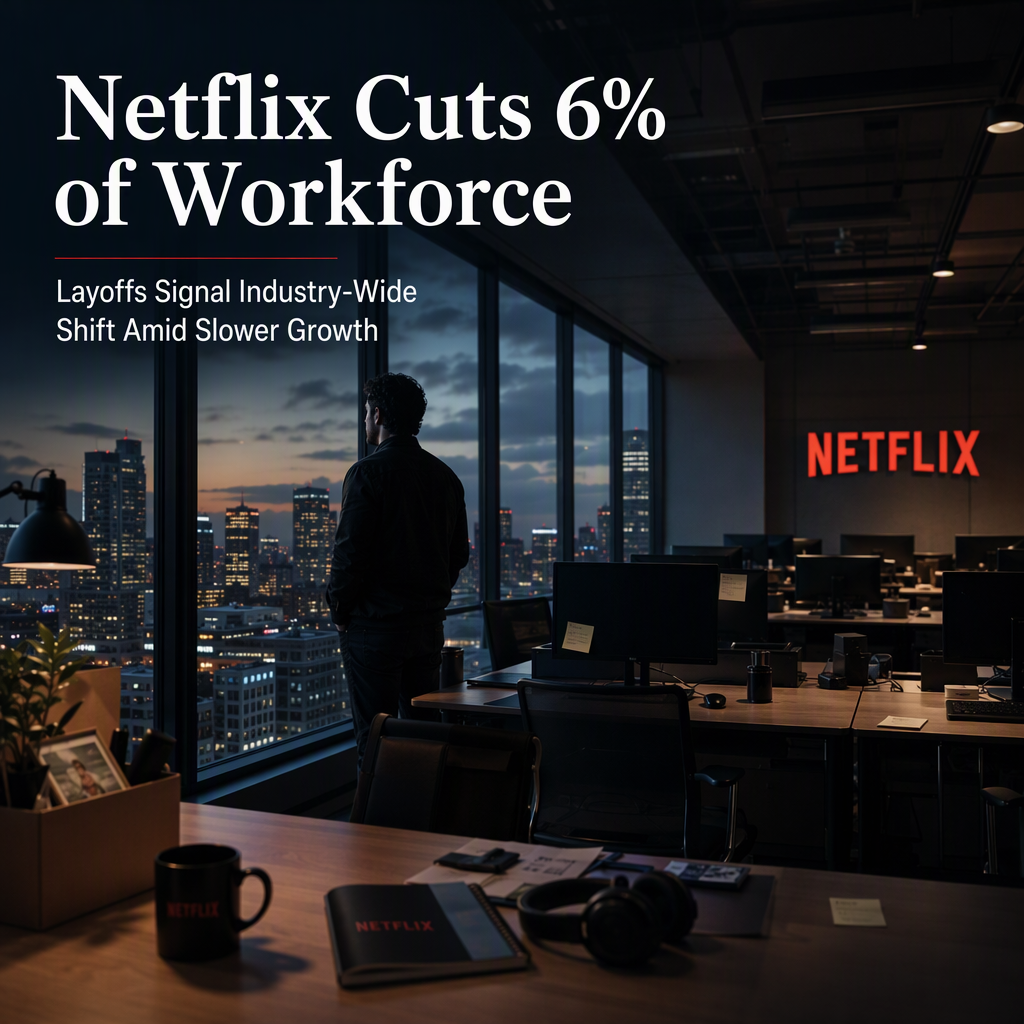
Netflix has announced it will eliminate approximately 6% of its global workforce, amounting to roughly 1,000 jobs, according to an internal company email and a source with knowledge of the matter [1]. The layoffs, which were communicated to staff on Wednesday, will primarily affect the product, technology, legal, and human resources teams [1]. Co-chief executives Greg Peters and Ted Sarandos stated that the company must be disciplined in prioritizing people and resources to fulfill its mission to entertain the world [1].
The decision comes as Netflix continues to face challenges in accelerating user engagement growth. In the first half of 2026, users watched more than 97 billion hours of content, representing a 2% year-over-year increase, as reported in the company's most recent quarterly earnings [1]. However, Sarandos acknowledged at Bloomberg’s annual media conference that overall growth is not meeting expectations and efforts are underway to improve the pace [1]. Netflix is scheduled to report its third-quarter financial results on Tuesday [1].
The company has recently sought to boost subscriber engagement by adding live sports programming and video podcasts, including content licensed from third-party companies such as Bill Simmons’ The Ringer [1]. The layoffs at Netflix are part of a broader trend in the entertainment industry, with other major studios like The Walt Disney Co. and Skydance also reducing their workforces to streamline operations and cut costs [1].
Despite the job cuts, Peters and Sarandos emphasized that Netflix will continue to invest aggressively in high-impact areas while making focused choices across the business to deliver value for members, partners, employees, and investors [1].
CONCLUSION
Netflix's decision to cut 6% of its workforce reflects ongoing efforts to manage costs amid slower user engagement growth. While the company continues to invest in new content and engagement strategies, the layoffs signal a cautious approach as Netflix prepares to report its upcoming financial results. The move aligns with broader industry trends of cost-cutting among major Hollywood studios.