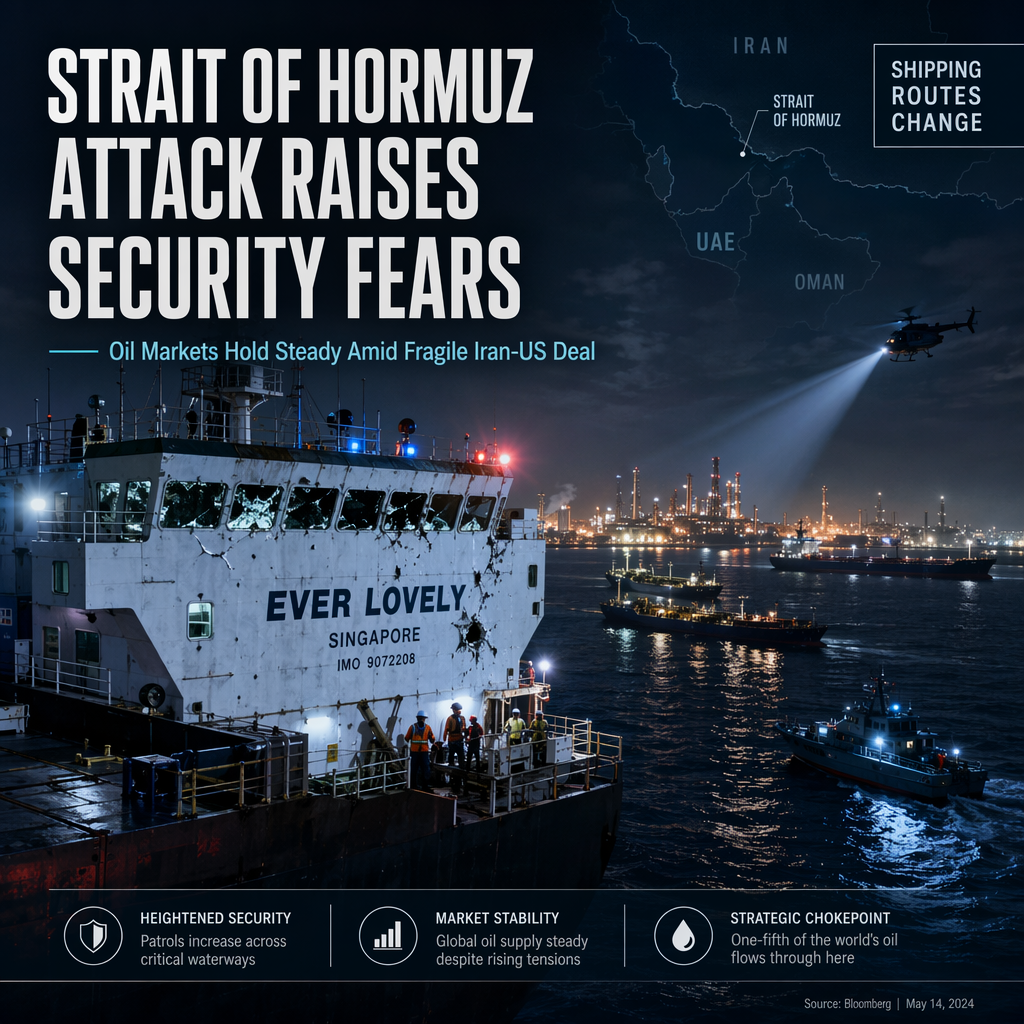
A cargo ship, the Singapore-flagged Ever Lovely owned by Taiwan-based Evergreen Marine, was struck by an unknown object near the coast of Oman while transiting the Strait of Hormuz on Thursday, according to statements from the company and MarineTraffic data reviewed by NBC News [2]. The vessel sustained damage to its bridge windows, but no injuries were reported, and the cargo, crew, and vessel remained safe. The ship's main engine and navigation equipment continued to operate, and it departed the strait without further incident [2][1]. Rabobank’s Senior Macro Strategist Bas van Geffen noted that this attack has renewed security concerns for oil shipments in the region, especially as shipping activity from the Gulf was beginning to pick up again [1]. Despite the incident, Brent crude traded at $73.8 per barrel, which is at the lower end of its weekly range, indicating market resilience and a belief that the Iran–US memorandum of understanding (MoU) will hold [1]. The MoU currently supports Iranian oil exports and restrains US economic risks, though it remains fragile. Both Iran and the US have motives to maintain the deal, even as US officials blamed Iran for the incident but downplayed its significance [1]. According to NBC News, at least 37 vessels transited the strait or were in the process of doing so since the attack, with 20 ships taking an alternative route far south of Iran, hugging the UAE and Oman coastlines to avoid Iranian waters [2]. Iran has warned that it cannot guarantee safety for ships not following its specified route and threatened that any consequences would be the responsibility of the vessels and their owners [2]. The International Maritime Organization (IMO) had coordinated the alternative route and announced a plan to evacuate 11,000 sailors, but suspended the operation after the attack on Ever Lovely. IMO Secretary-General Arsenio Dominguez clarified that the struck vessel was not part of the evacuation framework [2]. Evergreen Marine warned that the cancellation of the IMO evacuation plan has added "new uncertainty" to the ceasefire agreement [2]. Singapore’s Maritime and Port Authority condemned the incident as unprovoked and a breach of international law, while Iran has not publicly acknowledged the strike [2].
CONCLUSION
Despite renewed security concerns following the ship attack near Oman, oil markets have remained steady, with Brent crude prices at the lower end of their weekly range. The fragile Iran–US deal continues to support Iranian oil exports, but the cancellation of the IMO evacuation plan and Iran's warnings about safe passage have introduced new uncertainties. Market participants appear to believe the deal will hold, but ongoing tensions in the Strait of Hormuz could impact future shipping and oil flows.