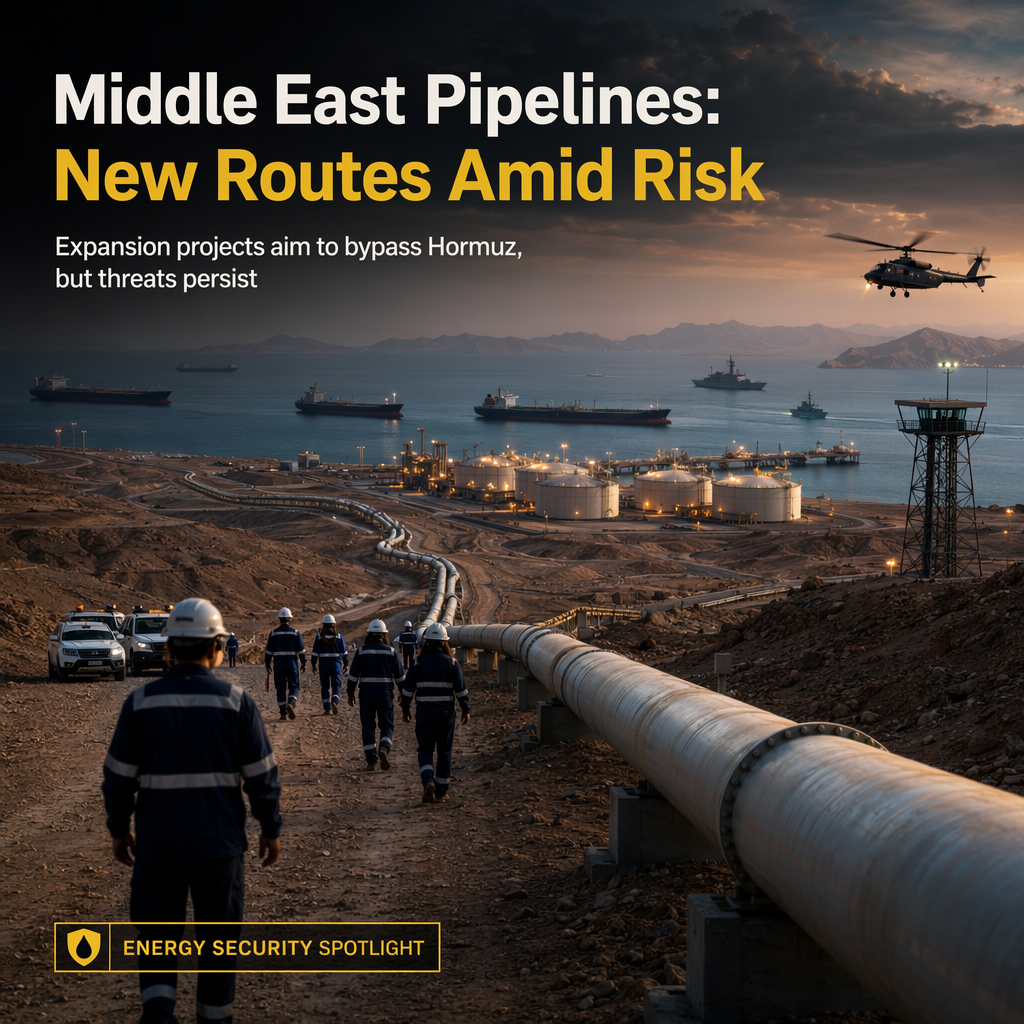
Middle East oil producers are accelerating the construction and planning of seven major pipeline projects designed to bypass the Strait of Hormuz, a critical chokepoint for global crude exports that has been increasingly targeted by Iranian attacks. According to Goldman Sachs, pipeline capacity in the region could expand to more than 14 million barrels per day (bpd) by the end of 2028, covering over 60% of the Gulf states' pre-war oil export volume of 23 million bpd [1]. This strategic shift comes as Iran continues to disrupt Gulf states' seaborne crude exports with near-daily attacks on tankers, prompting regional producers to seek alternative routes [1].
The United Arab Emirates (UAE) is set to double its export capacity outside Hormuz with the completion of a second pipeline to the Port of Fujairah on the Gulf of Oman, while Saudi Arabia is considering expanding its pipeline to the Red Sea by 2 million bpd, according to sources close to the matter [1]. The U.S. is also supporting Iraq's efforts to rebuild a crude oil pipeline from Kirkuk through Syria to the Mediterranean Sea, with American companies expected to participate in its construction [1]. Iraq, OPEC's second largest producer, has been particularly affected by the disruptions, with its production dropping by more than 50% in June to 1.9 million bpd from 4.2 million bpd in February, prior to the U.S. and Israel's military actions against Iran [1].
Despite these efforts, analysts warn that pipelines are not immune to the same low-cost, asymmetric attacks by Iran that have plagued tankers in the Strait of Hormuz. Jennifer Li, a geopolitical analyst at Rystad, emphasized that pipelines serve more as a geopolitical hedge than a full replacement for the strait, noting that Iran struck a pumping station on Saudi Arabia's pipeline to the Red Sea in April [1]. The UAE's existing West-East pipeline and Saudi Arabia's East-West pipeline have provided crucial relief during the ongoing conflict, allowing Abu Dhabi and Riyadh to divert millions of barrels per day around Hormuz [1].
Overall, while the expansion of pipeline infrastructure offers some mitigation against the risks posed by Iran, the vulnerability of these routes means that the threat to Middle East energy exports remains significant. The Gulf states are urged to diversify their export routes as much as possible, but the geopolitical risks persist [1].
CONCLUSION
The Middle East's push to expand pipeline capacity is a direct response to escalating threats in the Strait of Hormuz, but analysts caution that these new routes remain vulnerable to Iranian attacks. While the projects may provide some relief and diversification, the region's energy exports continue to face significant geopolitical risks. Market participants should remain alert to ongoing disruptions and the potential for further volatility.