
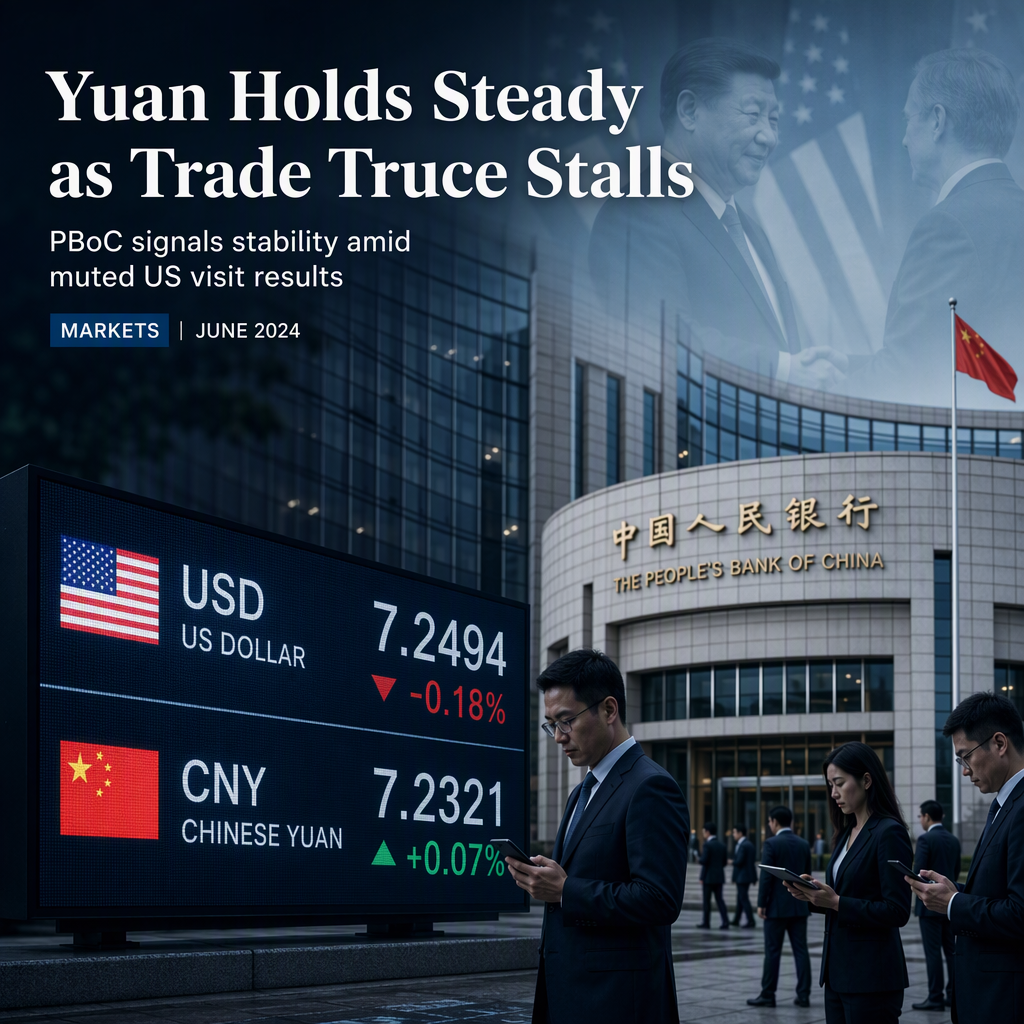
The People's Bank of China (PBoC) has kept the Chinese yuan broadly stable, following President Xi's recent visit to the United States, which resulted in only a limited extension of the trade truce until January and no major new agreements, such as additional tariff cuts or an AI dialogue mechanism [1]. According to Societe Generale, the anticipated outcomes from the visit did not materialize, and the impact on the yuan was limited [1].
The USD/CNY currency pair rebounded after briefly dipping below 6.70, a move attributed to higher US Treasury yields and a modest easing of PBoC's control over the currency [1]. The central bank reiterated its commitment to a moderately loose monetary stance and pledged to keep the yuan broadly stable, signaling a willingness to adjust policy tools as needed [1].
Chinese banks maintained both the 1-year and 5-year loan prime rates at 3.0% and 3.50%, respectively, indicating no change in benchmark lending rates [1]. To support liquidity, the PBoC raised the daily reverse repo cap to CNY1 trillion and injected a net CNY200 billion through Medium-term Lending Facility (MLF) operations [1].
While the market reaction was muted, the PBoC's actions demonstrate ongoing policy support and controlled flexibility in response to external developments and domestic needs [1].
CONCLUSION
The PBoC's commitment to yuan stability and liquidity support measures have helped maintain market confidence despite the lack of major breakthroughs from President Xi's US visit. With loan prime rates unchanged and the trade truce extended only until January, investors are likely to remain cautious, awaiting further policy signals or developments.