
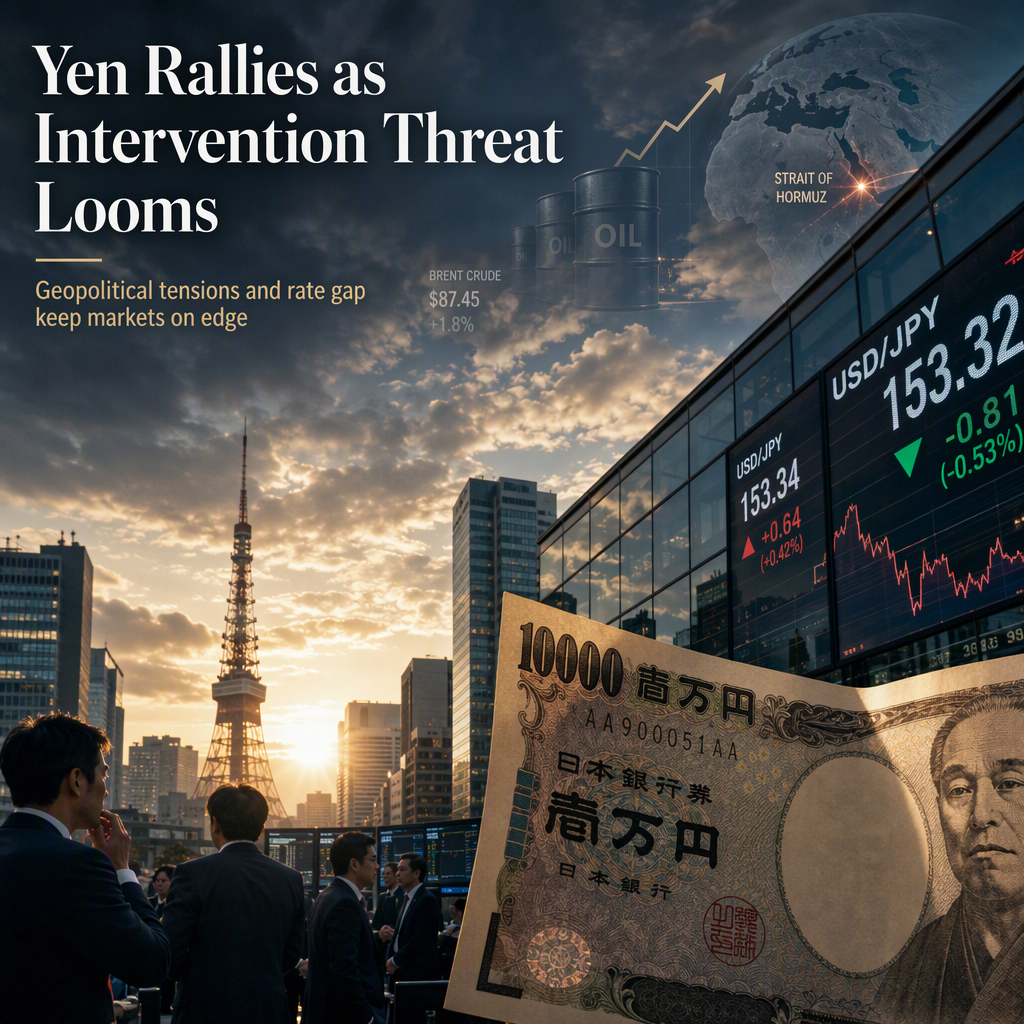
The Japanese Yen (JPY) recovered from a three-week low against the US Dollar (USD) during the Asian session on Friday, with the USD/JPY pair drifting lower after reaching near the 159.00 mark the previous day. Despite this pullback, the pair remains on track for strong gains for the second consecutive week and is currently trading just above the mid-158.00s, down approximately 0.20% for the day [1].
The risk of intervention by Japanese authorities has resurfaced as the Yen's two-week slide brings it close to the critical 160.00 threshold against the USD. The US Dollar's pause follows a strong move to a nearly two-month high, prompting some profit-taking among bullish traders and exerting downward pressure on the USD/JPY pair [1].
Geopolitical tensions remain elevated, with reports of US and Iran exploring a phased deal to reopen the Strait of Hormuz, while a Houthi missile attack on Saudi Arabia continues to fuel oil-driven inflation fears. These factors, combined with a hawkish Federal Reserve stance, have pushed US bond yields to multi-year highs, supporting the USD and the USD/JPY pair [1].
The interest rate gap between the US and Japan is wide, at roughly 250 to 275 basis points, sustaining the JPY carry trade and limiting downside risk for the USD/JPY pair. Technical analysis indicates a bullish near-term bias, with immediate support at the 50.0% Fibonacci retracement (158.45) and resistance at the 61.8% retracement (159.76), followed by the 78.6% retracement (161.62) and the cycle high zone at 163.99 [1].
The Japanese Yen was the strongest against the New Zealand Dollar today, and traders are now looking to US macro data and Federal Reserve speeches for further direction heading into the weekend [1].
CONCLUSION
The Japanese Yen's recovery from recent lows is driven by intervention risk and heightened geopolitical tensions, while the wide US-Japan rate gap continues to support USD/JPY. Market participants are closely watching upcoming US economic data and Fed commentary for further cues. The overall sentiment remains cautious, with medium market impact expected.