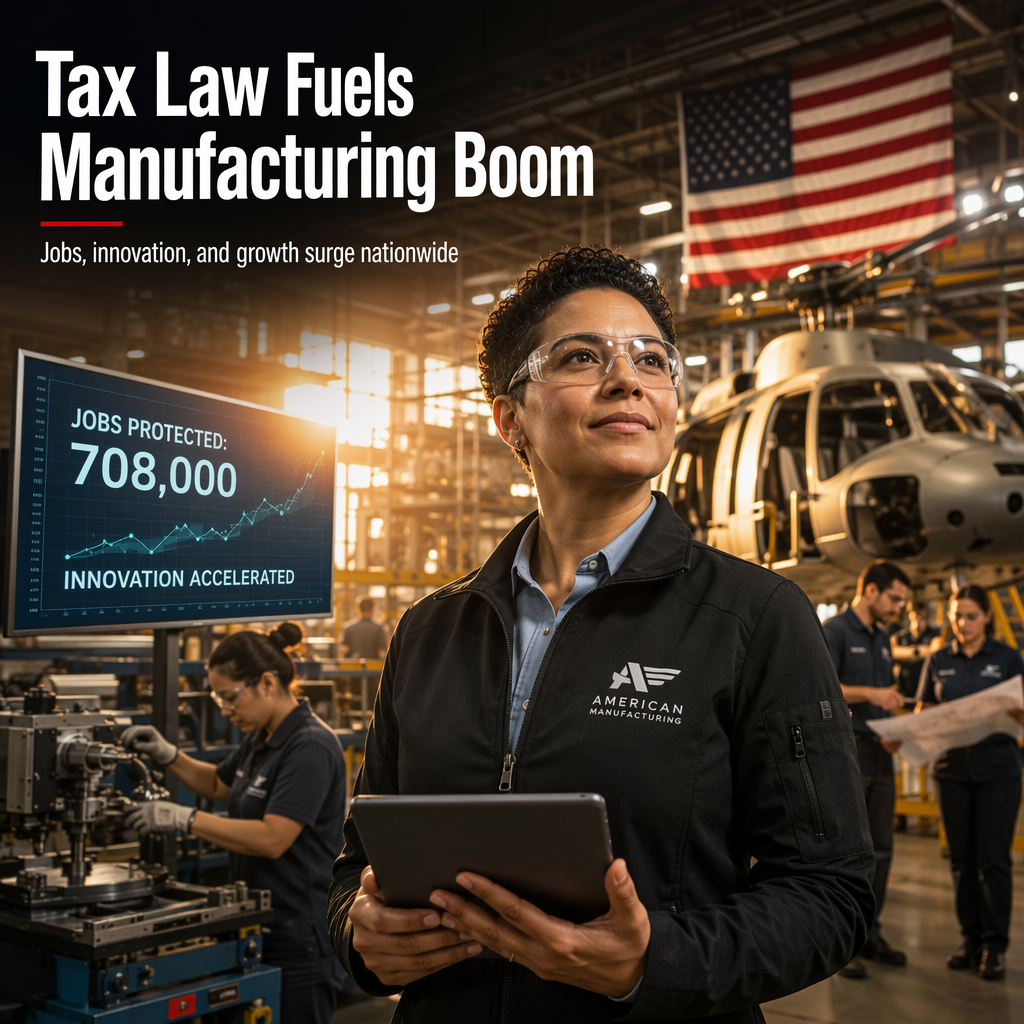
The National Association of Manufacturers (NAM) released a report marking one year since the enactment of the One Big Beautiful Bill Act (OBBBA), a tax law passed by Republicans in Congress and signed by President Donald Trump last July. The legislation included provisions such as 100% expensing of newly built factories and immediate depreciation of machinery, aimed at boosting the manufacturing industry and preventing tax hikes [1]. NAM's analysis estimated the number of jobs protected, economic growth, and wages preserved by the OBBBA, highlighting its impact across all 50 states [1].
NAM's report found that California benefited the most, with 708,000 jobs, $134 billion in GDP, and $67 billion in wages saved due to the OBBBA. Robinson Helicopter, a commercial helicopter manufacturer in California, utilized immediate research and development (R&D) expensing to accelerate innovation and deploy new R88 helicopters as control centers for fire surveillance drones. Will Fulton, vice president of business development at Robinson Helicopter, stated that the immediate R&D deduction "accelerates our ability to innovate and increases the ability with which we can bring these property and lifesaving innovations to market" [1].
Texas ranked second, with 547,000 jobs, $107 billion in GDP, and $51 billion in wages saved. WilliamsRDM, a Texas-based manufacturer, credited the tax law's R&D expensing for enabling continued investment in engineering, prototyping, testing, and design improvements for new technology in aerospace, defense, fire suppression, energy, and security sectors [1]. Florida was estimated to have 399,000 jobs and $36 billion in wages saved by the OBBBA [1].
NAM CEO Jay Timmons described the tax reform law as "one of the most consequential pieces of legislation in a generation," emphasizing that it delivered a permanent, pro-growth tax code that allowed manufacturers to invest in their people, purchase new equipment, and plan confidently for the future. The report chronicled how manufacturers in each state used the tax law to drive innovation and expansion, underscoring the real-world impact of pro-growth policies [1].
CONCLUSION
The NAM report underscores the significant positive impact of the GOP tax law on the manufacturing sector, with substantial job protection, wage preservation, and economic growth across all 50 states. Manufacturers attribute increased investment, innovation, and expansion to the provisions of the OBBBA. The market takeaway is that the tax law has fostered confidence and growth within the industry, supporting long-term economic stability.