
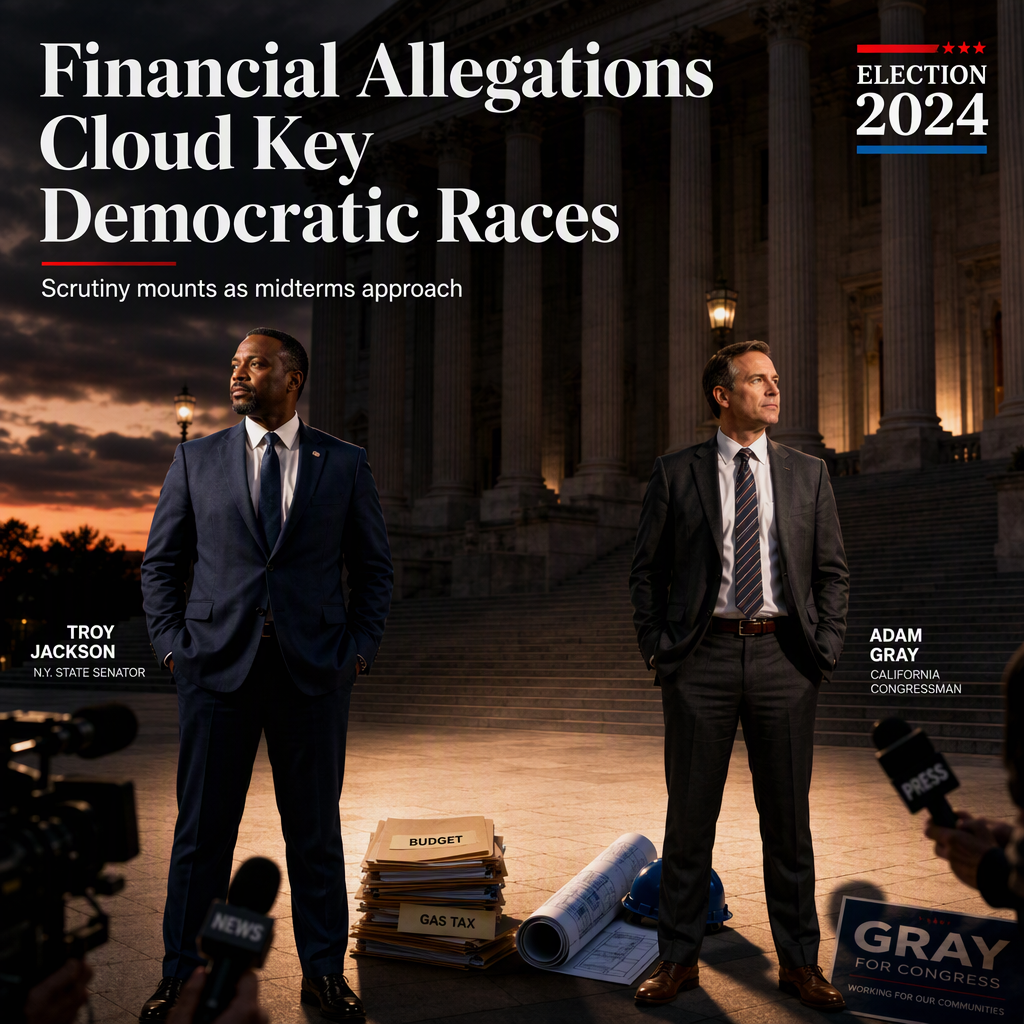
The 'Ruthless Podcast' has brought attention to recent financial allegations involving prominent Democratic candidates in two key races, which the hosts claim have been largely ignored by mainstream media [1]. One case involves Troy Jackson, the Democratic nominee for U.S. Senate in Maine, who co-sponsored a 2024 bill allocating $13.4 million in additional funding to Maine Maritime Academy while his son, Chace Jackson, served as the school's legislative designee [1]. Jackson also supported a 2023 state budget that provided the academy with an extra $2 million per year [1]. Jackson is set to face Republican Sen. Susan Collins in a high-profile Senate race, having replaced Graham Platner as the nominee in July after Platner withdrew due to a sexual assault allegation, which he denied [1].
In California, Rep. Adam Gray, a Democratic state assemblymember running for re-election in a battleground district, is under scrutiny for his role in advancing gas tax legislation that reportedly benefited his cousin's newly established construction company [1]. According to the podcast, this legislation resulted in California having the highest gas tax in the nation, impacting all residents [1]. Gray is also a part-owner of Marvulli Inc., which, according to his financial disclosures, owned land on both sides of a road where the company secured contracts to build its first hotel and gas station projects [1].
The podcast hosts argue that these cases exemplify a broader pattern of Democrats allegedly steering government funds to preferred parties or constituencies, sometimes with direct personal benefit [1]. They compared these actions to past congressional earmark scandals, suggesting that the current situations are even more egregious [1].
No specific market reactions or analyst opinions were discussed in the source article. However, the allegations could have implications for the upcoming elections, particularly in competitive races where financial ethics are a concern for voters [1].
CONCLUSION
The 'Ruthless Podcast' has spotlighted financial allegations against Democratic candidates Troy Jackson and Adam Gray, raising questions about the use of government funds for personal or familial benefit. While the article does not detail immediate market reactions, the controversies could influence voter sentiment in closely watched races.