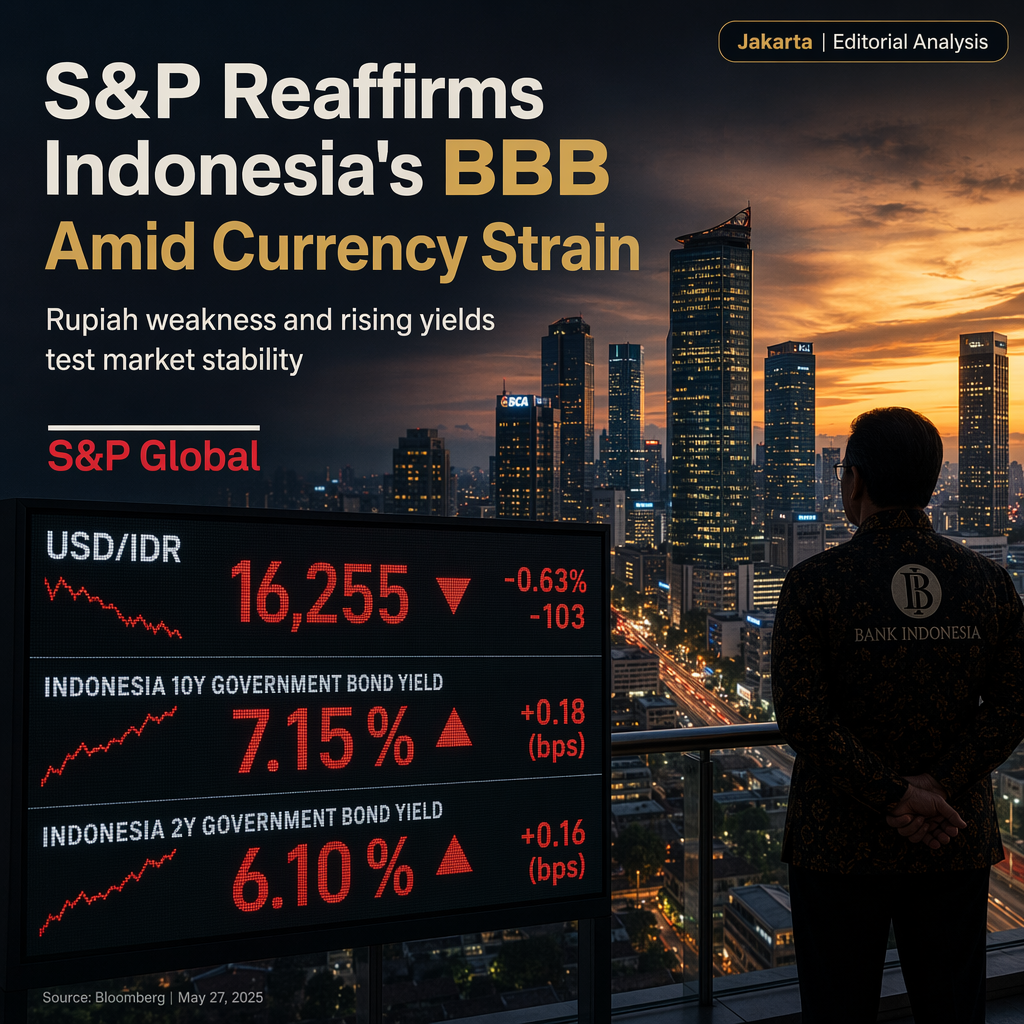
S&P Global Ratings has affirmed Indonesia's BBB sovereign rating with a stable outlook, citing the country's fiscal discipline and adherence to the statutory budget deficit ceiling of 3% of GDP, which has been maintained across multiple administrations [1]. This affirmation comes despite earlier downgrades in outlook by Fitch Ratings and Moody's Ratings earlier this year [1]. S&P views the recent deterioration in Indonesia's fiscal and external positions as temporary, expecting higher commodity prices and rationalisation of the free school meal programme to provide support [1].
However, S&P flagged higher bond yields and a weaker Indonesian Rupiah (IDR) as significant headwinds, contributing to a higher interest-to-revenue ratio [1]. The USD/IDR exchange rate rose 0.3% to 18,105 yesterday, nearing its all-time high of 18,178 recorded in early June, driven by a stronger US dollar and higher global crude prices [1]. Bank Indonesia (BI) has pledged to "go all out to keep the rupiah stable with a tendency to strengthen," indicating increased urgency to support the currency [1].
S&P also noted that Bank Indonesia retains operational independence comparable with regional peers, which is seen as a positive factor for Indonesia's financial stability [1]. Overall, the rating affirmation is considered more a removal of a potential headwind than a positive catalyst for Indonesian assets, as the market continues to face challenges from currency weakness and rising bond yields [1].
CONCLUSION
S&P's affirmation of Indonesia's BBB rating provides some stability, but persistent Rupiah weakness and rising bond yields remain key concerns for investors. Bank Indonesia's commitment to supporting the currency signals ongoing intervention, yet market sentiment remains cautious. The rating action removes a potential negative, but does not serve as a strong positive catalyst for Indonesian assets.