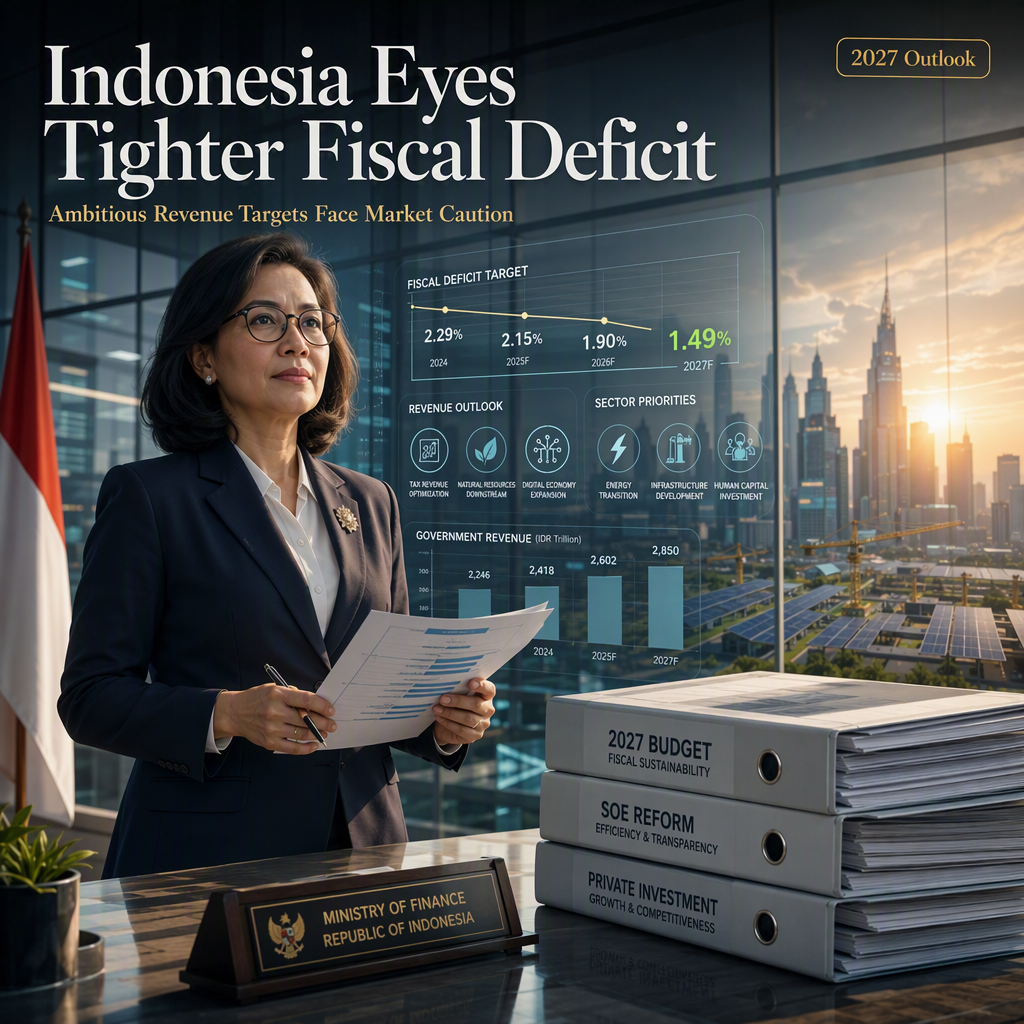
Indonesia's government has set a fiscal deficit target of 2.4% of GDP for 2027, down from the 2.9% target in 2026, according to an assessment by Standard Chartered's Aldian Taloputra. The fiscal policy for 2027 is focused on strengthening key sectors such as food, energy, education, and defense, as well as restructuring state-owned enterprise (SOE) assets and attracting private-sector investment in priority downstream and renewable sectors [1].
Despite the government's target, Standard Chartered maintains its own forecast for the 2027 fiscal deficit at 2.9% of GDP. The bank cites ambitious revenue assumptions, including a projected 12% tax revenue growth in 2027 following a 21% target in 2026, which it considers optimistic. Risks to achieving these targets include potential tax revenue shortfalls due to lower commodity prices—Standard Chartered forecasts average Brent crude at USD 75 per barrel in 2027, compared to USD 89 per barrel year-to-date in 2026—as well as a higher tax revenue base effect from slower tax restitution and uneven growth drivers that may continue to rely on government support [1].
Despite the narrowing fiscal buffer, Standard Chartered believes it remains adequate to keep the fiscal deficit below the 3% of GDP threshold. However, the bank also notes that financing needs will be larger in 2027, despite the narrower deficit target, due to higher debt maturities [1].
CONCLUSION
Indonesia's 2027 fiscal plans reflect an expansionary stance with a focus on key sectors and a targeted reduction in the fiscal deficit. While the government's deficit target is below 3% of GDP, Standard Chartered expresses caution over ambitious revenue projections and anticipates higher financing needs due to debt maturities. The overall market takeaway is cautiously optimistic, with the fiscal buffer seen as sufficient to maintain stability.