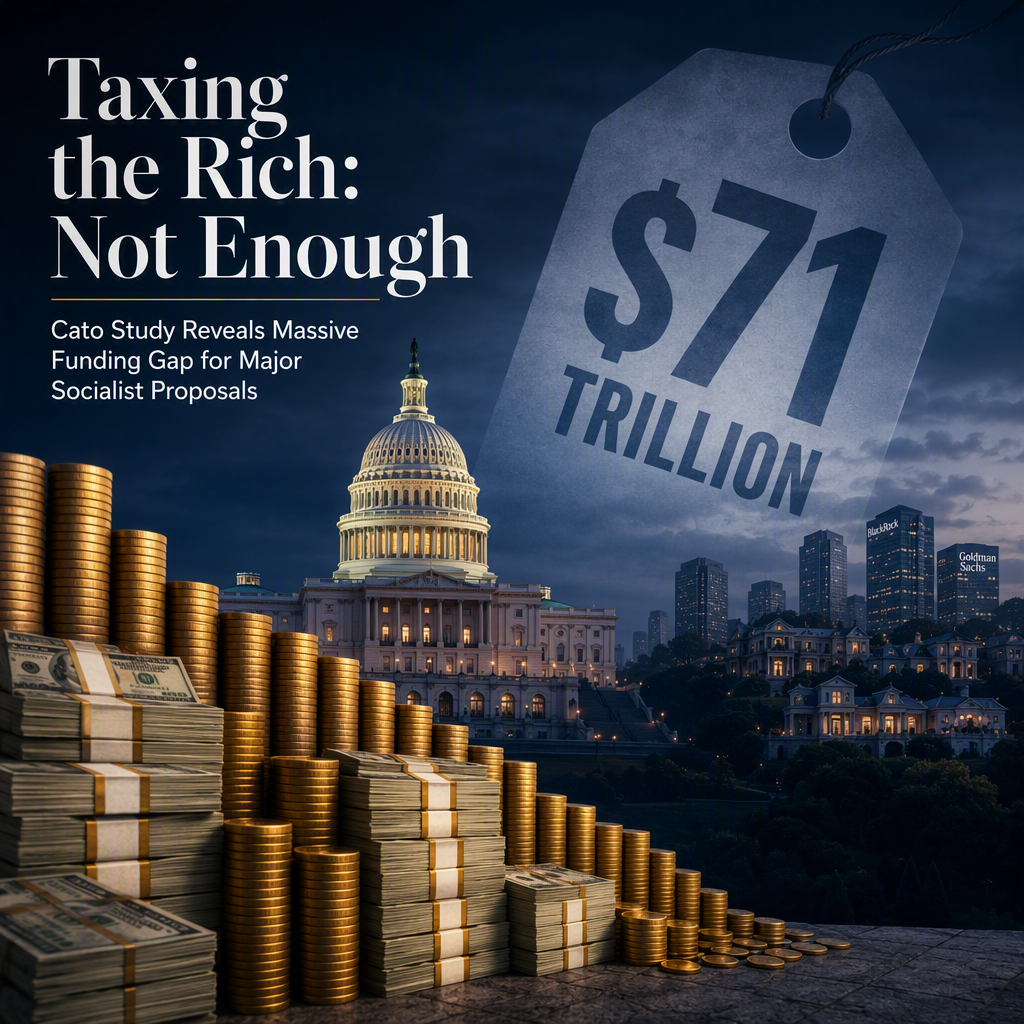
A recent analysis by the Cato Institute examined the financial feasibility of funding nine major proposals associated with the Democratic Socialists of America's 2026 platform, estimating the total cost to be between $71 trillion and $212 trillion over the next decade [1]. Even at the low end of this range, the study found that confiscating the entire wealth of America's 400 richest individuals—estimated at $6.6 trillion in 2025—would only cover about 9% of the $71 trillion needed [1].
The analysis further considered seizing all after-federal-tax profits from domestic corporations, projected at $35 trillion over ten years. Even with this extreme measure, only about half of the $71 trillion low-end estimate would be covered, and this does not account for the economic consequences such as the loss of jobs, dividends, and reinvestment [1].
Additionally, the federal government is already projected to run approximately $24 trillion in deficits over the coming decade, before factoring in any new spending proposals [1]. The Cato Institute also cited Joint Committee on Taxation economists, who found that even pushing top federal income-tax rates to their revenue-maximizing level would generate only about $400 billion in additional revenue over ten years, due to changes in taxpayer behavior in response to higher rates [1].
The article emphasizes that these calculations are not official Congressional Budget Office scores but rather estimates compiled from multiple studies to illustrate the scale of the proposed policies [1].
CONCLUSION
The Cato Institute's analysis suggests that even the most aggressive taxation of the wealthy and corporations would fall far short of funding the major proposals outlined by the Democratic Socialists of America. The findings highlight significant fiscal challenges and raise questions about the practicality of relying solely on taxing the rich to finance expansive government programs.