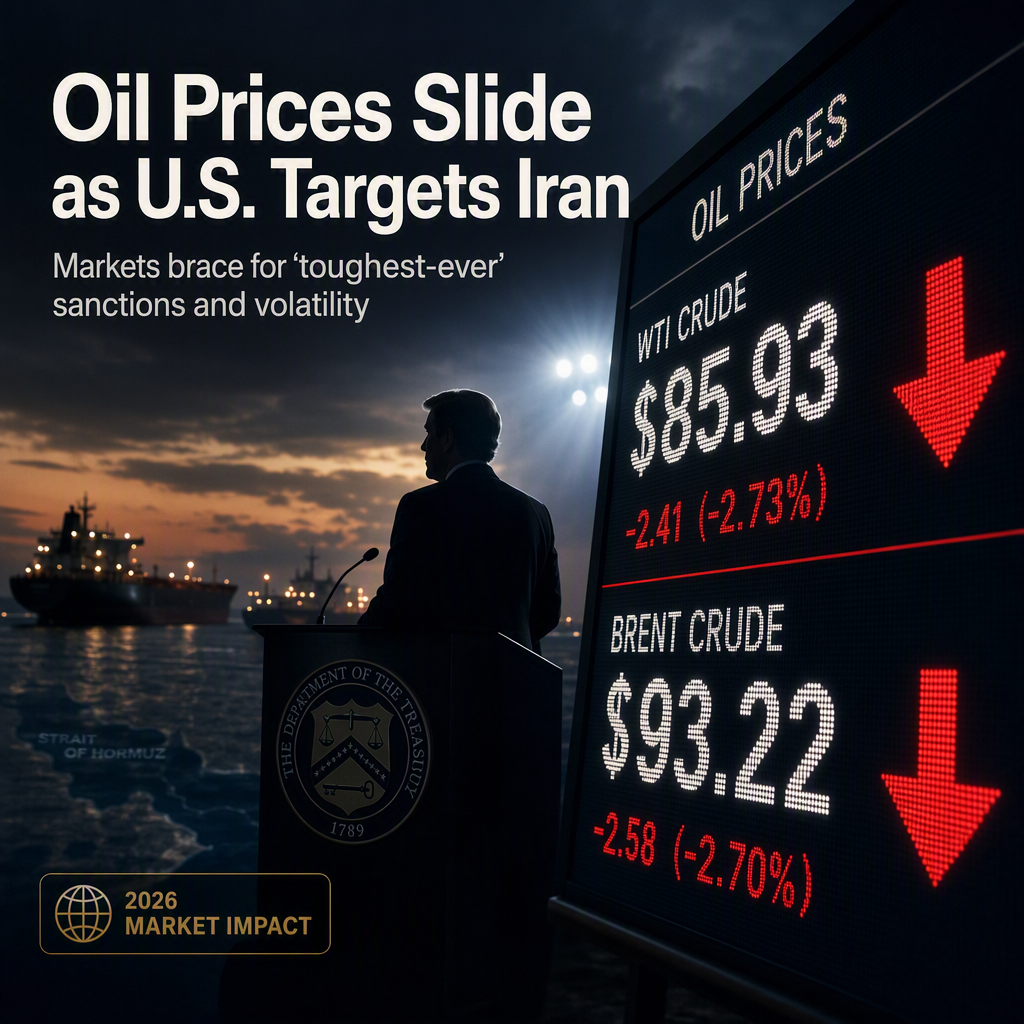
On August 24, 2026, oil prices declined as investors awaited the unveiling of what the U.S. government has described as its 'toughest-ever' sanctions campaign against Iran [1]. West Texas Intermediate futures, the U.S. benchmark, dropped approximately 1.3% to $85.93 per barrel, while Brent crude, the international benchmark, fell 1.24% to $93.22 a barrel [1]. U.S. Treasury Secretary Scott Bessent is scheduled to announce the new sanctions package later in the day, characterizing the effort as 'the single greatest financial offensive ever marshaled against an adversary' in a post on X [1]. President Donald Trump previously threatened to launch the 'most crushing economic operation ever taken against any country' and warned of severe financial penalties for nations assisting Iran in evading sanctions, describing the campaign as 'Economic Warfare and Isolation on an unprecedented scale' [1].
Iran has responded by downplaying the threat, with the Islamic Revolutionary Guard Corps stating that Tehran possesses methods to counteract the adverse effects of the sanctions and can 'easily establish economic relations with countries,' according to Iranian state media [1].
Analysts at Commonwealth Bank of Australia (CBA) expect oil prices to remain volatile throughout the second half of 2026, as markets assess the effectiveness of Washington's push to economically isolate Iran and the potential for Tehran to retaliate [1]. CBA noted that if U.S. measures succeed, the risk of increased violence from Iran could become a significant concern for energy markets [1]. The bank forecasts Brent crude to trade between $70 and $100 per barrel in the latter half of 2026, with prices potentially falling toward the lower end of that range if oil flows through the Strait of Hormuz recover to 50%–60% of pre-war levels, which could revive expectations of an oversupplied global market [1].
CONCLUSION
The announcement of impending U.S. sanctions against Iran has triggered a decline in oil prices, reflecting investor uncertainty and anticipation of market volatility. Analysts warn that the effectiveness of the sanctions and Iran's potential response could significantly impact energy markets in the coming months. The outlook for oil prices remains uncertain, with volatility expected as geopolitical tensions unfold.