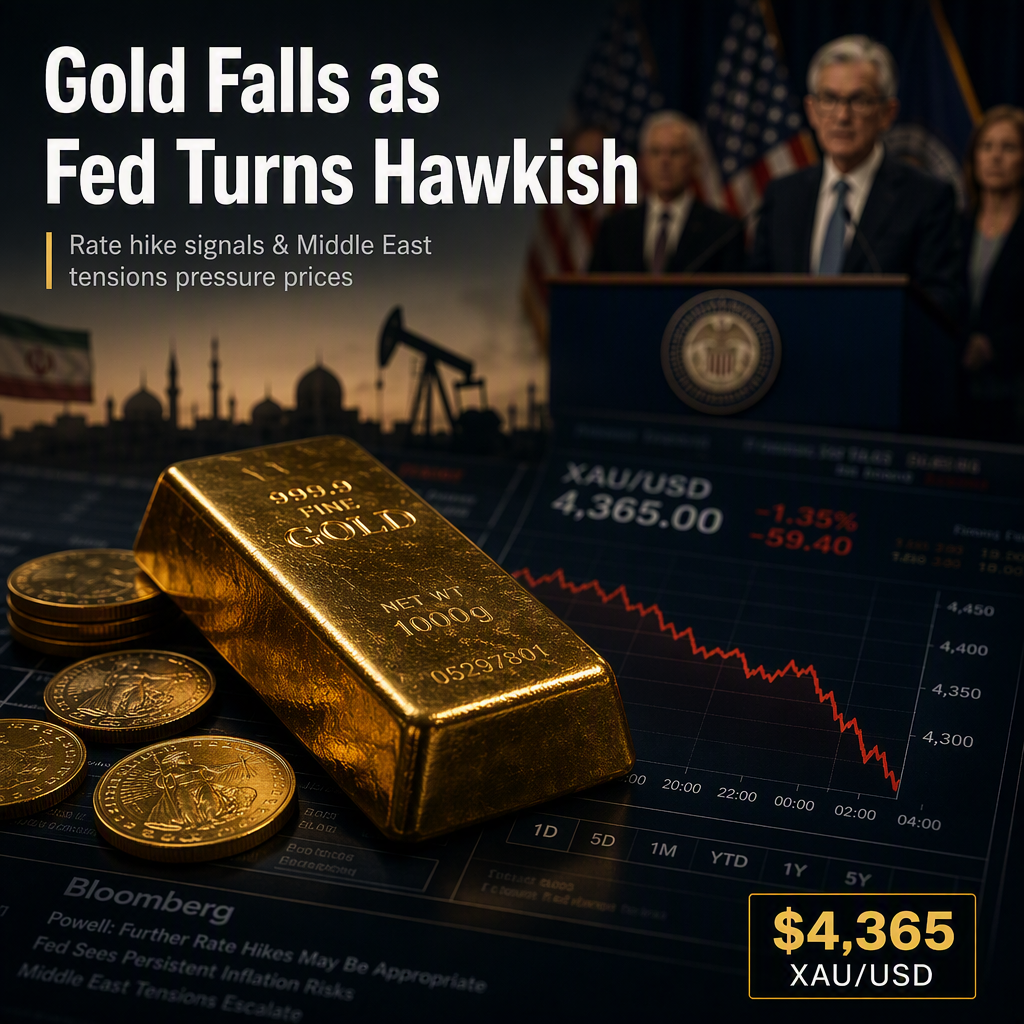
Gold prices (XAU/USD) edged lower to near $4,365 during the early Asian session on Monday, pressured by a combination of escalating Middle East tensions and hawkish remarks from Federal Reserve officials [1]. The decline comes as traders await further commentary from the Fed later in the week for additional direction [1].
Geopolitical risks remain elevated, with Reuters reporting that governments across the Middle East are preparing for potential escalation after Iran claimed it had received intelligence about a possible renewed US bombing campaign against the Islamic Republic. These tensions could stoke oil-driven inflation concerns, which in turn weigh on gold prices [1].
The Federal Reserve raised interest rates by 25 basis points to a range of 3.75%-4.0% last week and signaled the likelihood of further hikes in the coming months. According to the CME FedWatch tool, traders now assign a 56.5% probability to another rate hike at the Fed's next meeting in October [1]. Higher interest rates typically dampen gold's appeal, as the metal does not yield interest, making it less attractive compared to yield-bearing assets [1].
Hawkish comments from Fed officials reinforced the market's cautious stance. Kansas City Fed President Jeffrey Schmid supported the recent rate hike, citing data that show inflation trending above 3%. Minneapolis Fed President Neel Kashkari echoed concerns about persistently high inflation across multiple sectors, not just energy and oil prices [1]. Strategists at OCBC noted that elevated yields and a stronger US dollar may continue to cap gold in the near term, though they suggested that softer US data could eventually reverse these headwinds and restore support for the metal [1].
Fed’s Schmid delivered a notably hawkish message, emphasizing that inflation remains broad-based and that the latest rate hike is a step toward restoring the 2% target. His remarks, with a Speechtracker score of 8/10, indicate a firmer tightening bias and support expectations for a higher-for-longer rate path, which has bolstered the dollar and weighed on gold [1].
CONCLUSION
Gold prices are under pressure as the Federal Reserve signals a continued hawkish stance and Middle East tensions add to inflation concerns. With the market pricing in a significant chance of another rate hike in October, gold may remain capped in the near term unless US economic data softens. The outlook for gold hinges on future Fed policy moves and evolving geopolitical risks.