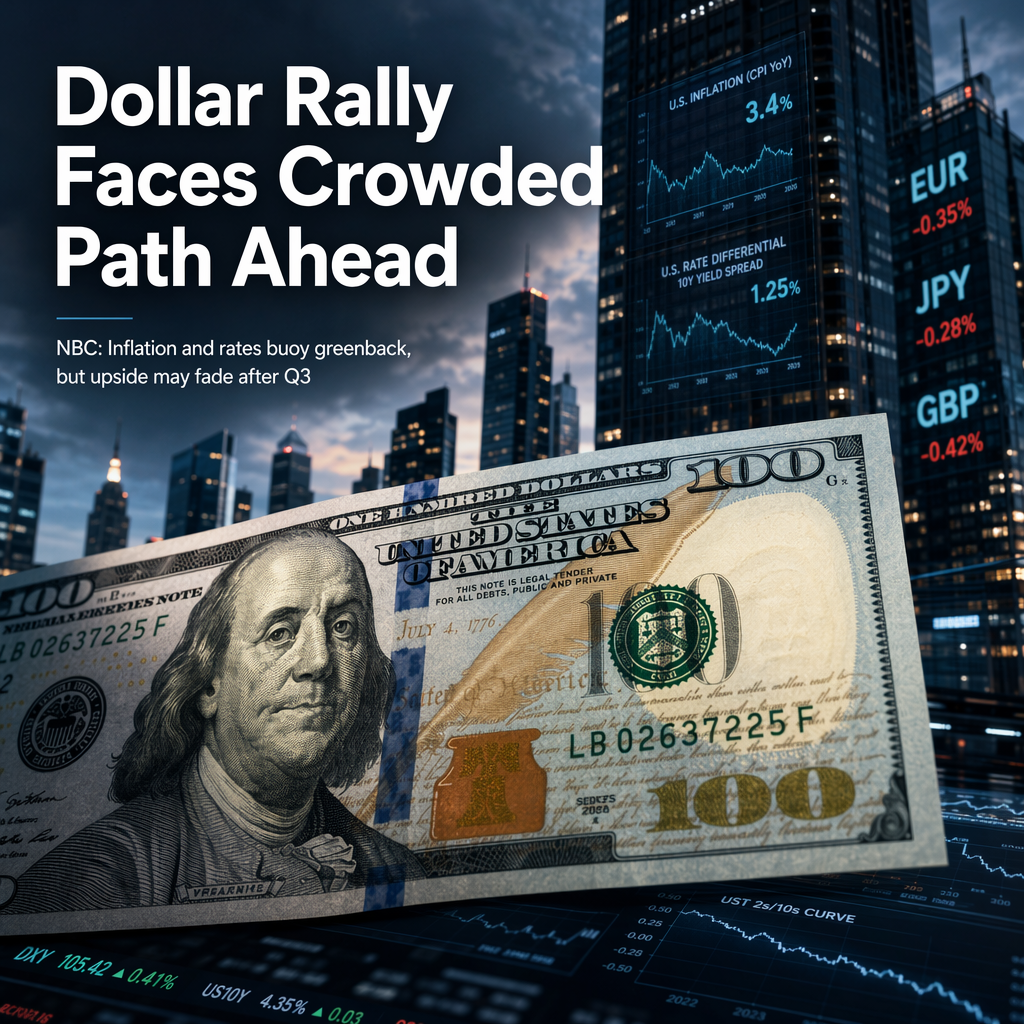
The US Dollar (USD) is currently trading near its 2026 high, supported by persistent US inflation and wider interest rate differentials, according to Stéfane Marion and Kyle Dahms of National Bank of Canada (NBC) [1]. The analysts note that the greenback has gained ground against every major currency in the past month, with the dollar's interest-rate advantage reinforcing its rally [1]. However, they caution that the rally appears increasingly crowded, especially beyond the third quarter of the year [1].
NBC highlights that June's US employment report showed nonfarm payrolls increasing by only 57,000, which was well below consensus expectations. Additionally, prior months' payroll figures were revised down by a cumulative 74,000, and the household survey reported a 507,000 decline in employment, including a sharp drop in full-time positions [1]. These labor market data points, combined with stretched speculative USD positioning, lead NBC to question the likelihood of imminent Federal Reserve tightening [1].
The analysts forecast that their broad USD index will gradually decline from 120.8 to 115.9 by the second quarter of 2027, suggesting a longer-term weakening trend for the dollar despite near-term support [1]. NBC also points out a significant gap between the Federal Reserve's projections and those of private-sector economists: while half of FOMC participants anticipate higher rates this year, only about 10% of forecasters expect an increase [1]. NBC shares the skepticism of the majority of private-sector economists, arguing that persistent inflation argues against rate cuts, but modest job growth gives policymakers time before considering further tightening [1].
Overall, NBC concludes that while the USD remains well supported in the near term due to inflation and rate differentials, the combination of modest job growth and stretched positioning makes the currency vulnerable to softer inflation data, further labor market cooling, or reduced expectations of Fed tightening [1].
CONCLUSION
NBC sees the US Dollar as well supported in the near term, driven by sticky inflation and rate differentials, but warns that the rally is increasingly crowded and may not persist beyond Q3. Softer labor market data and stretched investor positioning could make the USD vulnerable to downside risks. The bank forecasts a gradual decline in the USD index through 2027, reflecting skepticism about further Fed tightening.