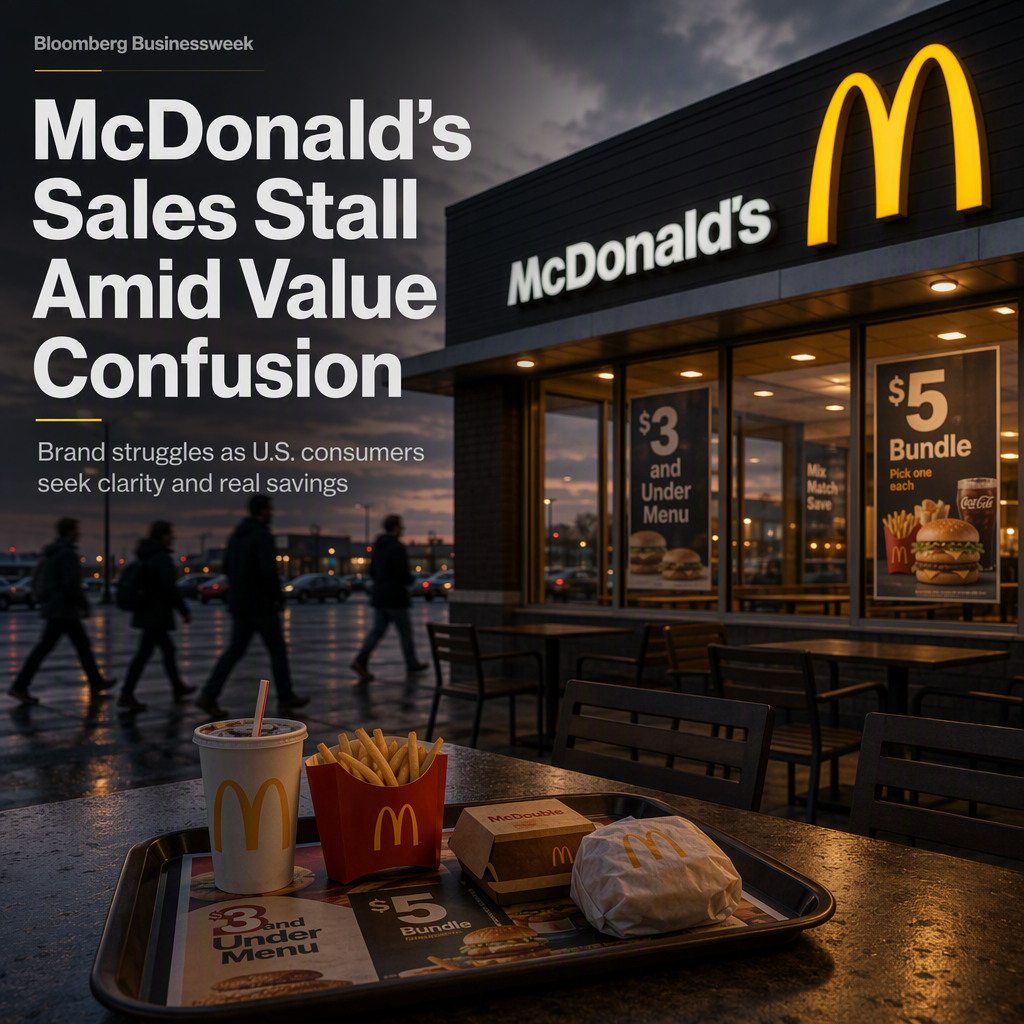
McDonald's reported its slowest U.S. sales growth in over a year, as efforts to attract budget-conscious customers with value meals failed to resonate amid ongoing affordability challenges. The company acknowledged a decline in overall U.S. customer count, attributing the underperformance to an overabundance of value offers, such as a $3-and-under menu and $5 bundled meal deals, which muddled the brand's message and failed to meet consumer expectations for both value and convenience [1]. CEO Chris Kempczinski stated, 'We simply didn’t execute at the level we needed to in the second quarter,' emphasizing the need to 'raise the bar in the U.S. and accelerate performance in our largest market' [1].
Despite reports of resilient U.S. consumer spending, McDonald's executives highlighted that the economic landscape remains uneven, with low-income households facing acute affordability issues. Fast-food spending has been pressured by rising food and labor costs, and wages have barely kept up with inflation, even as unemployment remains relatively low [1]. CFO Ian Borden described the situation as 'a challenging consumer environment,' noting that fast-food industry traffic in several major markets was 'flat to negative.' Federal data cited by the company shows U.S. household spending on fast-food establishments declined in seven of the last nine months [1].
In response to these challenges, McDonald's announced a leadership change in its U.S. division, with Skye Anderson taking over as president immediately in what the company described as a planned transition. Joe Erlinger, the outgoing president, will remain as an adviser through early next year [1].
Analysts were critical of McDonald's recent strategy, with Jonathan Maze, editor-in-chief of Restaurant Business, calling the earnings call 'a bit of a damning' and describing the company's approach as 'very jumbled' due to multiple value offers, loyalty program changes, and numerous promotions. Maze argued that these factors, combined with persistent inflation, angered customers and led to slowing traffic [1]. Industry analysts also noted that sit-down chains like The Cheesecake Factory, Chili’s, and Outback Steakhouse are outperforming, capturing market share from traditional fast-food outlets as consumers become more selective about where to spend their money [1].
CONCLUSION
McDonald's is grappling with declining U.S. sales growth and customer counts as its value-focused strategy fails to attract bargain-seeking consumers in a challenging economic environment. Analysts and company executives agree that strategic missteps and persistent inflation have hurt performance, while sit-down chains gain market share. The company is responding with leadership changes and a renewed focus on execution in its largest market.