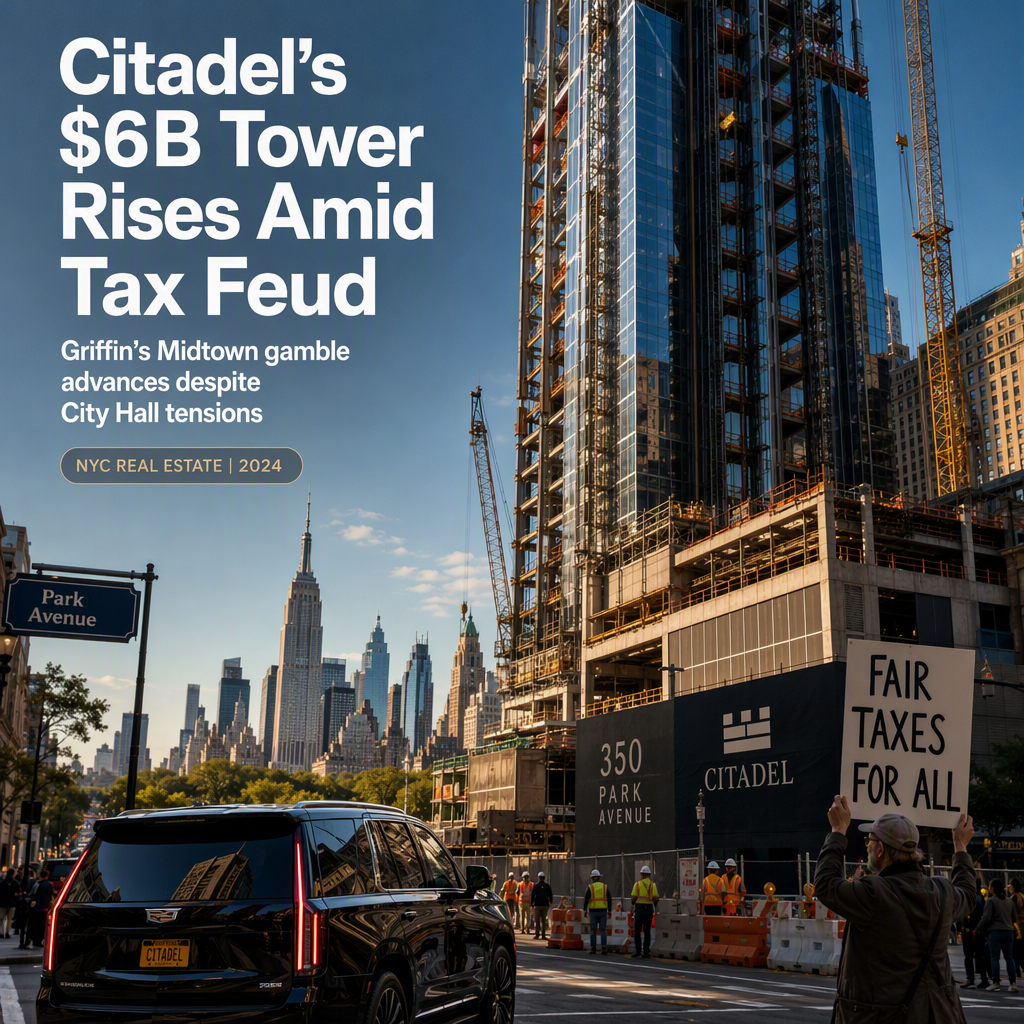
Ken Griffin's Citadel is moving forward with the development of a skyscraper at 350 Park Avenue in New York City, despite a public feud with New York City Mayor Zohran Mamdani over a new pied-a-terre tax targeting luxury property owners who do not reside full-time in the city [1]. The project is a partnership between Citadel, Vornado Realty Trust, and Rudin, with Citadel holding a 60% stake and Vornado's share expected to reach 36% [1]. According to Steven Roth, CEO of Vornado Realty Trust, the site is currently under demolition, and Vornado intends to exercise its investment option to maximize its ownership in the venture, with Citadel set to be the 1-million-square-foot anchor tenant [1].
The controversy began when Mayor Mamdani criticized Griffin in an April 15 video filmed in front of Griffin's $238 million Central Park South penthouse, highlighting the new annual tax on luxury properties valued over $5 million whose owners are not full-time residents [1]. Griffin responded by calling the mayor's actions 'creepy and weird,' expressing concerns for his safety and criticizing Mamdani's judgment [1]. Citadel executives, including COO Gerald Beeson, suggested that the new office development could be jeopardized by what they described as 'not-so-business-friendly policies' from the city administration [1].
Despite the tensions, Citadel confirmed in an April 23 memo that the 350 Park Avenue project is set to begin, projecting the creation of 6,000 highly paid construction jobs and more than 15,000 permanent jobs in Midtown New York [1]. The total investment for the project is expected to exceed $6 billion [1].
Following the exchange, Mayor Mamdani softened his stance and publicly thanked Griffin for his contributions to the city, including funding a memorial wall for police officers killed in the September 11 attacks and those who died from related illnesses, which is scheduled to open later this year at NYC Police Headquarters [1].
CONCLUSION
Citadel's major investment in a new Midtown Manhattan skyscraper is proceeding despite political tensions over New York City's new luxury property tax. The project is expected to generate significant economic activity and job creation, signaling continued confidence in the city's commercial real estate market.