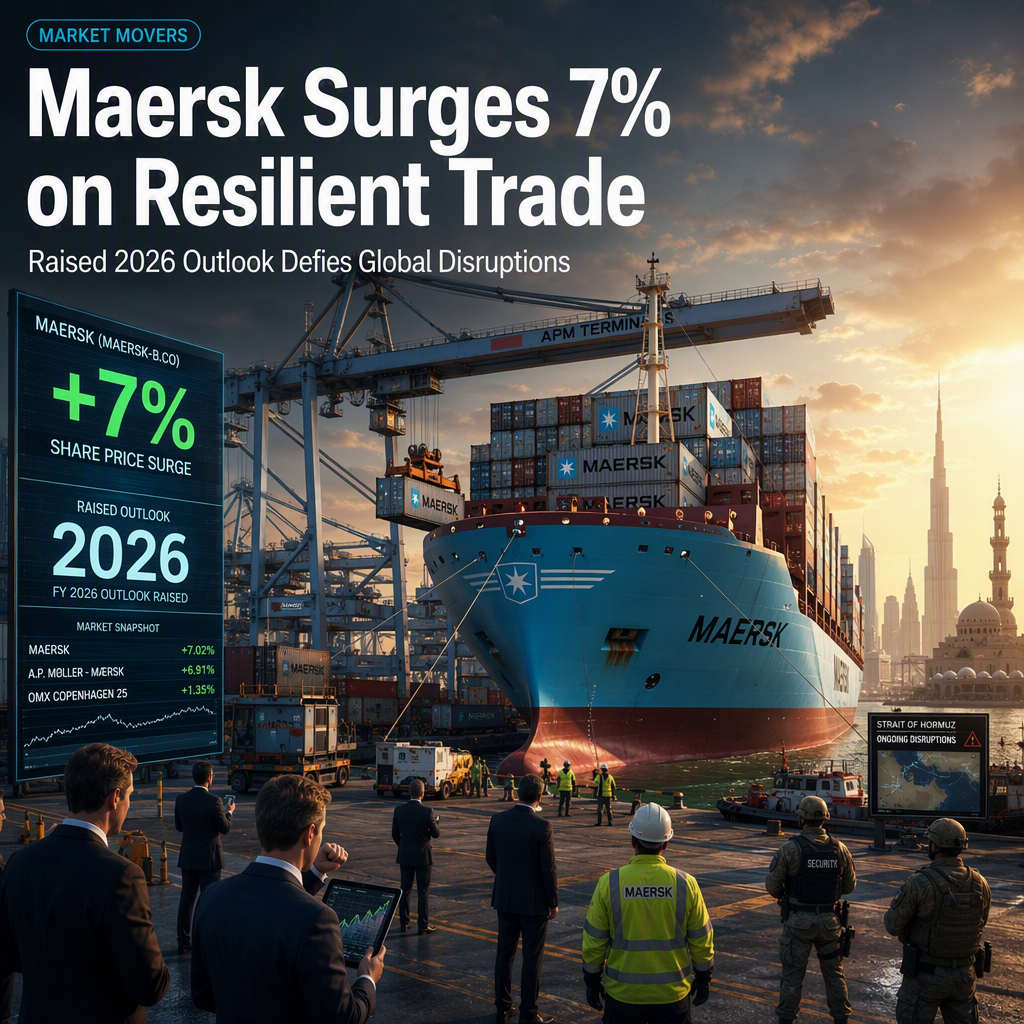
Danish shipping giant Maersk raised its 2026 earnings guidance for the second time this year, citing ongoing disruptions in global trade due to the Strait of Hormuz blockade [1]. The company reported preliminary underlying EBITDA of $3 billion for the April to June period, significantly surpassing the $2.04 billion expected by analysts in an LSEG-compiled consensus [1]. Following the announcement, Maersk shares jumped 7% shortly after the opening bell [1].
Maersk CEO Vincent Clerc highlighted the 'incredible resilience of demand and the incredible resilience of the economy,' noting that shipping volumes have continued 'completely unabated' despite challenges such as the war in the Middle East and U.S. tariffs [1]. Clerc also pointed out that current supply bottlenecks are occurring by land rather than by water, leading to congestion and higher freight rates globally [1].
The positive sentiment extended to the broader shipping sector, with shares of German freight company Hapag-Lloyd rising 0.7% after reporting higher volumes and spot rates in its own results [1]. Hapag-Lloyd CEO Rolf Habben Jansen stated that performance was 'materially better' than the first quarter, despite incurring an additional $600 million in costs related to the Middle East conflict, mainly in fuel and energy [1]. Jansen emphasized that the market has been 'remarkably strong,' resulting in a more balanced supply and demand environment than previously anticipated [1].
CONCLUSION
Maersk's strong earnings and raised outlook, driven by resilient demand and ongoing supply chain disruptions, have led to a significant positive market reaction. The shipping sector as a whole is benefiting from higher freight rates and improved supply-demand balance, despite increased costs from geopolitical tensions. Investors responded favorably, as reflected in the notable share price gains.