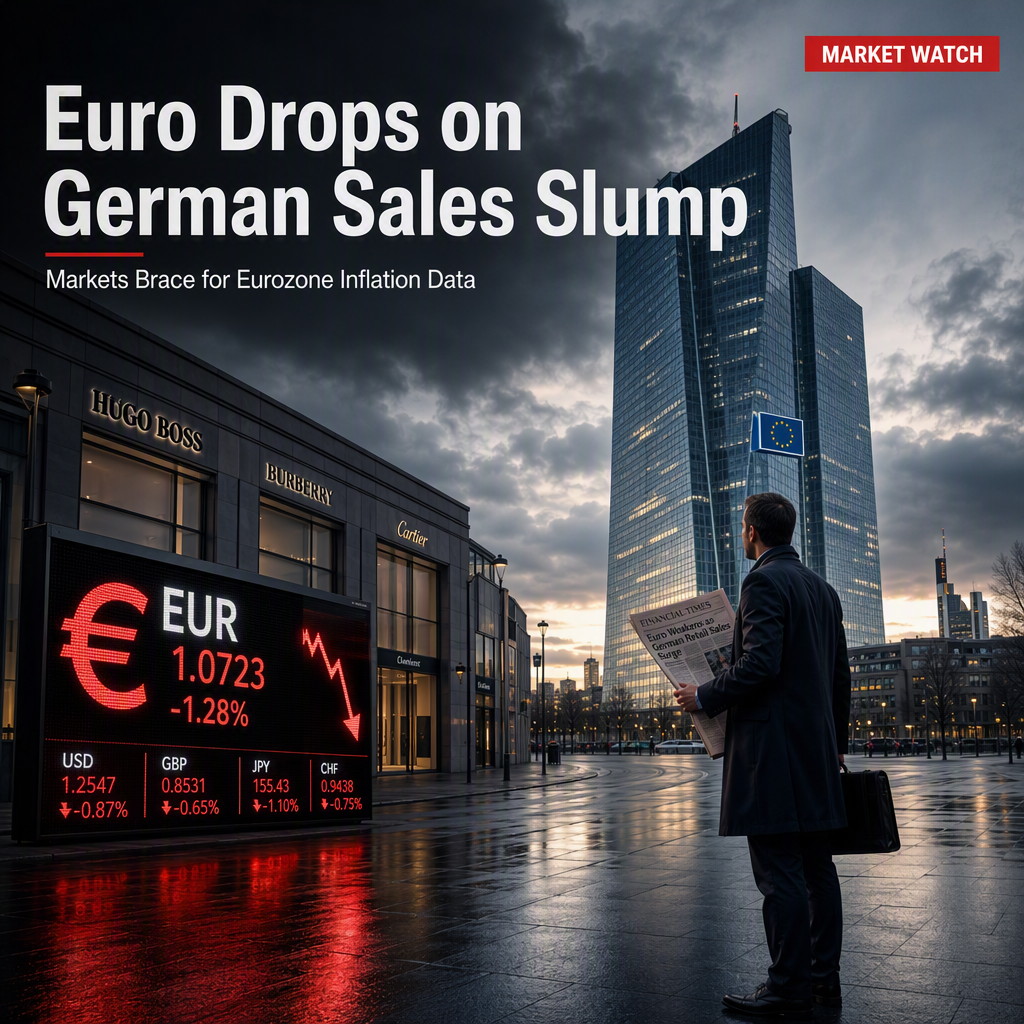
The Euro edged lower against both the British Pound and the US Dollar following a sharp decline in German Retail Sales for July, which fell by 3.4% month-on-month, significantly missing market expectations of a 0.4% rise and marking the steepest drop in over four years. June's figure was revised to 0% from -1.1% [1][5]. On an annualized basis, retail sales dropped 2.5% in July, compared to a 0.2% decline previously [1]. This disappointing data weighed on the EUR/GBP cross, which slipped to near 0.8570 during early European trading hours [1]. Technical analysis indicates EUR/GBP retains a bearish tone below key moving averages, with resistance at 0.8560 and support at 0.8535 [1].
Despite the weak German retail performance, the EUR/USD pair hovered just above 1.1600, giving up some of Monday's gains after being rejected at the 1.1620 area [5]. Danske Bank notes a modest rebound in EUR/USD above 1.16, supported by rising yields and contained underlying inflation pressures across major euro-area economies [3]. German HICP inflation for August increased to 2.9% year-on-year, slightly below consensus expectations of 3.1% and up from 2.8% previously. Core CPI remained unchanged at 2.4% year-on-year, with goods prices rising strongly but services momentum staying low [3]. Danske Bank expects headline inflation to rise to 3.2% year-on-year, while core inflation should decline to 2.4% [3].
Markets are closely watching the upcoming Eurozone preliminary Harmonized Index of Consumer Prices (HICP) release, expected to show inflation accelerating to 3.3% year-on-year in August from 2.9% in July, which could provide further impetus for the European Central Bank (ECB) to hike rates at its policy meeting scheduled for September 10 [1][5]. ECB policymakers have already raised borrowing costs once and are expected to tighten further, with traders betting on additional hikes next year [1].
Meanwhile, higher oil prices—driven by escalating tensions between the US and Iran—are exerting pressure on Eurozone growth, as Brent crude remains above $90, up more than 6% from last week's lows [5]. Political pressure on the US Federal Reserve is also impacting the US Dollar, with President Trump criticizing the Fed for not cutting rates more aggressively, raising concerns about central bank independence and policy trajectory [2][5].
On the UK side, Bank of England Governor Andrew Bailey downplayed inflation threats, citing subdued second-round effects and a softening labor market, while markets are fully pricing in a quarter-point rate increase this year and another by spring [1]. Fiscal discipline in the UK is challenged by rising security and defense demands, which is becoming a key consideration for investors [1].
CONCLUSION
German retail sales data disappointed, dragging the Euro lower against major currencies and reinforcing a bearish technical outlook. With Eurozone inflation data due and oil prices elevated, markets are bracing for potential ECB rate hikes amid persistent geopolitical and political pressures. The overall sentiment is cautious, with medium market impact expected as investors await further economic and policy signals.