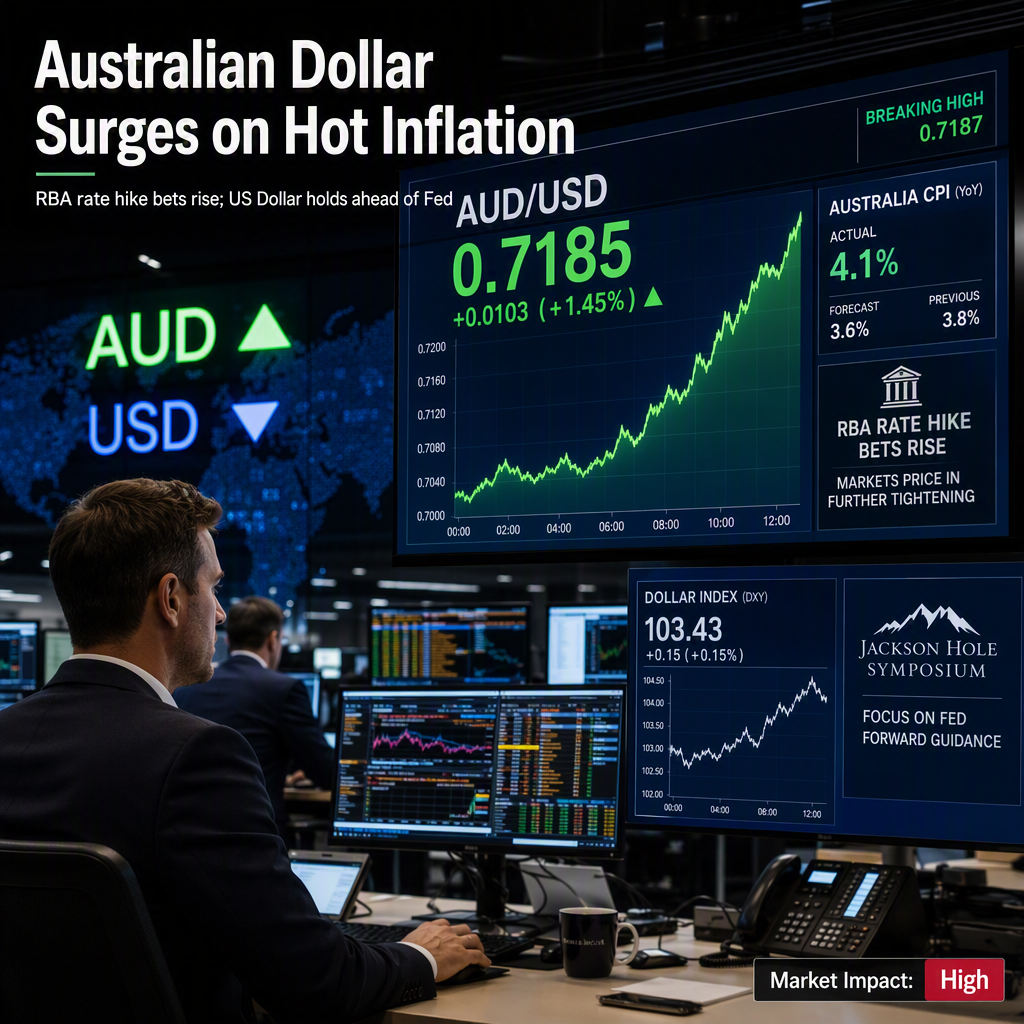
The Australian Dollar (AUD) advanced by 0.2% to trade near 0.7185 against the US Dollar (USD) during Thursday's European session, buoyed by hotter-than-expected July Consumer Price Index (CPI) data from Australia. Headline CPI rose 1.0% month-on-month (consensus: 0.9%) versus -0.1% in June, driven by increases in automotive fuel and clothing prices. On an annual basis, headline CPI eased less than anticipated to 3.5% (consensus: 3.3%) from 3.8% in June. The trimmed mean CPI remained at 3.6% (consensus: 3.5%) for a second consecutive month, exceeding the Reserve Bank of Australia's (RBA) end-December forecast of 3.3%. As a result, RBA cash rate futures now almost fully price in a 25 basis point hike to 4.60% by year-end, up from 60% before the July CPI release [1].
Brown Brothers Harriman noted that the Australian Dollar is "outperforming" following the inflation data, which has lifted expectations for further RBA tightening. Technical analysis shows AUD/USD trading at 0.7185, maintaining a bullish near-term bias above the 20-day exponential moving average at 0.7100. The Relative Strength Index (14) stands at 69.2, just below overbought territory, indicating strong but potentially stretched upside momentum [1].
Meanwhile, the US Dollar remains resilient, supported by robust economic data. The US Personal Consumption Expenditure (PCE) Price Index for July accelerated to 0.2% month-on-month, surpassing the 0.1% consensus, with the annual rate rising to 3.7%. This unexpected uptick has reinforced market expectations that the Federal Reserve could implement one final rate hike before year-end. Investors are now focused on upcoming remarks from Fed leadership at the Jackson Hole Symposium [2].
In related currency markets, the Indonesian Rupiah (IDR) weakened, with USD/IDR trading around 17,800, as domestic protests and inflation risks weighed on sentiment. Despite these pressures, comments from Bank Indonesia's leadership helped limit broader losses, emphasizing policy continuity and economic stability [2].
Strategists at Scotiabank highlighted that the technical backdrop for the US Dollar Index (DXY) remains fragile, warning that "bear pressure will build on the DXY again below 98.75," a key threshold for renewed downside momentum [2].
CONCLUSION
Hotter-than-expected Australian inflation data has fueled a rally in the AUD and increased market bets on further RBA tightening, while the US Dollar remains supported by strong economic indicators and anticipation of Fed policy signals. The overall market impact is high, with both currencies reacting to shifting inflation and rate expectations.