
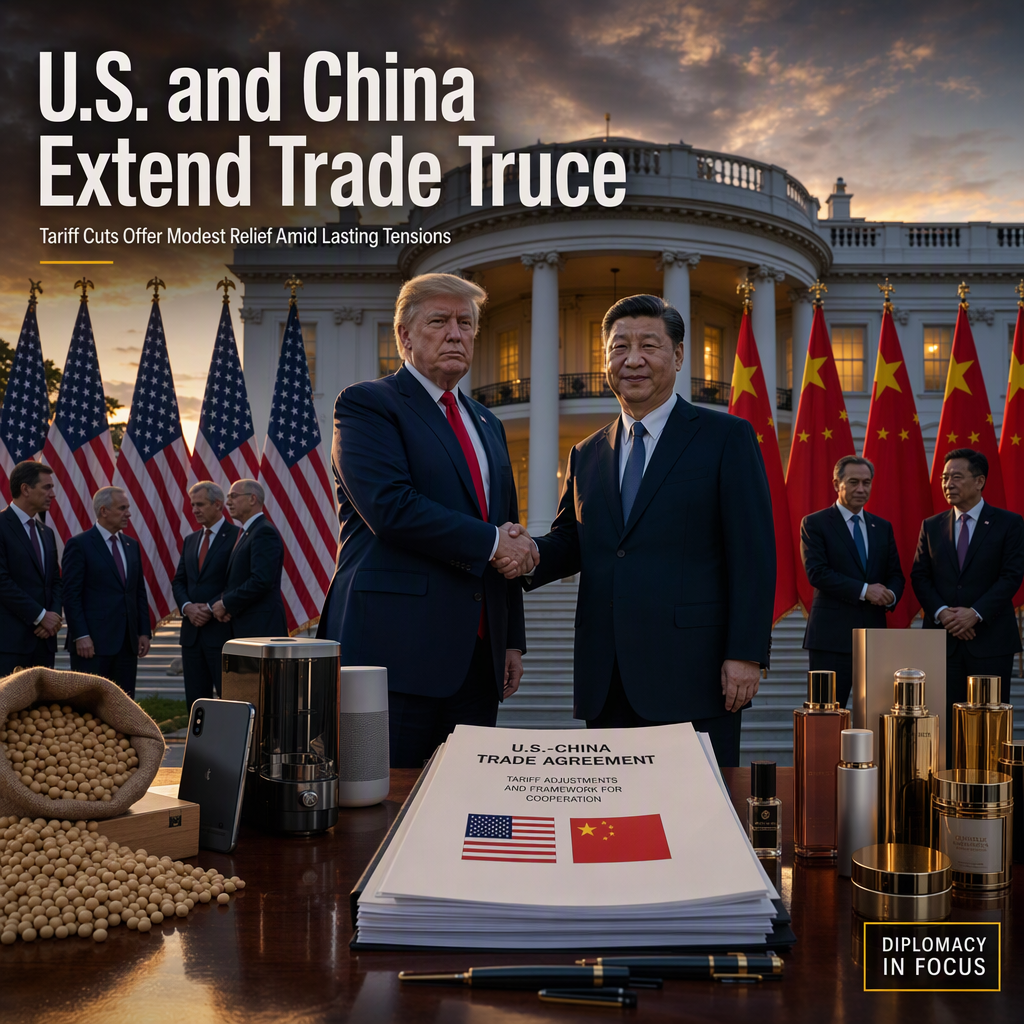
Chinese President Xi Jinping's state visit to Washington resulted in modest agreements between the U.S. and China, including a two-month extension of the trade truce and a reduction of tariffs on $30 billion of goods. The tariff reductions will apply to U.S. exports such as agricultural goods, wood, and cosmetics, as well as U.S. imports including small appliances, toys, and decorations, according to a White House statement [1]. However, the agreement did not include any concrete purchase commitments, and the duration of the truce extension was shorter than the six months anticipated by some analysts prior to the summit [1].
Peter Alexander, managing director at Z-Ben Advisors, described the post-summit relationship as 'fraught,' noting that neither side appears willing to make significant concessions at this time [1]. In addition to trade, the U.S. and China agreed to launch a dialogue on artificial intelligence and reached consensus that Iran should not develop nuclear weapons. Both leaders also agreed that no country or entity should impose transit tolls on international waterways [1].
Market reactions were mixed following the summit. Stock futures slipped and oil prices edged higher as Treasury yields reached their highest levels since 2007, reflecting ongoing investor uncertainty amid the unresolved U.S.-Iran tensions and the limited scope of the U.S.-China agreements [1]. Iranian Foreign Minister Abbas Araghchi stated that Tehran is prepared for a 'doomsday' war with the U.S. but remains open to diplomacy to avoid missing any opportunity for peace [1].
The summit's outcomes suggest that while some progress was made on trade and diplomatic fronts, significant challenges remain, and markets are likely to remain cautious as geopolitical risks persist [1].
CONCLUSION
The U.S.-China summit yielded incremental progress with a short-term trade truce extension and targeted tariff reductions, but fell short of broader market expectations. Ongoing geopolitical tensions, particularly involving Iran, continue to weigh on investor sentiment and market stability.