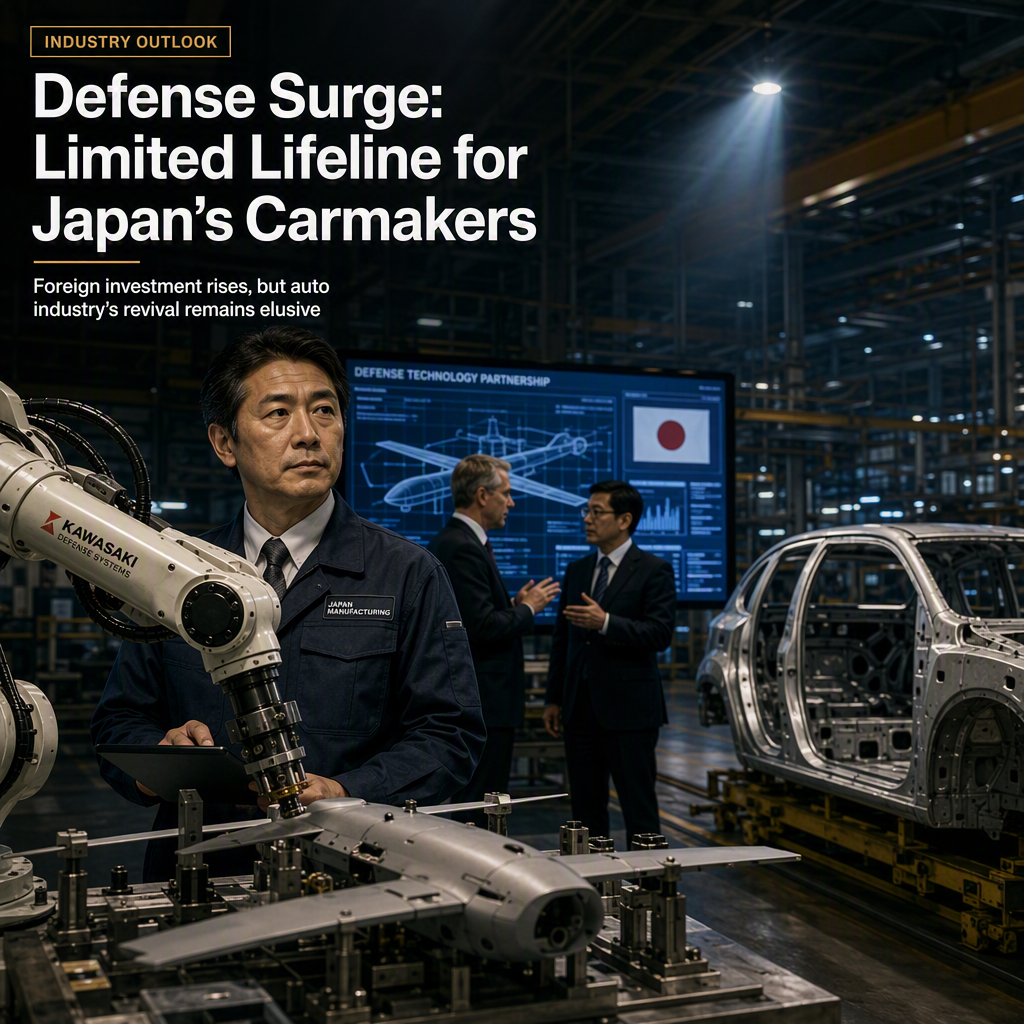
Japan is currently experiencing a surge in defense sector activity, driven by increased government spending and international interest, particularly from companies like Anduril, an American defense technology firm. Anduril is in talks to acquire one of Nissan Motor's manufacturing plants in Japan, a move welcomed by some policymakers as a potential revitalization of the nation's industrial base [1]. The Japanese government has announced significant subsidies and investments to foster the domestic defense industry, aiming to stimulate job creation and attract foreign investment [1].
Despite these developments, the article emphasizes that the defense boom should not be mistaken for a solution to the deeper structural challenges facing Japan's traditional manufacturing sectors, especially its automobile industry. The car industry, once a pillar of Japan's economic growth, is now struggling with declining global demand for gasoline vehicles, intense competition in electric vehicles, and technological disruption from U.S. and Chinese rivals [1]. While defense subsidies may provide short-term relief, they do not address these fundamental issues.
The defense sector's growth is also limited by export controls, political sensitivities, and reliance on government contracts, making it less viable as a long-term engine for economic expansion compared to the automobile industry [1]. The article warns that policymakers should not conflate defense-driven investment with genuine industrial renewal, as sustainable growth requires innovation, global competitiveness, and adaptation to technological change [1].
Ultimately, the opinion piece concludes that Japan's defense boom may bring temporary relief and foreign interest to its manufacturing sector, but it will not save its carmakers or restore the country's industrial strength without deeper structural reforms and a commitment to innovation [1].
CONCLUSION
Japan's defense sector is attracting foreign investment and government support, but these measures offer only short-term relief for the country's struggling carmakers. Sustainable industrial renewal will require structural reforms and innovation beyond defense-driven stimulus. The market takeaway is cautious optimism for defense-related manufacturing, but continued concern for the broader automobile industry.