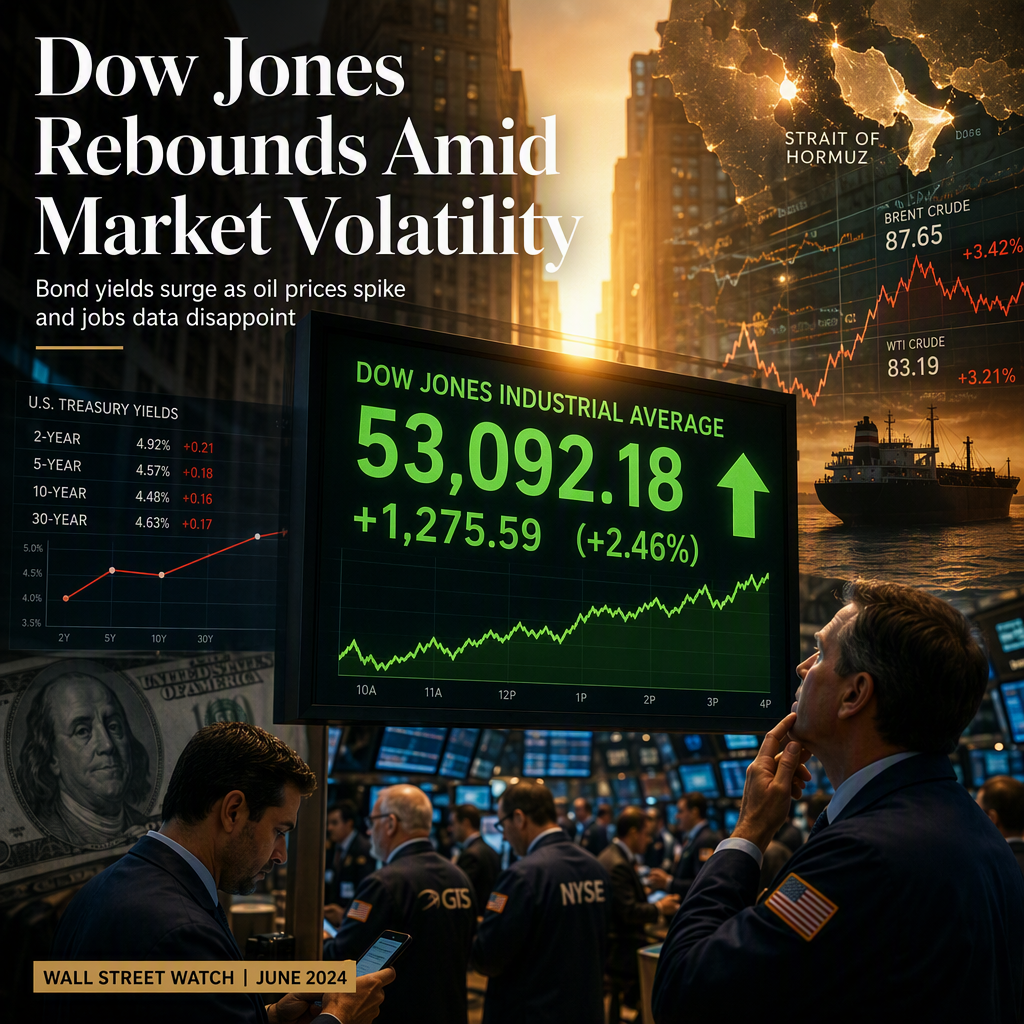
The Dow Jones Industrial Average (DJIA) rebounded on Wednesday, trading near 53,000 and closing roughly 250 points higher after opening just above 52,750 and dipping to a session low beneath the rising 50-day Exponential Moving Average (EMA) near 52,700. This recovery, amounting to about half a percent, followed three consecutive lower sessions. The rebound was attributed to movements in the bond market rather than any fundamental change in the equities of the thirty DJIA companies, as equities turned upward when long-term bond yields stopped climbing [1].
During the session, the benchmark 10-year Treasury note yield reached 4.818%, a level last seen in November 2023, while the 30-year yield stood above 5.28% and the 2-year near 4.40%. European government bonds also saw declines, and Japanese 10-year debt remained at multi-decade highs. Market participants noted that the shift in equities coincided with stabilization in long-end yields. The New York Federal Reserve president commented that the yield surge reflected a strong economy rather than market dysfunction and did not indicate whether further tightening would be necessary. Meanwhile, the commerce secretary suggested that faster economic growth and a shrinking deficit could lower rates over the next six months. Market pricing now places the probability of a September rate hike at nearly 66%, up from about 40% a week ago [1].
In the commodities market, West Texas Intermediate (WTI) crude traded above $90.00 and Brent above $94.50, with Brent prices approximately $20 higher than before the war began on February 28. American forces struck Islamic Revolutionary Guard Corps (IRGC) targets near Bandar Abbas and along Iran's southern coast after two tankers were attacked in the Strait of Hormuz. The U.S. energy secretary reported that more than 17 million barrels moved through the strait on Monday, a record for the war, and that regional exports exceeded pre-war levels when including Saudi and Emirati bypass pipelines. However, preliminary tracking data showed only five commodity vessels that day, with no liquid tankers, and later revised crude flow estimates to roughly 8.6 million barrels per day, about half the official figure [1].
On the labor front, private payrolls added 38,000 jobs in August, missing the consensus estimate of 47,000 and down from 46,000 in July. This represents the smallest monthly gain since January, with hiring concentrated in health care and some sectors experiencing job losses [1].
CONCLUSION
The DJIA's rebound was driven by stabilization in bond yields rather than changes in equity fundamentals. Rising oil prices and ongoing geopolitical tensions in the Middle East contributed to market uncertainty, while weaker-than-expected private payroll data added to the cautious sentiment. Market participants are closely watching bond yields and rate hike probabilities for future direction.