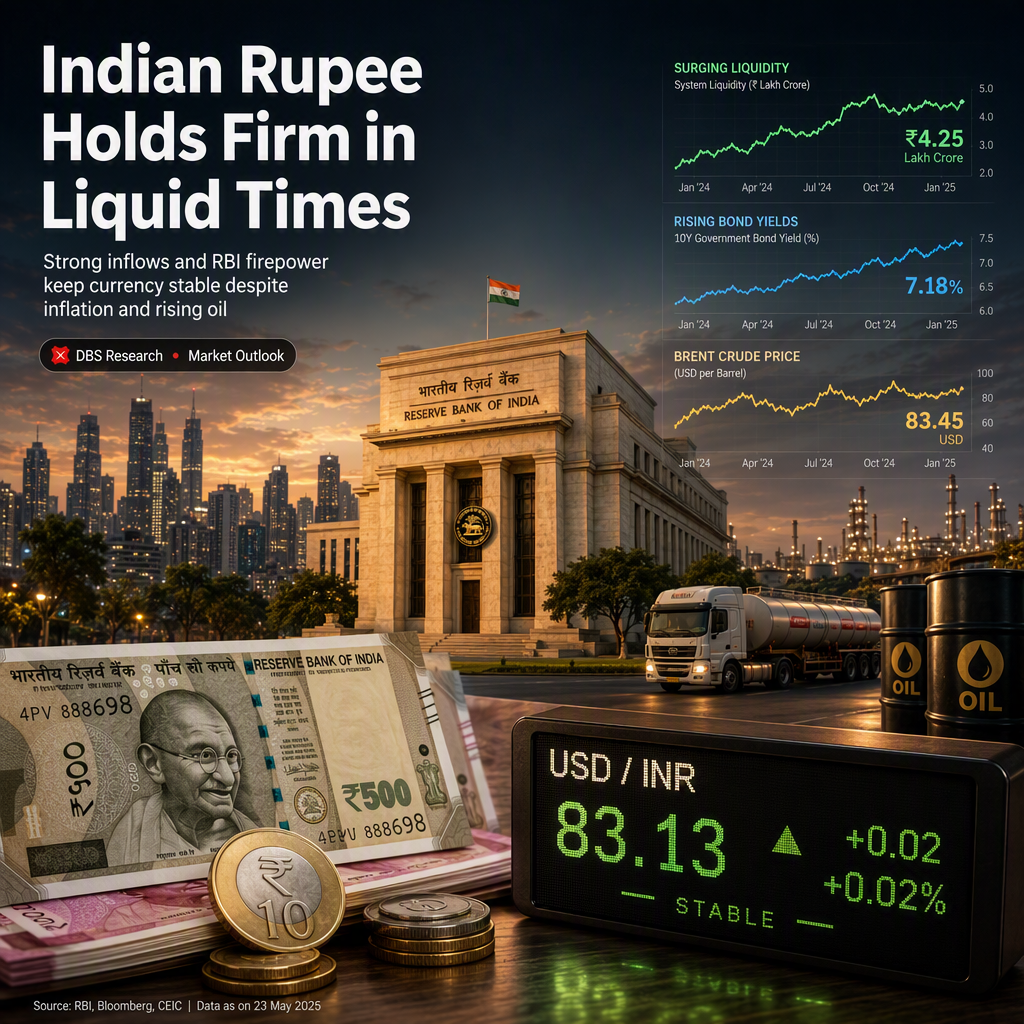
DBS Group Research reports that the Indian Rupee has settled into a stable range against the US Dollar, specifically around the mid-94 handle, following earlier outperformance driven by intervention and strong inflows [1]. The banking system surplus has jumped past INR 10 trillion this week, surpassing previous highs seen in 2022 and during the Covid period, with the durable balance widening sharply to INR 14 trillion. This surge in liquidity has suppressed overnight call rates, a significant change from the average INR 1 trillion surplus in late June [1].
Despite rising oil prices and continued support for the US Dollar due to expectations of US rate hikes, DBS expects any pullbacks in USD/INR to be shallow. Recent inflows have provided authorities with additional firepower, reducing the risk of sharp, one-sided rupee depreciation in the near term [1]. August inflation, due next week, is projected to accelerate to 4.8-4.9% from 4.4% the previous month, driven by a broader rise in food prices and a pick-up in precious metals, which is expected to push up core inflation as well [1].
The weak take-up at the recent 30-day Variable Rate Reverse Repo (VRRR) operation suggests that market participants are hesitant to lock up funds ahead of a potentially higher policy rate. This implies that longer-tenor VRRRs may remain less effective until the October meeting, should current rate hike expectations persist. If the Reserve Bank of India (RBI) seeks to drain liquidity before then, such measures are likely to exert further upward pressure on bond yields [1].
Indian rates continue to face upward pressure, as the RBI has little incentive to counteract the recent hawkish repricing while system liquidity remains exceptionally abundant. The immediate challenge for the RBI is that surplus liquidity has become increasingly difficult to absorb [1].
CONCLUSION
The Indian Rupee remains stable against the US Dollar, supported by strong inflows and abundant liquidity, though upward pressure on rates and inflation is expected. Market participants are cautious about locking in funds ahead of potential policy rate hikes, and the RBI faces challenges in absorbing surplus liquidity. Overall, the risk of sharp rupee depreciation has diminished in the near term, but bond yields may rise if liquidity draining measures are implemented.