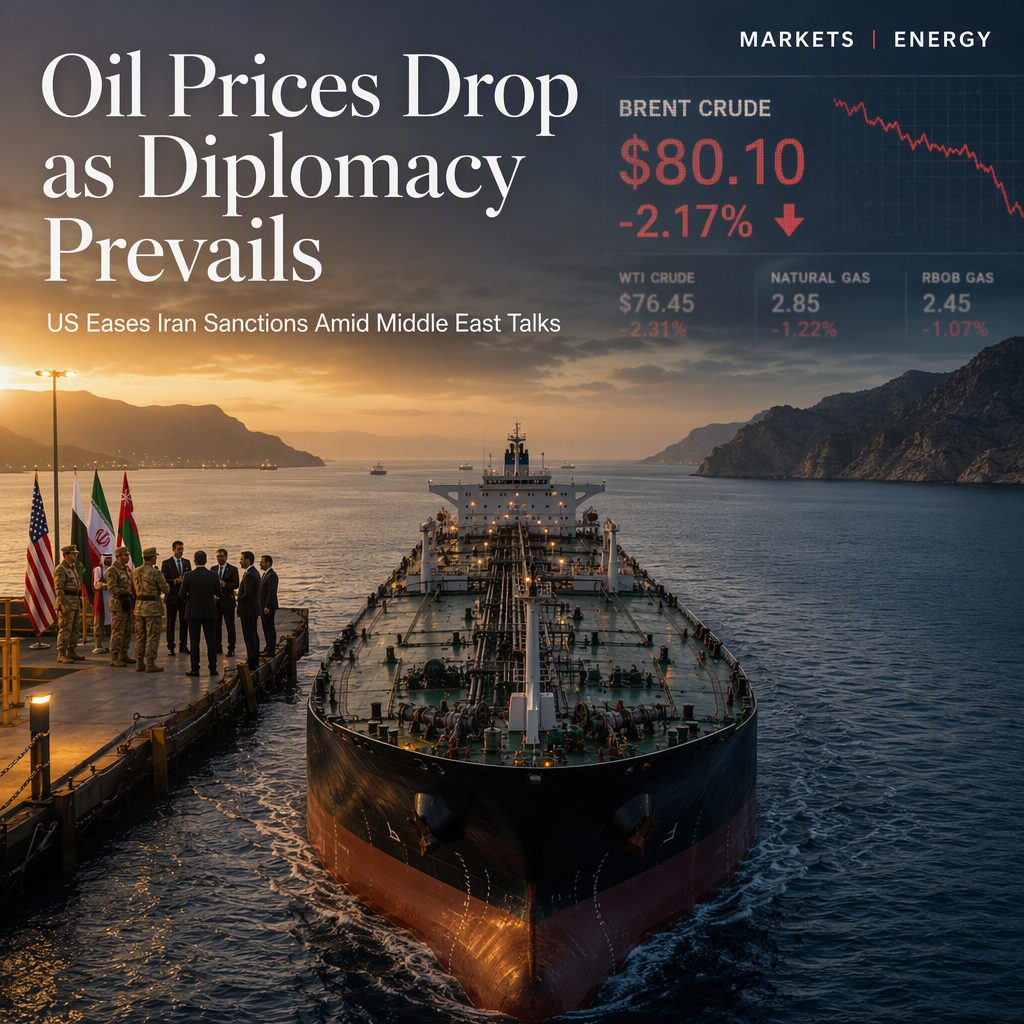
West Texas Intermediate (WTI) oil prices continued their decline for a third consecutive day, trading around $80.10 per barrel during Asian hours on Wednesday, while U.S. WTI futures for October dropped 2.17% to $80.56 per barrel and Brent crude futures for October fell 2.52% to $86.35 per barrel [1][2]. The drop in oil prices follows reports that Iran and Oman are in talks to establish a temporary joint maritime corridor in the Strait of Hormuz, with technical discussions ongoing and a permanent arrangement anticipated in the future [1][2]. Oman's foreign minister stated that future management of the Strait and a permanent solution will follow, with ongoing discussions aimed at supporting peace, cooperation, stability, and freedom of navigation [2].
Regional diplomatic efforts have intensified, with Pakistan's army chief visiting Tehran to support ongoing initiatives and Qatar confirming its continued mediation efforts [1][2]. Pakistan also reported meaningful progress in talks aimed at de-escalation and restoring navigation through the Strait of Hormuz [2].
Oil prices have also faced downward pressure due to the U.S. pivoting to economic sanctions on Iran, which were described as less severe than anticipated, as the U.S. stopped short of imposing secondary sanctions on Iran's trading partners [1][2]. Dan Coatsworth, head of markets at AJ Bell, noted that the less severe sanctions and lower oil prices helped markets regain some poise as government bond yields eased [2]. Paolo Broccardo, CEO of BankPro, highlighted that the shift away from military action reduced the perceived risk to Gulf oil supply, though the U.S. has not ruled out other interventions [2].
Despite the recent price declines, TD Securities noted that crude flows remain extremely constrained and the product market continues to tighten, suggesting a worsening supply backdrop that supports a more constructive stance on Brent [1].
CONCLUSION
Oil prices have declined as diplomatic efforts in the Middle East gain traction and U.S. sanctions on Iran prove less severe than expected. While the immediate risk to Gulf supply has eased, ongoing supply constraints and tightening product markets may continue to influence prices moving forward.