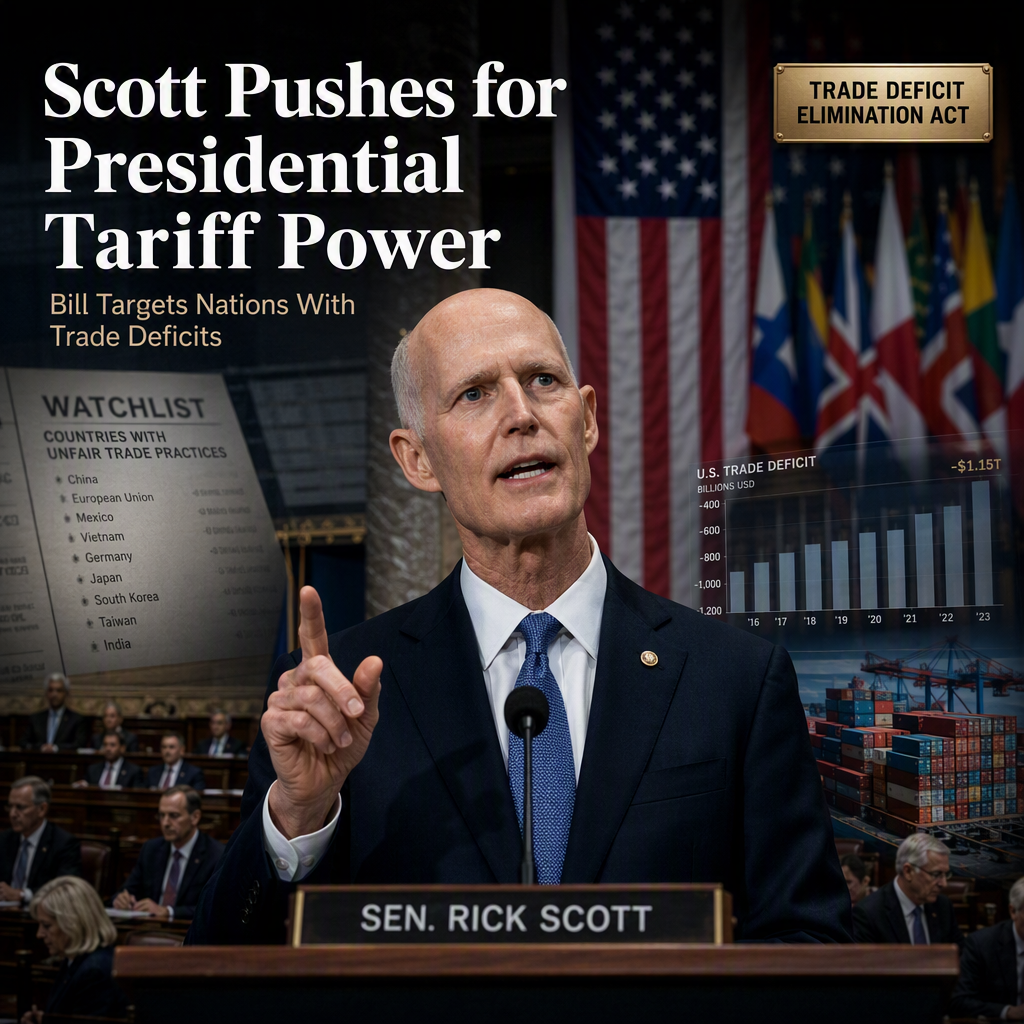
Senator Rick Scott, R-Fla., is spearheading a legislative effort in the Senate to grant President Donald Trump enhanced authority to impose tariffs on countries with longstanding trade deficits with the United States, following the Supreme Court's decision to strike down Trump's previous universal tariff measures under the International Emergency Economic Powers Act (IEEPA) earlier this year [1]. The proposed legislation, named the Trade Deficit Elimination Act, would establish a congressional framework allowing the president to authorize, adjust, or suspend tariffs on imports from countries identified as having detrimental trade deficits with the U.S. [1].
The bill mandates the creation of an annual watch list, compiled by U.S. Trade Representative Jamieson Greer, to identify 'trade deficit economies.' While the president and Greer would be required to consult with the House Ways and Means and Senate Finance committees, they would not need full congressional approval to apply tariffs to countries on the list [1]. Certain products critical to U.S. supply chains, national security, or lacking alternative sources would be exempt from these tariffs [1].
Sen. Scott emphasized the need to protect American economic interests, stating, 'We can’t let other countries rip us off,' and described the bill as a means to restore American prosperity and ensure fair trade practices [1]. The announcement of the bill closely follows the Trump administration's refunding of $100 billion in tariff revenue collected during a previous round of global duties, which were later invalidated by the Supreme Court [1].
The bill has garnered support from Sens. Kevin Cramer, R-N.D., and Tim Sheehy, R-Mont., and is positioned as a new authority under Article 1, Sec. 3, distinct from the IEEPA, with a focus on directly targeting foreign commerce [1]. Market implications were not explicitly discussed in the article, nor were there any analyst opinions or forward-looking statements regarding the bill's potential impact on trade relations or the broader economy [1].
CONCLUSION
Sen. Rick Scott's proposed Trade Deficit Elimination Act seeks to empower the president with new tariff tools to address trade deficits, following the Supreme Court's rejection of previous tariff actions. While the bill has attracted some Senate support, its market impact and future prospects remain undiscussed in the source.