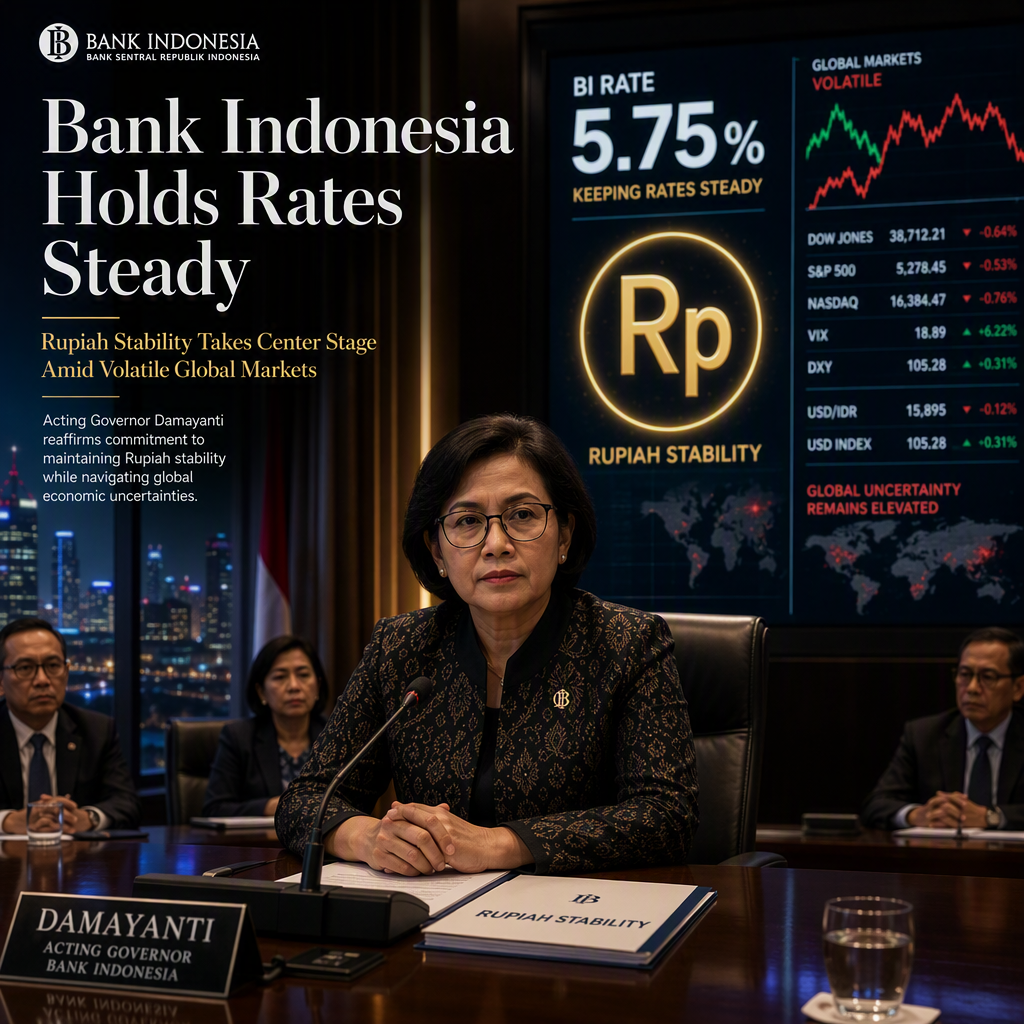
Bank Indonesia (BI) decided to keep its benchmark BI Rate unchanged at 5.75% in August, with the central bank emphasizing the importance of Rupiah and macro-financial stability over immediate growth concerns [1]. UOB economist Enrico Tanuwidjaja noted that BI's policy mix is designed to support sustainable economic growth while focusing on external risk management and deploying liquidity and macroprudential tools to bolster domestic conditions [1]. Acting Governor Damayanti, in her first lead, underscored that maintaining Rupiah stability amid heightened global financial market volatility is BI's primary focus, alongside keeping inflation within the target range of 2.5% ±1% for 2026-2027 [1].
The decision to hold rates was widely anticipated by markets and was unanimous among economists surveyed prior to the meeting [1]. BI's communication repeatedly referenced elevated global uncertainty and ongoing volatility, particularly due to geopolitical tensions in the Middle East [1]. According to Tanuwidjaja, BI is prepared to maintain a relatively tight monetary stance until global risk sentiment improves, aiming to moderate capital flow volatility and stabilize the Rupiah [1].
UOB's outlook suggests that the current rate pause is not necessarily the end of the hiking cycle. Risks to the Rupiah's trajectory remain due to persistent external uncertainty and potential increases in energy prices [1]. Given the recent relative stability of the Rupiah, UOB has revised its forecast to expect only two additional 25 basis point rate hikes in the fourth quarter of 2026, which would bring the policy rate to a terminal level of 6.25% by the end of 2026 [1].
August's Monetary Policy Committee (MPC) decision signals BI's continued commitment to defending macro-financial stability, with a cautious policy bias that prioritizes currency stability over growth support in the current global environment [1].
CONCLUSION
Bank Indonesia's decision to keep rates steady at 5.75% reflects a clear focus on Rupiah stability and external risk management amid ongoing global uncertainty. The market reaction was muted, as the move was widely expected, and analysts anticipate further rate hikes only if external risks intensify. Overall, BI's cautious stance signals ongoing vigilance in defending macro-financial stability.