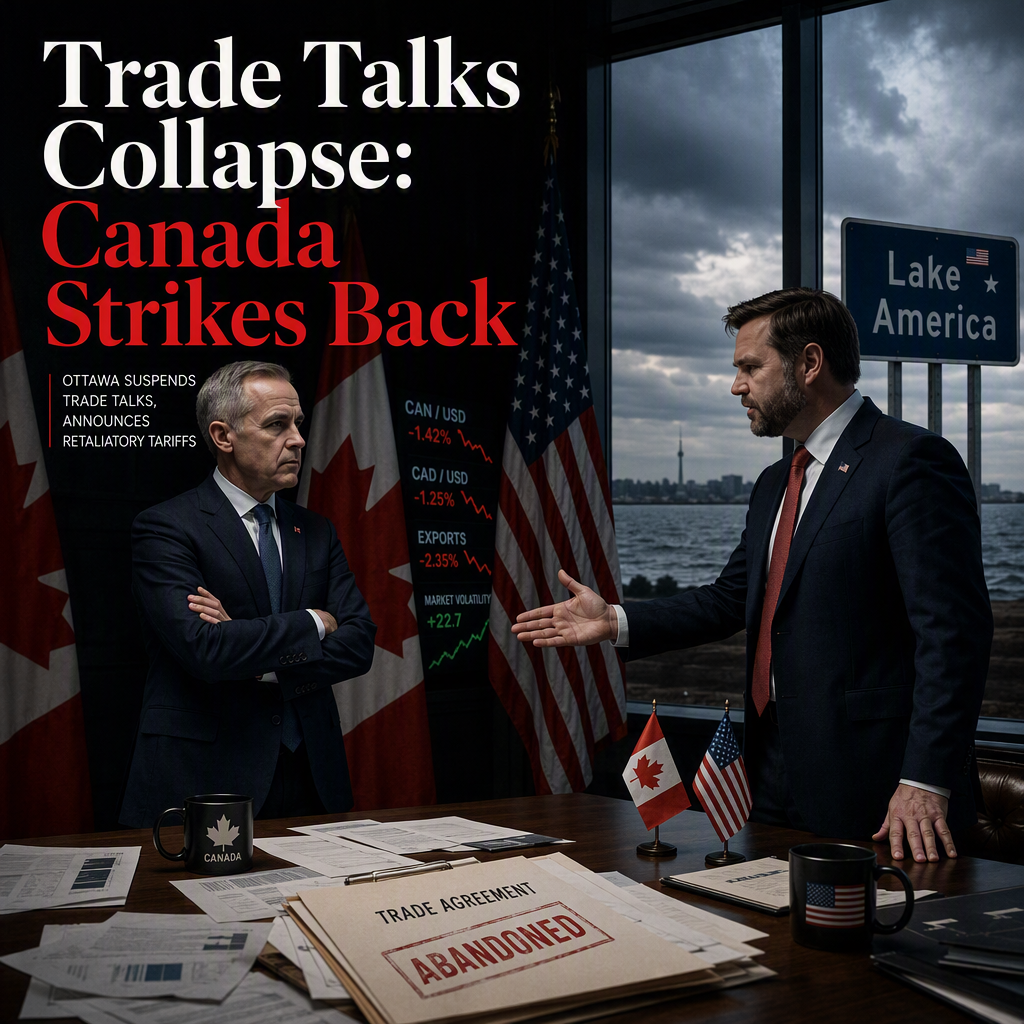
President Donald Trump's top trade advisor, U.S. Trade Representative Jamieson Greer, revealed that Canada walked away from what he described as the 'best deal in the world' after declining to finalize a trade agreement with the U.S. nearly two weeks ago [1]. Greer detailed the negotiations on 'Special Report,' stating, 'We offered them the best deal. They looked at it square in the face and turned around' [1]. The breakdown in talks occurred after Canadian Prime Minister Mark Carney accused the U.S. of making last-minute changes to proposed terms and subsequently suspended trade negotiations on August 21, announcing retaliatory tariffs against the U.S. [1].
Greer explained that the U.S. was willing to negotiate on sensitive sectors for Canada, including steel, aluminum, autos, and lumber, and had moved government levers to offer favorable terms [1]. After a handshake agreement between Trump and Carney, Canadian officials returned to Ottawa but later sought additional concessions, particularly more tariff relief, which the U.S. could not accommodate [1]. U.S. trade officials attributed the breakdown to 'new demands and walk backs of other commitments by Canada' that disrupted the balance of the negotiations [1].
Following the collapse of the deal, Canadian leaders appeared on television claiming the country had 'been attacked,' a characterization Greer disputed, noting that most Canadian goods enter the U.S. duty-free and highlighting Canada's history of limiting U.S. dairy imports and importing goods from China [1]. Greer also pointed out that Canada and China are the only countries to have retaliated against U.S. trade measures [1].
The escalation of the trade dispute was further marked by President Trump signing an executive order to rename Lake Ontario as 'Lake America,' underscoring the heightened tensions between the two countries [1].
CONCLUSION
The suspension of trade talks and the announcement of retaliatory tariffs by Canada signal a significant escalation in the U.S.-Canada trade dispute. With both sides unable to reach a compromise on key issues, market participants should expect continued volatility and uncertainty in sectors sensitive to cross-border trade. The breakdown underscores the challenges of negotiating complex trade agreements amid shifting demands and political tensions.