
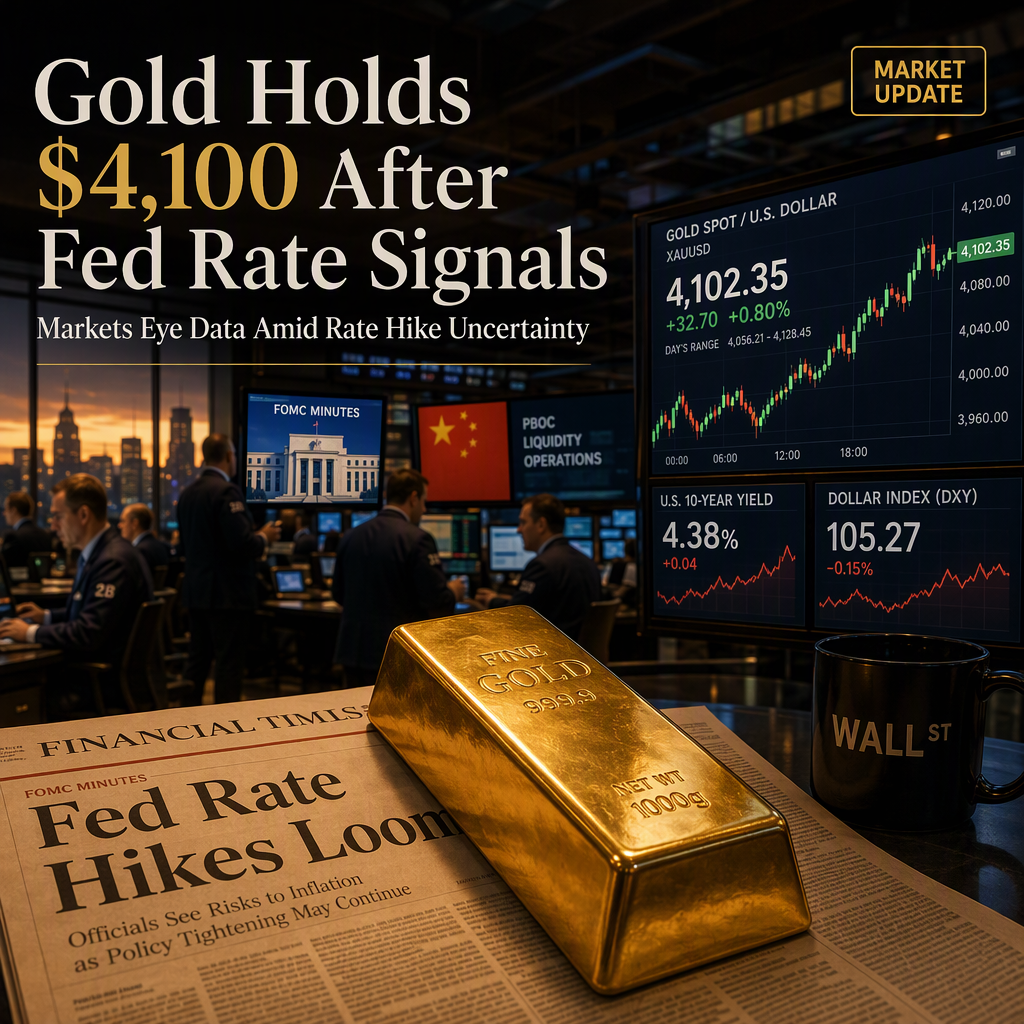
Gold (XAU/USD) experienced downward pressure on Wednesday, dropping to a two-month low of $4,066 before rebounding to trade at $4,115, down 1.16% on the day, as US Treasury yields erased earlier gains and turned negative [1]. The release of the Federal Open Market Committee (FOMC) minutes revealed that all members supported September’s rate hike, with officials divided on whether the move was a precaution or the start of a tightening cycle to curb investment and spending and push prices lower [1]. The minutes indicated that 'many participants' viewed the hike as insurance against persistently high inflation, while others saw it as a measure to prevent inflation from broadening, and 'a couple' cited the need to match a higher-than-expected neutral interest rate [1]. Fed members expect another rate hike to be 'appropriate by year's end,' according to the minutes [1].
Market pricing reflected skepticism about an imminent hike, with money markets assigning a 19% probability to a rate increase at this month's meeting and an 80% chance of a hold, as per Prime Terminal data [1]. The US 10-year Treasury yield fell one basis point to 5.27% after reaching a 24-year high of 5.365%, while the US Dollar Index (DXY) rose 0.40% to 102.24 [1]. Comments from Kansas City Fed's Jeffrey Schmid suggested further rate increases may be needed to curb inflation, whereas San Francisco Fed's Mary Daly emphasized a data-dependent approach, noting that future adjustments would consider external shocks [1].
Despite the bearish trend, gold found support near $4,100, with sellers unable to push prices decisively lower toward $4,000 [1]. The ongoing gold purchases by China’s central bank for the 23rd consecutive month were cited as a potential factor for near-term recovery in gold prices [1]. Additionally, a 1.66% decline in West Texas Intermediate (WTI) oil prices to $88.45 helped limit gold’s fall below $4,100, opening the door for a possible rebound [1].
Looking ahead, market participants are awaiting US Initial Jobless Claims data on Thursday and the University of Michigan's Consumer Confidence report on Friday, which could influence gold’s direction [1]. Technical analysis suggests that while gold remains in a bearish trend, key support at $4,100 has held so far [1].
CONCLUSION
Gold prices remain under pressure following the FOMC minutes, which signaled the possibility of further Fed rate hikes by year-end. However, strong support near $4,100 and ongoing central bank purchases provide some optimism for a near-term recovery. Market participants are closely watching upcoming US economic data for further direction.