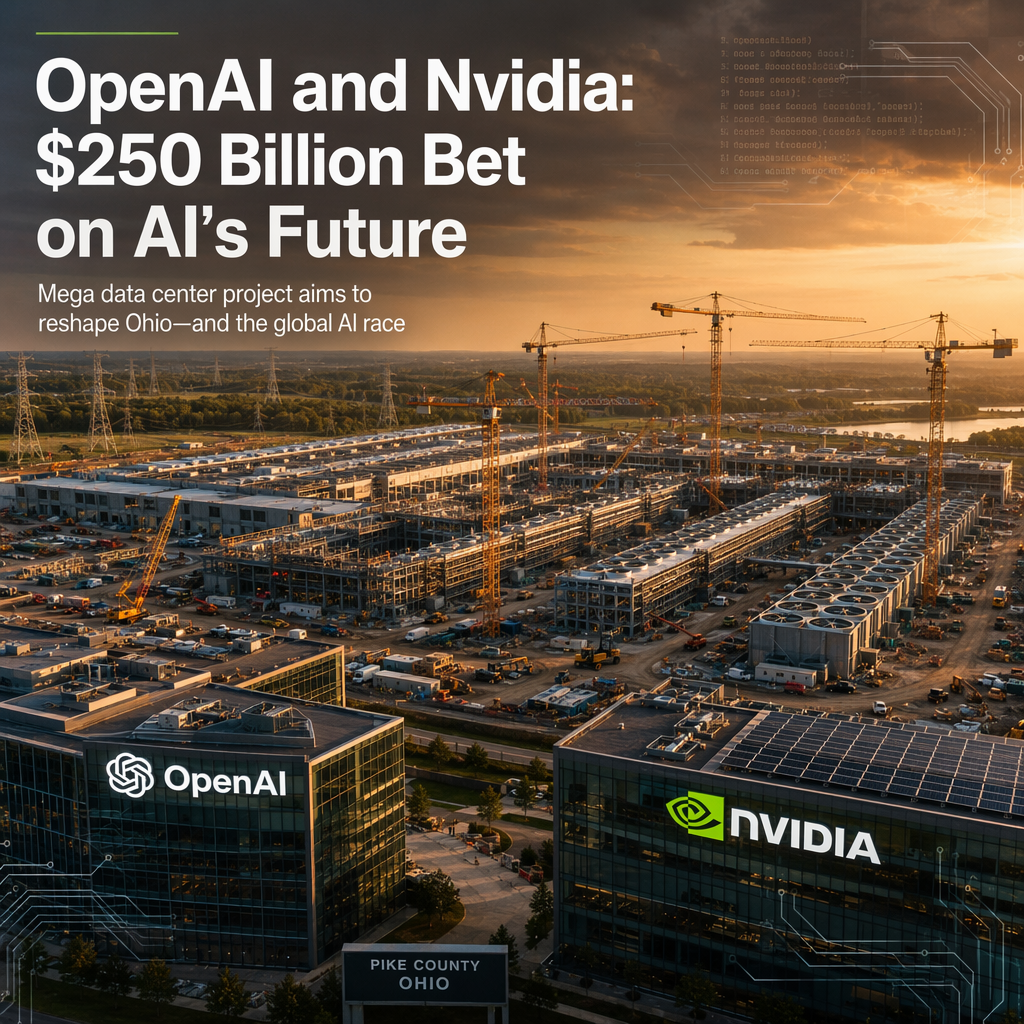
OpenAI is in advanced discussions with Nvidia regarding a potential backstop of up to $250 billion to support OpenAI's plans to lease and construct a massive artificial intelligence data center campus in Pike County, Ohio, CNBC confirmed [1]. The proposed backstop would enable OpenAI to raise debt for a 10 gigawatt data center, leveraging Nvidia's credit strength. This guarantee would specifically cover lease and construction debt, while negotiations for Nvidia chips to be used in the facility are being conducted separately [1].
The Ohio site, previously a uranium-enrichment plant, is expected to require more than $500 billion in total investment, according to a source familiar with the plans [1]. The 10 gigawatt capacity is roughly equivalent to the annual power consumption of 8 million U.S. households, highlighting the scale of OpenAI's infrastructure ambitions [1]. The talks are ongoing and subject to change, with no final agreement reached yet [1].
Nvidia declined to comment on the negotiations [1]. Previously, Nvidia had announced intentions to invest up to $100 billion in OpenAI as part of a strategic partnership, but that investment did not materialize. Instead, Nvidia contributed $30 billion to OpenAI's record-breaking funding round in March [1]. Nvidia CEO Jensen Huang indicated that this might be the company's last investment in OpenAI before its potential IPO, for which OpenAI confidentially filed with the SEC in June, though no official timeline has been disclosed [1].
The Ohio data center campus is being developed by SoftBank and SB Energy in partnership with the U.S. Department of Energy. SoftBank, a major OpenAI investor, and OpenAI announced a $1 billion investment in SB Energy earlier this year [1]. OpenAI is currently valued at nearly $1 trillion by private investors, but faces increasing competition and pricing pressure from rivals such as Anthropic, Google, Amazon, Meta, and open-weight alternatives from China [1].
CONCLUSION
OpenAI's negotiations with Nvidia for a $250 billion backstop underscore the escalating scale and financial stakes in the AI infrastructure race. The potential deal could significantly boost OpenAI's capacity to meet future demand, but the outcome remains uncertain as talks continue. Market attention is focused on the implications for both companies and the broader AI sector.