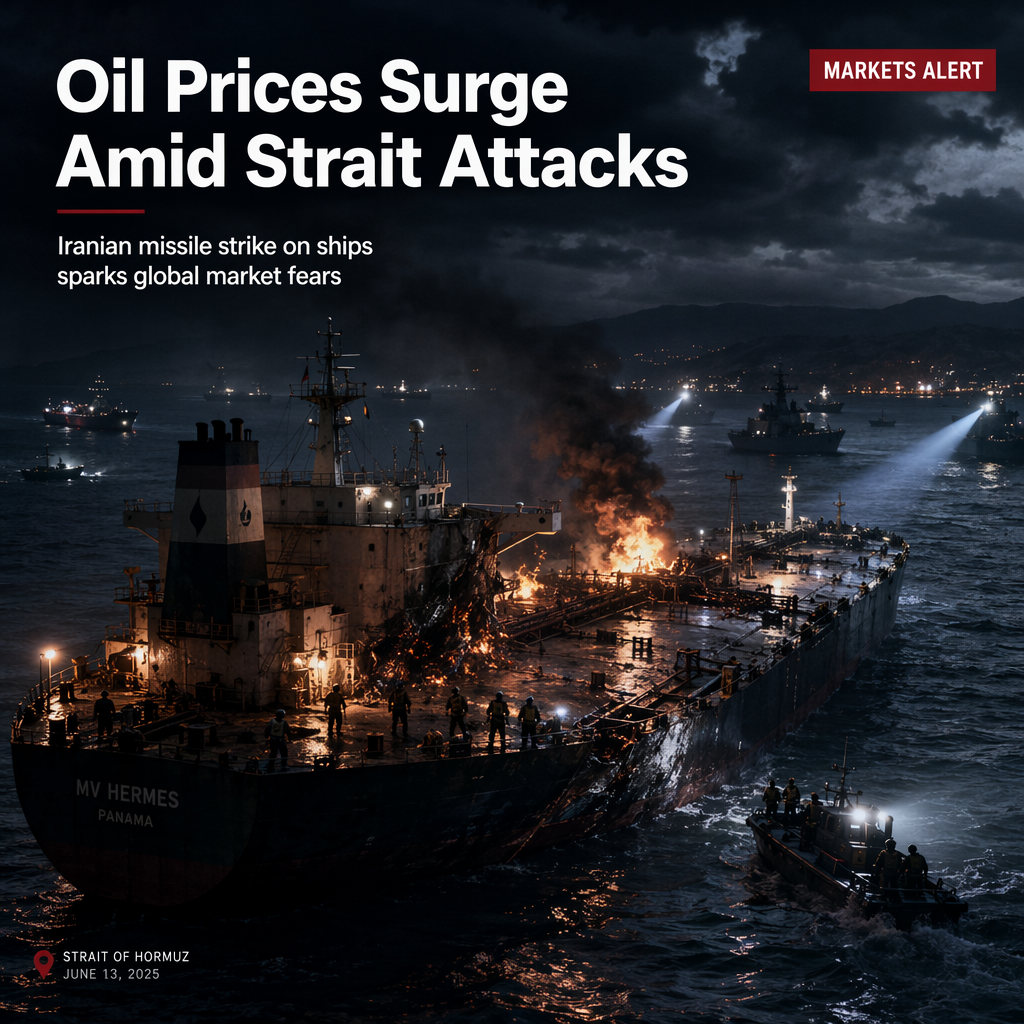
Oil prices climbed sharply on Tuesday morning following reports of an Iranian attack on commercial ships in the Strait of Hormuz, a critical waterway that handles approximately 20% of global oil traffic [1]. According to Axios, citing two unnamed U.S. officials, Iran fired at least two missiles at ships navigating the strait on Monday evening, causing significant damage to the vessels but resulting in no casualties [1]. CNBC was unable to independently verify these reports [1].
The United Kingdom Maritime Trade Operations Centre (UKMTO) reported an incident 8 nautical miles east of Limah, Oman, where a tanker was struck by an unknown projectile while traveling southbound, leading to a fire but no casualties [1]. These incidents have heightened concerns about the fragility of the interim peace agreement between the U.S. and Iran, as both sides continue to negotiate a permanent resolution to their nearly four-month war [1].
In response to the reported attacks, international benchmark Brent crude futures for September delivery rose 1.5% to $73.09 per barrel, while U.S. West Texas Intermediate (WTI) futures for August delivery increased 1.5% to $69.56 per barrel, extending earlier gains after WTI had closed at its lowest level since February 27 in the previous session [1].
U.S. President Donald Trump reiterated on Monday that the two countries would either reach a deal or the U.S. would "finish the job," renewing threats of military action against Iran [1]. Holger Schmieding, chief economist at Berenberg, noted that both sides have an interest in containing the conflict, especially with the U.S. mid-term elections approaching and economic incentives at play for both nations [1].
CONCLUSION
The reported Iranian attack on commercial ships in the Strait of Hormuz has triggered a notable rise in oil prices and underscored ongoing geopolitical risks in the region. Market sentiment remains cautious as the situation develops, with both the U.S. and Iran facing internal and external pressures to contain the conflict. The market will likely remain sensitive to further developments in the strait and the broader U.S.-Iran negotiations.