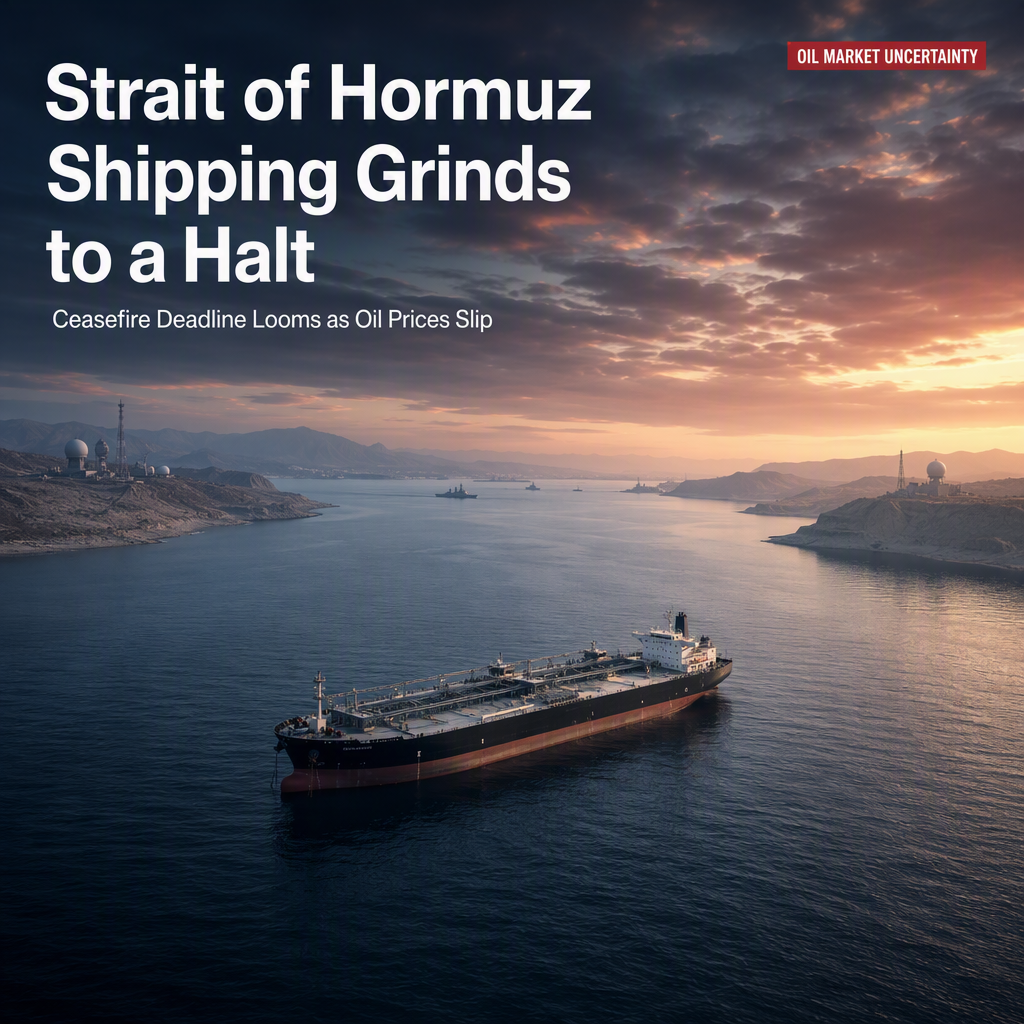
Shipping traffic through the Strait of Hormuz, a critical passage for global oil transport, has slowed to a near halt ahead of the expiry of the 60-day ceasefire between the U.S. and Iran on Monday, with no official negotiations or deal in sight [1]. Over the weekend, only five cargo ships passed through the Strait on Saturday, and none were registered on Sunday, a sharp decline from 31 vessels the previous weekend, according to Kpler data cited by Reuters [1]. Last week, shipping traffic had already reached a three-month low, with a five-day average of 13 vessel transits on Tuesday, the lowest since May 12. Overall, shipping is down 90% since before the war began on February 28, with the Strait typically handling about 130 vessel transits per day, representing about a fifth of the world's oil supply [1].
Despite the dramatic drop in shipping activity, oil prices inched lower on Monday. International benchmark Brent crude futures fell 0.15% to $88.45 per barrel, while U.S. West Texas Intermediate crude declined 0.74% to $81.79 [1]. HSBC shipping expert Parash Jain commented that investors should recognize that "chaos is the norm" for the industry and factor such volatility into their base assumptions [1].
Diplomatic efforts appear stalled, with Iran's Foreign Minister Seyed Abbas Araghchi stating that there is "not anything like a ceasefire" and that "no negotiations have been held between the United States and us at this time." He noted that Qatar and Pakistan are exchanging messages between the parties but emphasized that this does not constitute negotiations [1]. U.S. President Donald Trump claimed last week that he would "pretty soon" declare the Hormuz Strait a territory of the United States, while Iran's Deputy Foreign Minister Kazem Gharibabadi asserted that the Strait will remain "Iranian" and will only be closed or opened "under Iran's command" [1].
CONCLUSION
The impending expiry of the U.S.-Iran ceasefire has led to a dramatic reduction in shipping through the Strait of Hormuz, though oil prices have only edged slightly lower. With no negotiations underway and both sides making strong statements about control of the Strait, market uncertainty remains high.