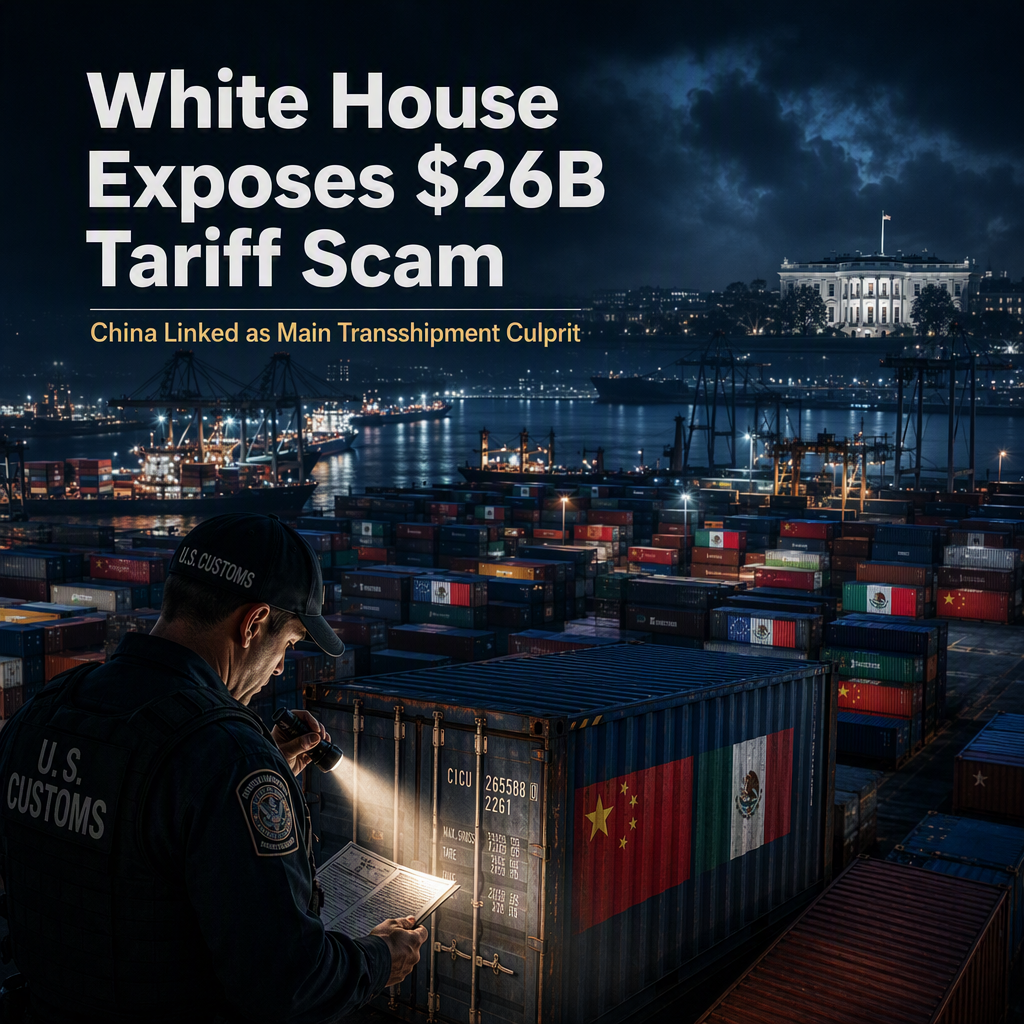
The White House has released a 25-page report titled 'The Great Transshipment Scam,' highlighting concerns that foreign exporters are routing goods through third countries to evade U.S. tariffs, a practice known as transshipment [1]. The report, produced by the White House Office of Trade and Manufacturing Policy led by Peter Navarro, identifies China as the most developed historical example of this practice, with other high-risk countries including Panama, Mexico, Colombia, Brazil, Argentina, Chile, Peru, Costa Rica, and the Dominican Republic [1].
According to the report, after the imposition of Section 301 tariffs on China in 2018, the direct U.S. trade deficit with China decreased in 2019 and 2020. However, Chinese exporters increasingly routed goods through third countries, using methods such as limited assembly, finishing, repackaging, relabeling, or documentation changes to disguise the true origin of products [1]. This has led to the creation of a global network of production hubs, logistics platforms, free-trade zones, bonded warehouses, processing corridors, and re-export centers [1].
The report estimates that tariff-avoiding transshipment costs the U.S. Treasury between $19 billion and $26 billion in revenue annually, with the total value of goods transshipped to avoid tariffs ranging from $34.2 billion to $303 billion each year, based on government and private-sector estimates [1]. Peter Navarro stated that the Trump administration has taken steps to strengthen transshipment enforcement, including the use of artificial intelligence by U.S. Customs and Border Protection in a prototype program to detect transshipment [1]. Importers found to have falsified a product’s origin can face retroactive tariffs for roughly a year [1].
Navarro also indicated that new trade frameworks being pursued by the Trump administration will include provisions to penalize trading partners that engage in transshipment, and that countries such as India could also use this practice to avoid tariffs [1]. The report's release comes ahead of a planned September visit to Washington by Chinese President Xi Jinping, following President Donald Trump’s visit to Beijing in May [1].
CONCLUSION
The White House report exposes significant revenue losses due to transshipment, with China identified as the primary source of the problem. The Trump administration is responding with enhanced enforcement measures and plans to penalize trading partners involved in such practices. The issue is likely to remain a focal point in upcoming U.S.-China trade discussions.