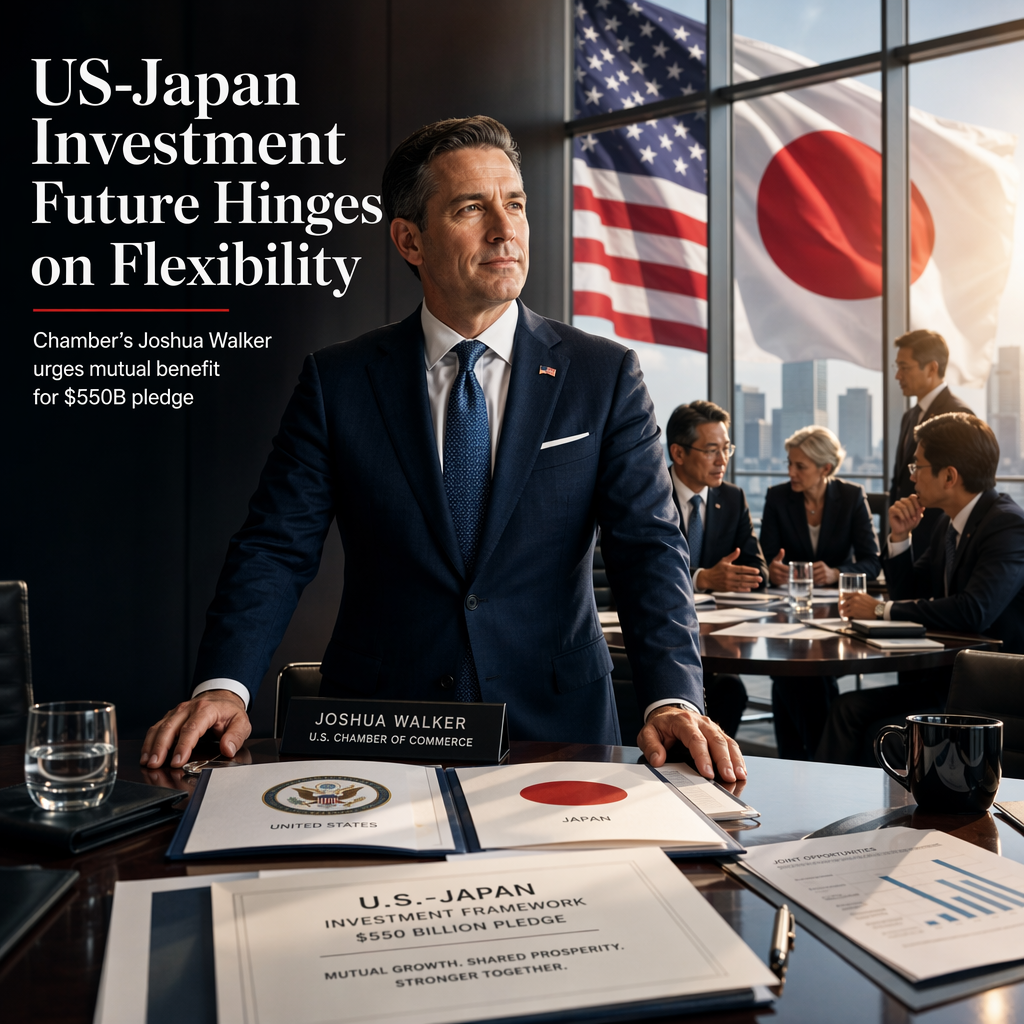
Joshua Walker, who is set to become the chief international officer of the U.S. Chamber of Commerce after leaving the Japan Society at the end of July, has urged Japan to adopt a more flexible approach regarding its $550 billion investment pledge in the United States [1]. Walker emphasized that the success and longevity of this large-scale investment depend on it remaining mutually beneficial, especially in the context of changing U.S. administrations. He warned that Japanese firms are unlikely to continue investing if the commitments are perceived as coerced, underscoring the need for voluntary and reciprocal investment strategies [1].
Walker stated, 'Japan's $550 billion investment initiative in the U.S. must remain mutually beneficial for it to endure beyond the Trump administration' [1]. His remarks highlight ongoing concerns about the sustainability of Japan's significant investment in the U.S. and the importance of maintaining open dialogue between the two countries to ensure the arrangement's long-term viability [1].
The future of Japan’s large-scale U.S. investment remains a key issue in bilateral economic relations, and Walker’s comments suggest that both sides should prioritize flexibility and mutual benefit to avoid potential disruptions or reversals in the investment flow [1]. No specific market reactions or analyst forecasts were mentioned in the article.
CONCLUSION
Joshua Walker's call for flexibility in Japan's $550 billion U.S. investment pledge underscores the importance of voluntary, mutually beneficial arrangements for long-term sustainability. The future of this significant investment will depend on ongoing dialogue and adaptability between Japan and the U.S.