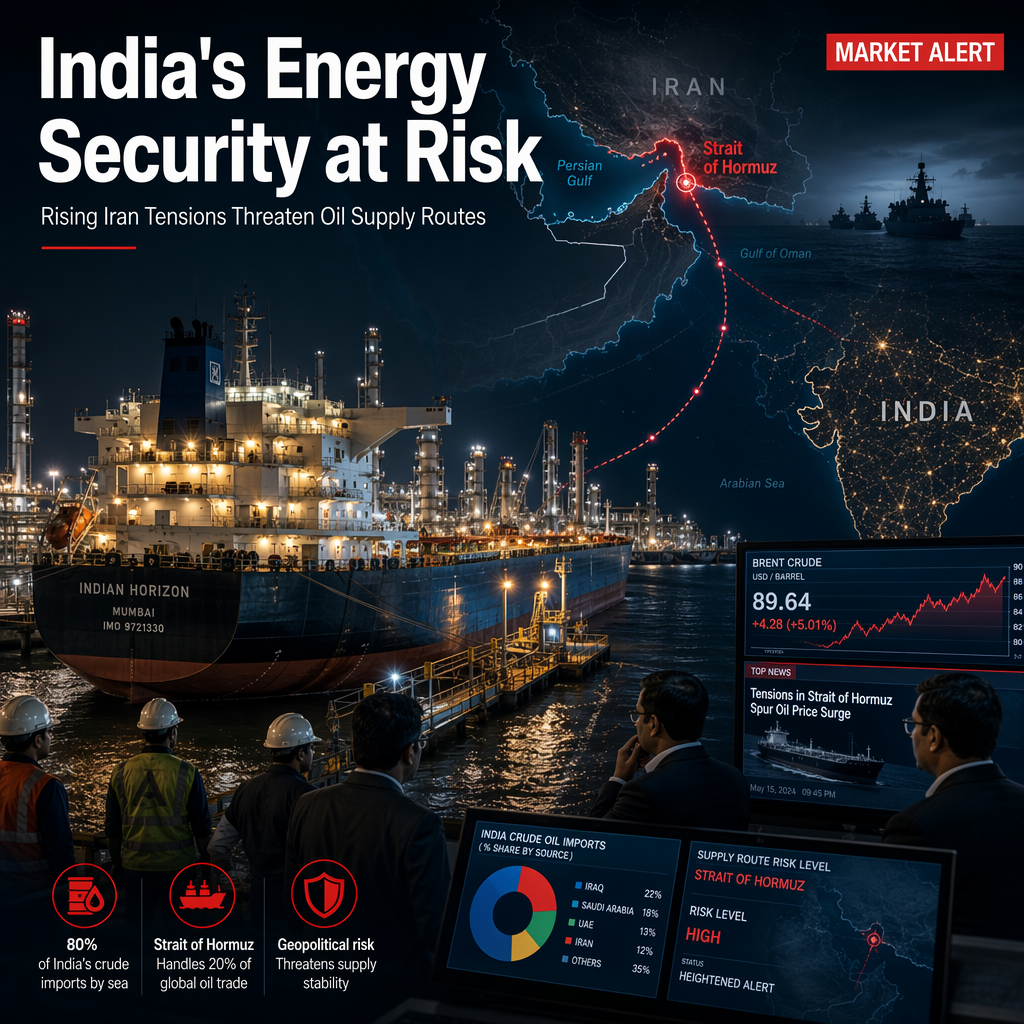
India's energy security is under increased pressure as geopolitical tensions escalate in the Middle East, particularly involving Iran [1]. The country, which is the world's third-largest oil importer, is heavily dependent on crude oil supplies that transit the Strait of Hormuz—a strategic chokepoint adjacent to Iran that handles about 20% of global oil trade [1]. Any disruption or even the threat of disruption in this region has the potential to unsettle markets, drive up oil prices, and highlight India's vulnerability [1].
In response to recent instability and tightened US sanctions on Iranian oil, India has diversified its crude import sources. The share of Russian oil in India's imports surged to over 35% in early 2026, a significant increase from less than 2% before the Ukraine war, as India capitalized on discounted Urals crude. Additionally, India has sought more cargoes from the US and Latin America to mitigate immediate risks [1].
Despite these efforts, the risk of further escalation with Iran remains a concern. Analysts warn that if hostilities break out, Brent crude prices could spike above $100 per barrel, compared to the current range of $82–$86 [1]. Indian refiners are already facing higher freight and insurance costs for Middle East cargoes, and rerouting shipments has increased logistical expenses. The government has increased its strategic oil reserves from the equivalent of 10 days of net imports to about 13 days, but this buffer is still modest compared to major OECD countries [1].
Market sentiment is described as cautious, with traders closely monitoring the situation for signs of escalation. Technical analysts note that Brent crude faces resistance at $90 and support near $80, and expect volatility to rise if tensions worsen [1]. Policymakers in India are considering further diversification of supply sources and accelerating investments in renewables to insulate the economy from potential oil shocks, but with over 80% of its oil needs met through imports, India's energy resilience remains a concern as long as Middle East tensions persist [1].
CONCLUSION
India's energy security is facing renewed scrutiny as tensions with Iran threaten the stability of oil supplies through the Strait of Hormuz. While diversification efforts and increased strategic reserves have provided some buffer, the risk of price spikes and market volatility remains significant. Policymakers and market participants are maintaining a cautious outlook as the situation develops.