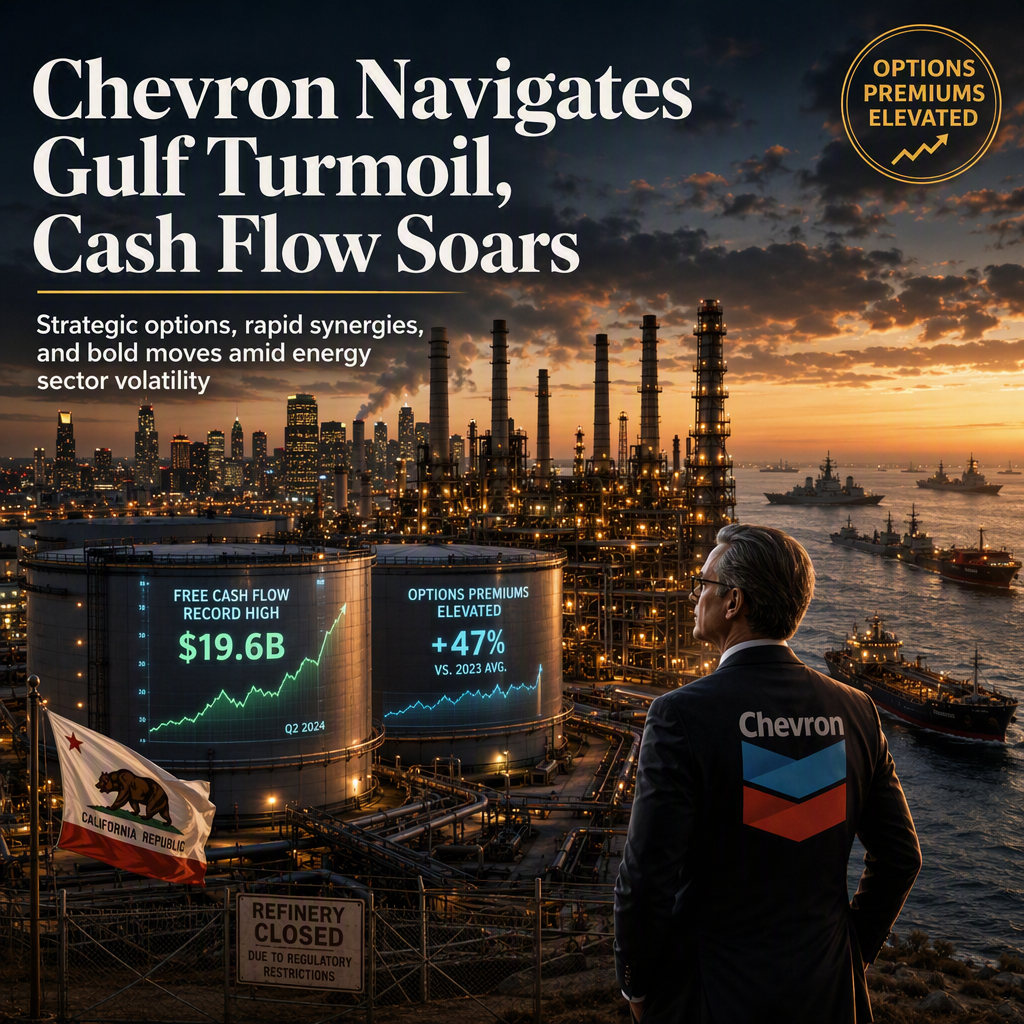
Chevron is capitalizing on ongoing military conflict in the Gulf, which has led to elevated options premiums and increased uncertainty in the energy sector. The company generated approximately $18 billion-plus in free cash flow in the most recently reported quarter, and currently trades at less than 14 times forward price-to-earnings, despite its stock price being roughly unchanged from late 2022 and early 2023. This is notable given Chevron's improved operating results and outlook, with both oil prices and crack spreads expected to remain elevated, supporting continued strong cash flow and a forward multiple below 14 times earnings [1].
Chevron has also reported that the $1.5 billion in run-rate synergies from its Hess acquisition are being realized faster than management initially guided. The company is addressing regulatory risks by announcing a move of its corporate headquarters from San Ramon, California, to Houston, and has indicated the possibility of closing refineries in Richmond and El Segundo, following the lead of other companies. Despite these risks, the current valuation is seen as compensating investors appropriately, and there is potential for compromise with local politicians due to the risk to California residents if refining capacity for proprietary blends declines further [1].
Options strategies are highlighted as particularly attractive in the current environment. Selling the October $180 put for $4.75 (about 2.6% of the strike price) offers a probability of profit above 72%, with a maximum profit of $475 per contract and an effective cost basis of $175.25 if assigned, which is about 7.5% below the current price or 13x forward earnings. This trade structure allows investors to profit if the stock rises, stays flat, or even declines moderately, given the elevated implied volatility in CVX options due to Gulf-related disruptions [1].
CONCLUSION
Chevron is navigating Gulf-related uncertainty and regulatory risks with strong free cash flow, accelerated synergy realization from the Hess acquisition, and strategic options trades. Elevated options premiums and a compelling valuation provide investors with attractive risk-adjusted opportunities, while the company’s operational and strategic moves position it well for continued resilience.