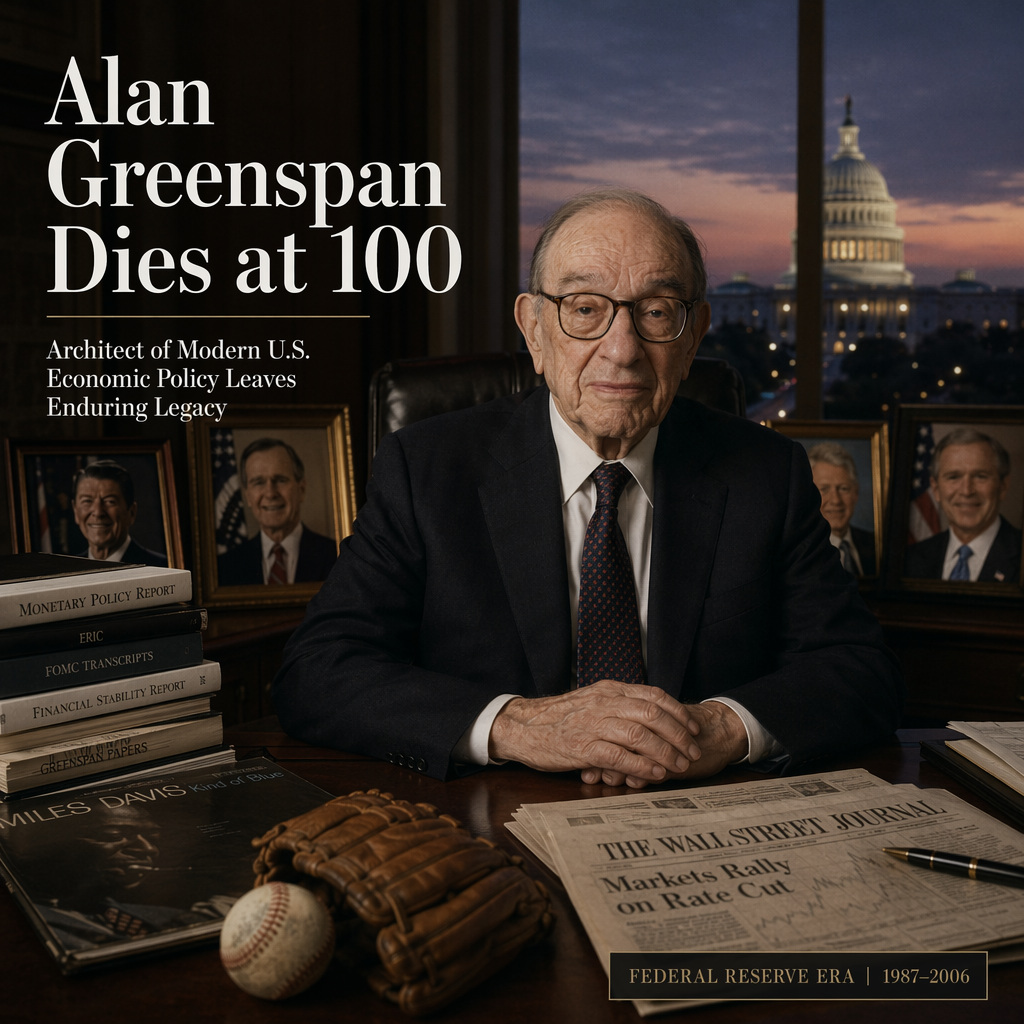
Alan Greenspan, the influential economist and longtime chairman of the Federal Reserve, died at the age of 100 on Monday, according to a statement from his wife, Andrea Mitchell, who is the chief Washington correspondent and chief foreign affairs correspondent for NBC News [1]. Greenspan passed away at home due to complications of Parkinson’s Disease [1].
Greenspan served five terms as chairman of the Federal Reserve under four U.S. presidents, guiding U.S. monetary policy through significant periods, including one of the longest economic expansions in U.S. history from 1991 to 2001 [1]. He was both praised for his role in shaping modern American capitalism and criticized for decisions, such as advocating for deregulation of the financial sector, which some say contributed to the conditions leading to the global financial crisis of 2007-08 [1].
Born on March 6, 1926, in New York City, Greenspan demonstrated early mathematical talent and pursued economics at New York University, later working under economist Arthur F. Burns at Columbia University [1]. He was also influenced by Ayn Rand, whose philosophy of self-interest and laissez-faire capitalism shaped some of his economic views [1]. Greenspan led the economic consulting firm Townsend-Greenspan Co., Inc., and began his political advisory career with Richard Nixon’s 1968 presidential campaign [1].
Andrea Mitchell described Greenspan as a "giant of a man who helped shape the U.S. economy for decades under presidents of both parties, but was always honest in acknowledging his mistakes" [1]. She also highlighted his personal passions, including baseball, the Washington Commanders, tennis, golf, and jazz music [1].
No immediate market reaction or analyst opinions were discussed in the article. The article focuses on Greenspan’s legacy and personal life, rather than short-term market implications [1].
CONCLUSION
Alan Greenspan’s death marks the end of an era for U.S. economic policy, as he was a central figure in shaping monetary policy for decades. While his legacy is mixed, with both praise and criticism, his influence on American capitalism and the Federal Reserve remains significant. No immediate market impact or analyst commentary was provided in the article.