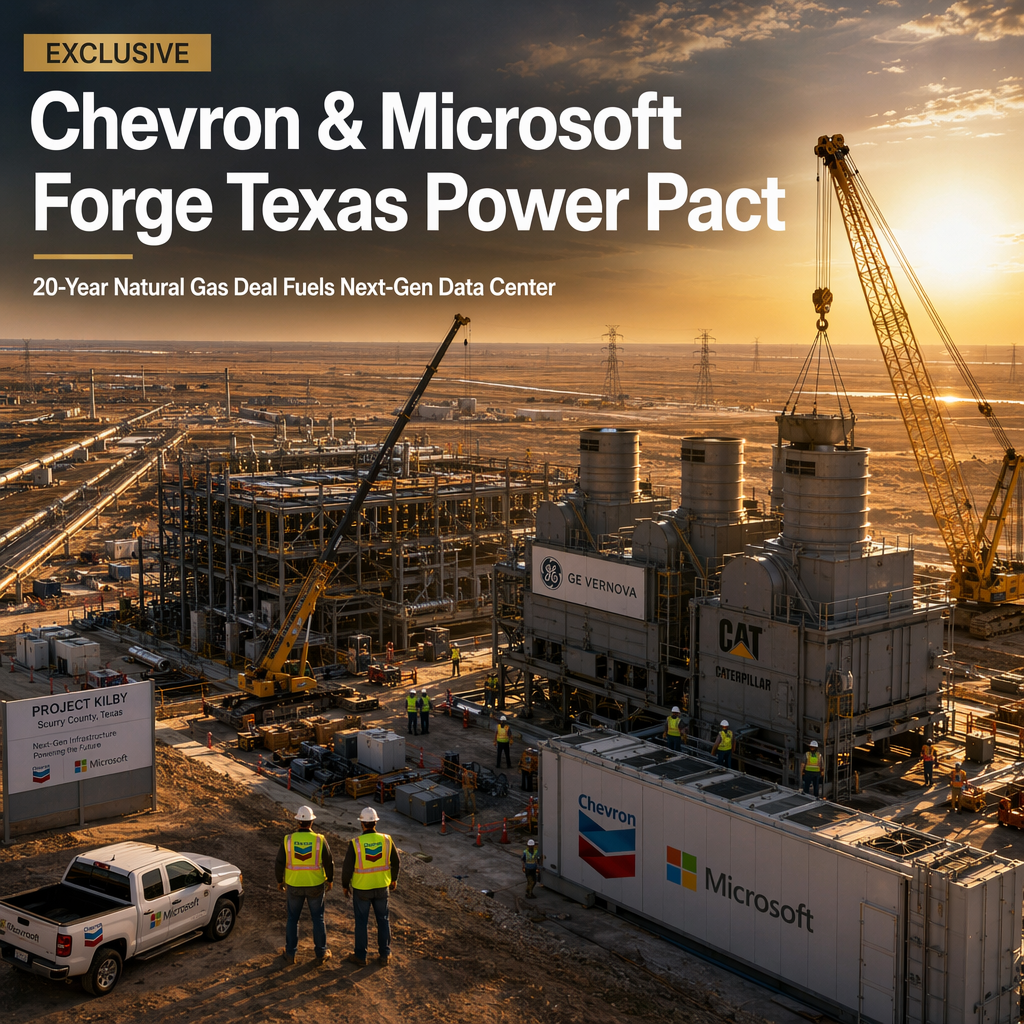
Chevron announced a 20-year agreement to supply natural gas to a massive Microsoft data center in West Texas, known as Project Kilby, marking a significant collaboration between the energy and technology sectors [1]. The data center is projected to require nearly 2.7 gigawatts of electricity, an amount equivalent to the power needs of about 2 million homes [1]. Most of this electricity will be generated on-site using large gas turbines provided by GE Vernova, with additional turbines supplied by Caterpillar [1].
Project Kilby has not yet begun construction in Reeves County, Texas. Chevron stated that a final investment decision on the project is expected later this year, with the data center anticipated to begin receiving power in 2028 [1]. This long-term deal highlights Microsoft's evolving energy strategy: while the company has primarily invested in renewable and nuclear energy to reduce carbon emissions from its data centers, this agreement demonstrates a willingness to utilize natural gas to meet the surging power demands of its operations [1].
The partnership underscores the growing energy requirements of large-scale data centers and signals a potential shift in how technology companies address their sustainability goals amid increasing demand. Market implications are significant, as the deal involves major players in both the energy and technology industries and could influence future energy sourcing decisions for data centers [1].
CONCLUSION
Chevron and Microsoft’s 20-year natural gas agreement for Project Kilby represents a major step in meeting the escalating energy needs of data centers. The deal signals a pragmatic approach by Microsoft, balancing sustainability goals with operational demands, and could set a precedent for future collaborations between the energy and tech sectors.