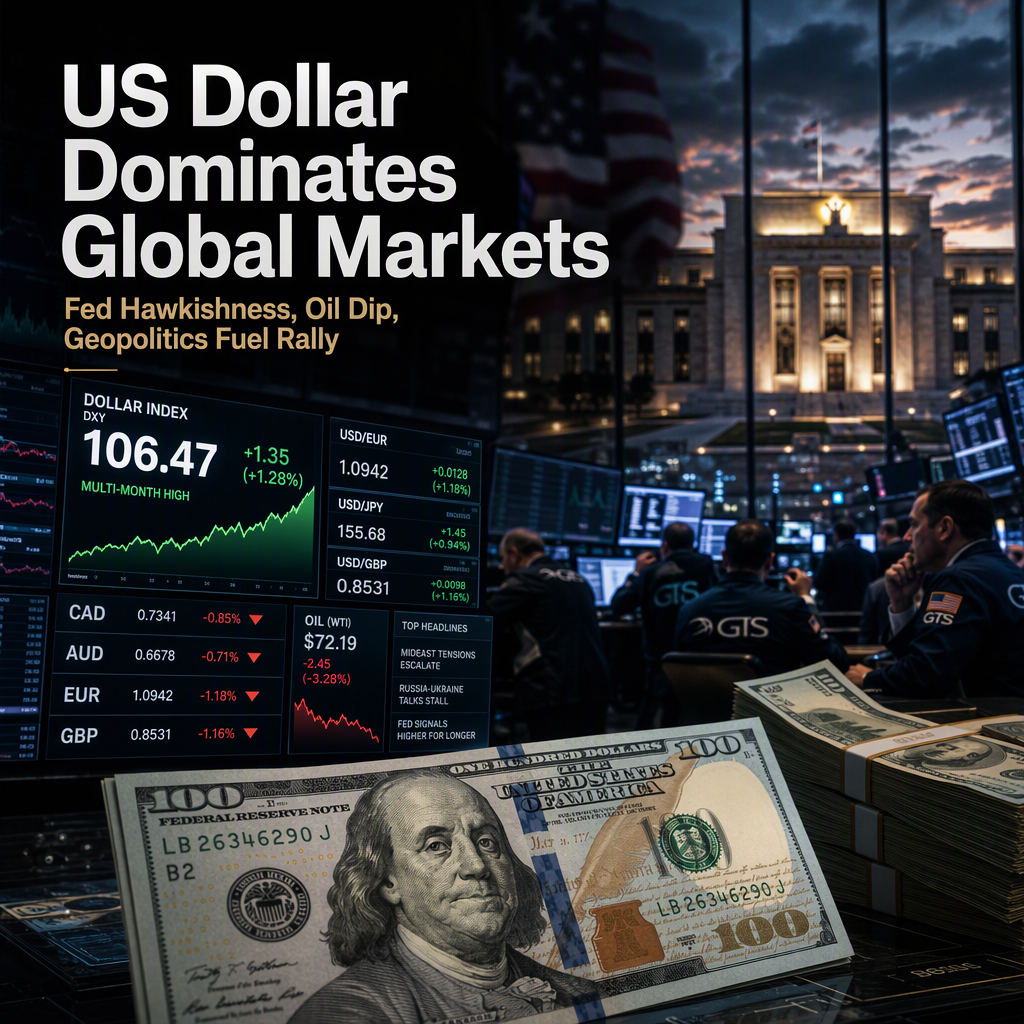
The US Dollar (USD) extended its rally against major currencies, reaching its highest levels since late July, as the Federal Reserve's hawkish policy stance and evolving geopolitical dynamics shaped global FX markets on Wednesday [1][2][3][4]. The Federal Reserve recently raised its benchmark interest rate by 25 basis points to the 3.75%-4.00% range and signaled another hike before year-end, with policymakers such as Boston Fed President Susan Collins and St. Louis Fed President Alberto Musalem emphasizing the risk of inflation remaining above the 2% target [1][2][3][4]. Market participants are now pricing in an 89.2% probability of a December rate increase, according to the CME FedWatch Tool [2][3].
The Canadian Dollar (CAD) weakened as USD/CAD traded around 1.4070-1.4075, near its highest since July 29, driven by a sharp decline in crude oil prices and a bullish USD backdrop [1]. West Texas Intermediate (WTI) crude fell to a two-week low amid hopes for a diplomatic resolution to the US-Iran conflict, with Iran reportedly offering to unblock the Strait of Hormuz in exchange for US military de-escalation [1][4]. This development eased supply concerns and inflation fears, keeping US bond yields below multi-year highs and capping further USD gains [1][4]. Technical analysis suggests a bullish near-term bias for USD/CAD, with resistance at 1.4137 and support at 1.4051 [1].
The Australian Dollar (AUD) also came under pressure, with AUD/USD trading around 0.7110 after Australia's preliminary September PMI data showed a broad-based slowdown: Manufacturing PMI fell to 49.3 from 52.0, Services PMI eased to 51.4 from 53.2, and Composite PMI dropped to 50.8 from 52.7 [2]. The Fed's hawkish outlook and rising US yields further weighed on the AUD, as the FXS Fed Sentiment Index rose by 0.53 points to 150.49, reflecting stronger conviction for sustained restrictive policy [2].
The Euro (EUR) weakened below 1.1450, with EUR/USD trading near 1.1445, as the Fed's hawkish signals and German political risks pressured the currency [3]. The far-right Alternative for Germany (AfD) party's electoral gains led to the worst regional election defeat for Chancellor Friedrich Merz’s coalition, increasing political uncertainty in Germany [3]. However, strategists at Scotiabank noted that the decline in oil prices is positive for the Eurozone, given its dependence on energy imports, and that yield spreads remain supportive for the EUR, with a fair value estimate just above 1.15 [3].
The British Pound (GBP) hovered near late July lows against the USD, with GBP/USD trading below the mid-1.3300s. The BoE's cautious stance amid stagflation fears contrasted with the Fed's hawkishness, contributing to GBP underperformance [4]. The pair remained vulnerable, with technical resistance at 1.3343 and support at 1.3253 [4]. Traders awaited UK and US flash PMI releases and further FOMC commentary for fresh direction [4].
Across all markets, the combination of a hawkish Fed, softer oil prices due to Middle East diplomatic developments, and political risks in Europe and the UK created a risk-off environment favoring the US Dollar. Market participants remained focused on upcoming PMI data and geopolitical headlines for further cues [1][2][3][4].
CONCLUSION
The US Dollar's strength was reinforced by the Federal Reserve's hawkish outlook and rising expectations for another rate hike, while falling oil prices and geopolitical developments further pressured commodity-linked and risk-sensitive currencies. Major pairs such as USD/CAD, AUD/USD, EUR/USD, and GBP/USD all reflected this dynamic, with technical and fundamental factors suggesting continued USD dominance in the near term. Traders are closely watching upcoming PMI releases and geopolitical news for the next market-moving catalysts.