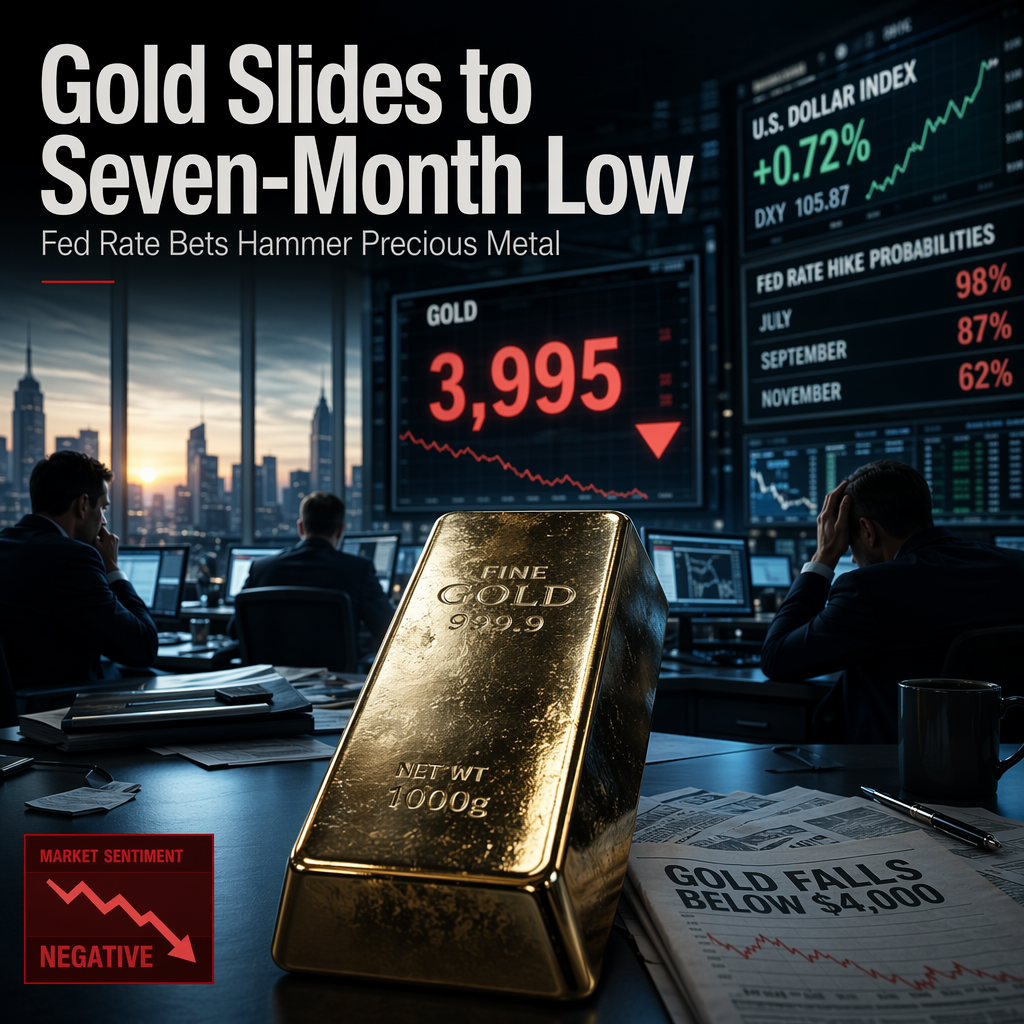
Gold prices (XAU/USD) fell to approximately $3,995 during the early Asian session on Thursday, marking the first time the precious metal has dropped below the $4,000 psychological level since November 2025. This decline is attributed to increased expectations of higher US interest rates and a strengthening US Dollar, following hawkish signals from the US Federal Reserve at its June policy meeting and ongoing concerns about inflationary pressures related to the Iran war [1].
Market participants have notably increased their bets on further US rate hikes this year. According to the CME FedWatch tool, the probability of a 25-basis-point hike at the July meeting has risen to 34.2%, up from 8.5% a week ago, while the likelihood for a September hike has climbed to 66.4% from 29.1% [1]. Darwei Kung, head of commodities at DWS Group, commented that 'Gold is clearly trading in sympathy with market expectation on rate rising in the US,' highlighting the influence of Federal Reserve Chair Kevin Warsh's focus on inflation in shaping these expectations [1].
Traders are now closely watching the upcoming US May Personal Consumption Expenditures (PCE) data, the Fed’s preferred inflation measure, which is set to be released later on Thursday. Any indication of easing inflation could potentially weaken the US Dollar and provide some support to gold prices, as gold is denominated in USD [1].
The current environment, where gold is less attractive due to its lack of yield compared to interest-bearing assets, has contributed to the metal's recent weakness. The market's focus remains on inflation data and the Fed's monetary policy outlook for further direction [1].
CONCLUSION
Gold's drop below $4,000 reflects heightened market expectations for further US rate hikes and a stronger US Dollar. The upcoming US PCE inflation data is seen as a key catalyst for the next move in gold prices. Market sentiment remains negative for gold in the near term, pending further clarity on inflation and Fed policy.