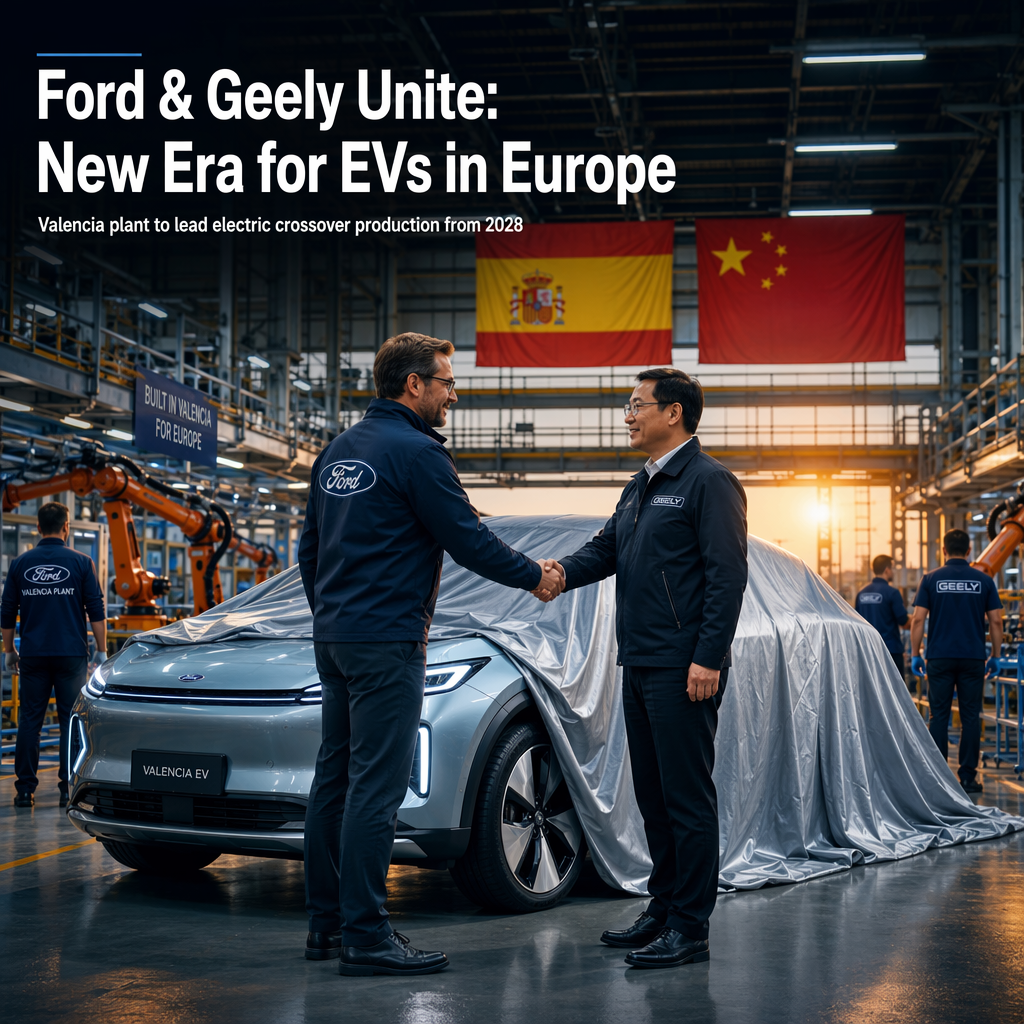
China's Geely and Ford Motor Company have announced a new manufacturing joint venture to produce electric vehicles (EVs) at Ford's plant in Valencia, Spain, with operations expected to begin in the first half of 2027, pending regulatory approvals [1]. The first vehicles from this collaboration are scheduled to roll off the production line in 2028 [1]. Ford will hold a 66% stake in the joint venture, while Geely will own 34% [1].
The joint venture will produce a new electric crossover for Ford, a new member of the Bronco family, and two electric SUVs for Geely, all starting production in 2028 [1]. Until then, the Valencia plant will continue manufacturing the Ford Kuga [1]. The companies stated that this partnership addresses the evolving European market, characterized by intense global competition, cost pressures, and tightening regulations, aiming to set a new cost benchmark for the industry [1].
This move follows months of reported negotiations and reflects a broader trend of legacy automakers partnering with Chinese companies to expand their global reach and competitiveness, particularly in Europe [1]. Ford CEO Jim Farley has previously emphasized the importance of partnerships to support Ford's global operations [1]. The announcement also comes amid increasing regulatory scrutiny in the U.S., with a Senate committee recently approving legislation to restrict Chinese automakers' access to the American market [1].
Geely's vice president, Alex Nan, highlighted the joint venture's commitment to delivering high-quality vehicles tailored for European customers and contributing to Europe's green future, emphasizing the local production aspect: "We are building cars in Europe, for Europe, alongside a trusted partner" [1].
CONCLUSION
Ford and Geely's joint venture marks a significant step in the European EV market, leveraging both companies' strengths to address competitive and regulatory challenges. With production set to begin in 2028 and a focus on local manufacturing, the partnership is poised to reshape the competitive landscape for electric vehicles in Europe.