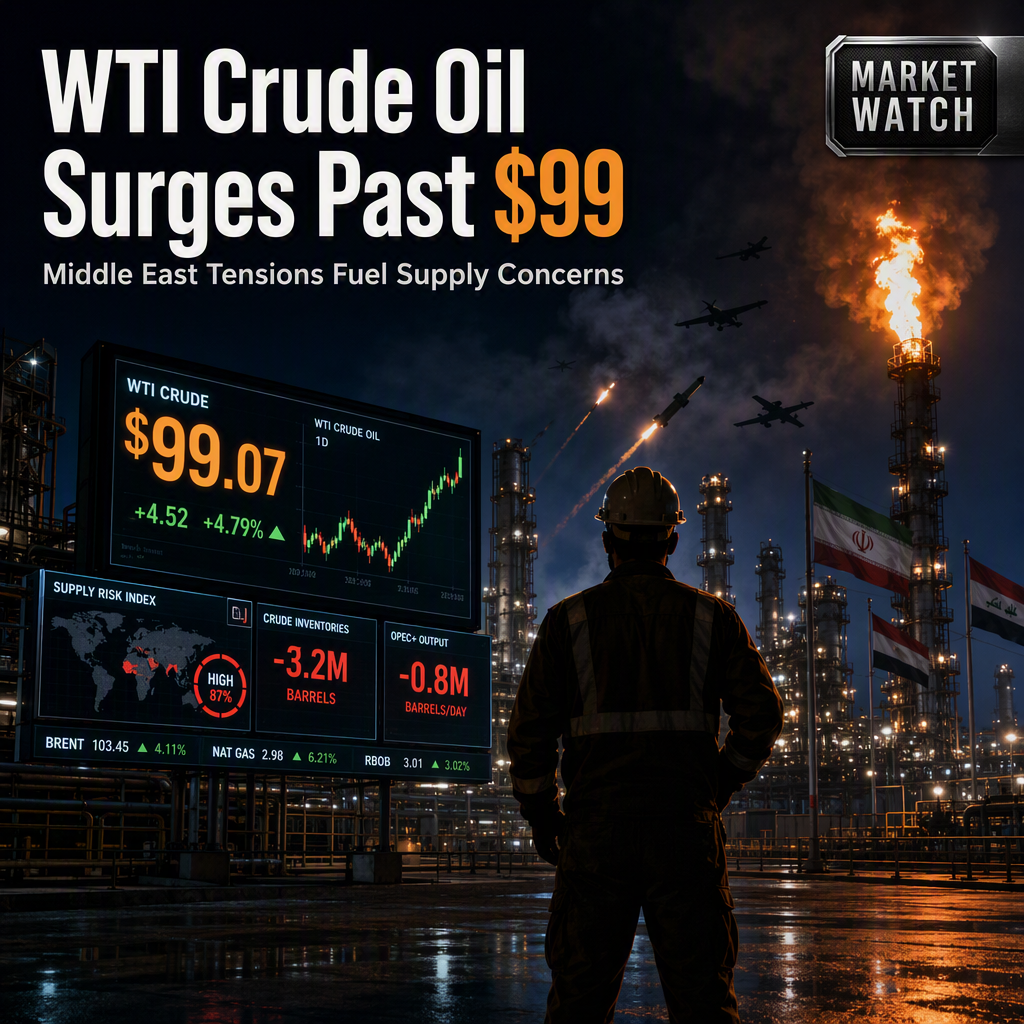
West Texas Intermediate (WTI), the benchmark US crude oil price, attracted renewed buying interest and climbed back above the $99.00 mark during the Asian session on Tuesday, following volatile price swings the previous day [1]. This move keeps WTI close to its highest level since May 21, which was reached last Friday, and signals further potential gains as supply concerns intensify due to ongoing Middle East tensions [1].
A key development fueling the bullish sentiment was a large-scale missile and drone attack by Iran-backed Houthis in Yemen on a Saudi air base in Khamis Mushait on Monday [1]. Additionally, Iranian Supreme National Security Council Secretary Mohsen Rezaei stated that Tehran will not return to negotiations with the US until its conditions are met, dampening hopes for a diplomatic resolution to the conflict and maintaining the geopolitical risk premium for crude oil prices [1].
From a technical perspective, the recent breakout above the $91.00 horizontal barrier, which also represented the 61.8% Fibonacci retracement level of the May-July corrective fall, has triggered fresh bullish momentum. The Relative Strength Index is hovering just below overbought territory at around 69, and the MACD remains positive, indicating persistent upside pressure as long as prices stay above the high-$90s area [1]. The next notable resistance is near the prior cycle high of $107.23, while initial support is seen at $98.57, followed by $91.78 and $87.01. Further pullbacks would encounter the 100-day SMA at $85.39, with additional Fibonacci support levels at $82.24 and $76.33 before the cycle low at $66.79 [1].
Market participants are closely watching these technical levels and geopolitical developments, as they continue to drive volatility and upward momentum in WTI prices. The ongoing Middle East crisis and lack of diplomatic progress suggest that supply risks and the geopolitical premium will remain key factors influencing crude oil markets in the near term [1].
CONCLUSION
WTI crude oil's surge above $99 reflects heightened supply concerns and geopolitical tensions in the Middle East, with technical indicators supporting further upside. The lack of diplomatic progress and recent attacks underscore persistent risks, suggesting continued volatility and elevated prices for crude oil in the short term.