
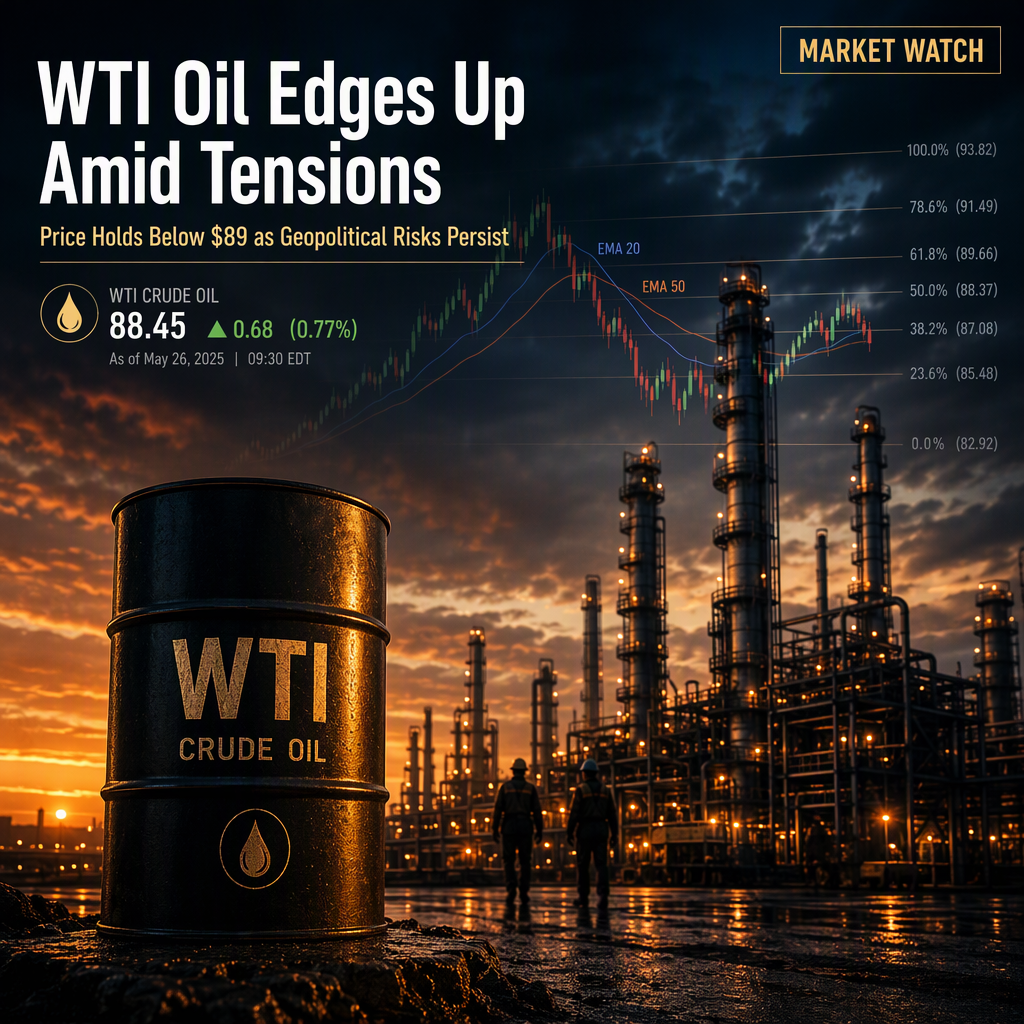
West Texas Intermediate (WTI), the benchmark US crude oil price, edged higher on Wednesday, reversing part of the previous day's heavy losses that had taken it to an over three-week low. WTI was trading around the $88.80 region, up just over 0.80% for the day, as market participants awaited further developments regarding the Middle East crisis [1]. Hopes for a diplomatic solution to the US-Iran conflict diminished after US President Donald Trump rejected a seven-day ceasefire proposal from Iran. Additionally, Qatari efforts to broker a breakthrough between the US and Iran made little progress during the week. US officials indicated that Trump could order a return to major combat after the midterm elections, maintaining the geopolitical risk premium and providing some support to crude oil prices. However, signs of recovering Middle East exports have capped the upside for WTI [1].
From a technical perspective, the overnight breakdown below the 200-period Exponential Moving Average (EMA) on the 4-hour chart was seen as a key trigger for bearish traders. The subsequent decline found support near the 61.8% Fibonacci retracement level of the August-September upswing. Momentum indicators remained soft, with the Relative Strength Index (RSI) just above the oversold band at 39 and the Moving Average Convergence Divergence (MACD) in negative territory [1].
Analysts noted that any further recovery in WTI would likely encounter selling pressure at the 200-EMA, around $89.78. A sustained break above this level could open the way toward the $90.57 Fibonacci barrier, with further resistance at the 38.2% retracement at $93.24, and higher levels at $96.54 and $101.87. On the downside, a drop below the 61.8% Fibonacci retracement at $87.90 would expose deeper support at the 78.6% retracement at $84.10 and the prior cycle base near $79.26 [1].
CONCLUSION
WTI oil prices showed a modest recovery but remained below the key $89 level, reflecting ongoing geopolitical tensions and technical resistance. While the risk premium from the Middle East crisis supports prices, recovering exports and bearish technical signals limit upside potential. Market participants are closely watching for further developments that could influence the next move.