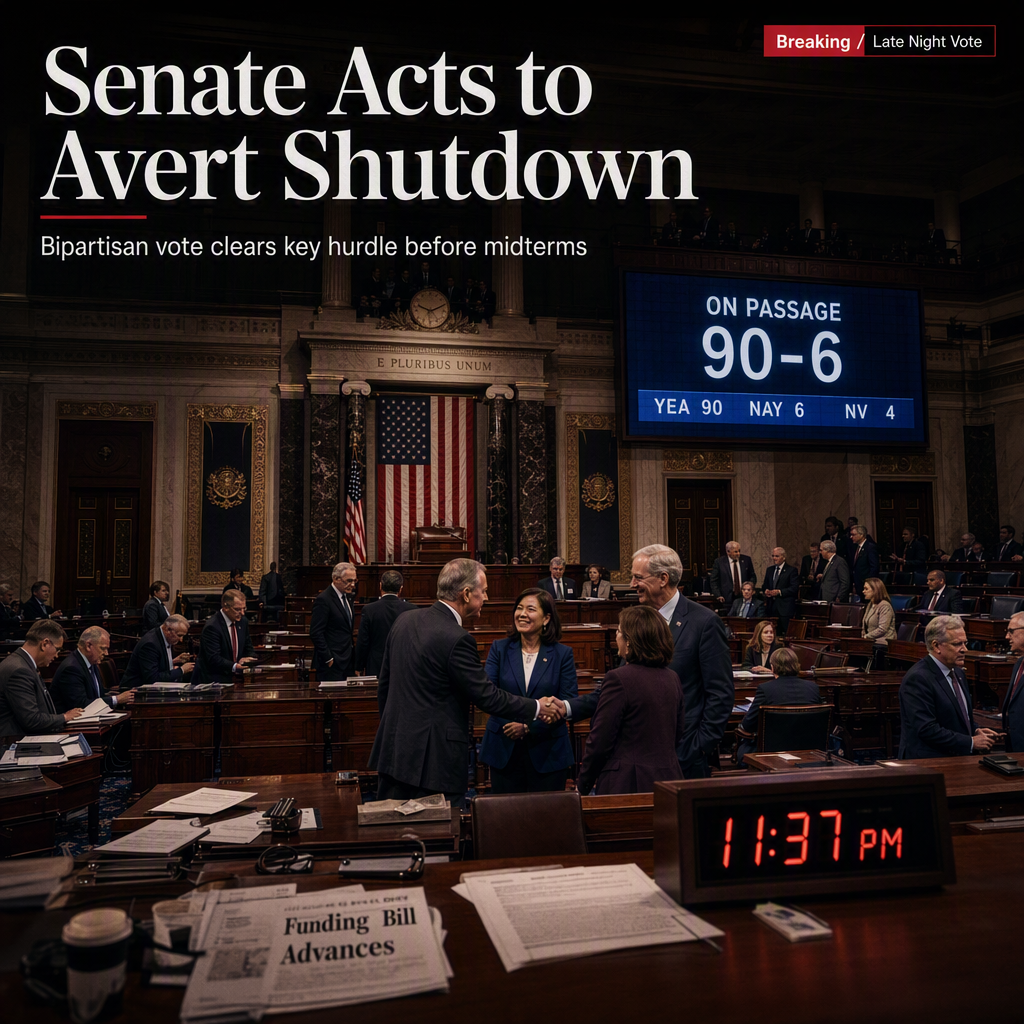
The U.S. Senate voted 90-6 in a late-night session to pass a short-term funding bill designed to prevent a government shutdown before the upcoming midterm elections [1]. The legislation will keep federal funding at existing levels through December 11, providing lawmakers additional time to negotiate a full-year funding agreement [1]. Key provisions in the bill include measures to preserve the SNAP and WIC food programs, disaster relief, and national security funding, as well as a Democratic-backed clause to prevent President Donald Trump from blocking federal grants to states for political reasons [1].
The bill now moves to the House of Representatives, which must approve it and send it to President Trump for his signature by September 30 to avoid a shutdown set to begin on October 1 [1]. The House had previously passed a different short-term funding bill before the August recess [1]. The Senate is expected to adjourn for the month after concluding remaining business [1].
The passage of the bill reflects bipartisan efforts to avoid the political risks associated with a government shutdown, particularly given the prevailing anti-incumbency sentiment among voters during the primary season [1]. Both parties are motivated to prevent brinkmanship that could have negative consequences ahead of the November 3 Election Day [1].
No specific market reactions or analyst opinions were mentioned in the article. However, the avoidance of a shutdown is generally seen as a stabilizing factor for markets, especially in the context of upcoming elections [1].
CONCLUSION
The Senate's passage of the short-term funding bill reduces the immediate risk of a government shutdown and signals bipartisan cooperation ahead of the midterm elections. The bill must still clear the House and be signed by President Trump before the September 30 deadline to ensure continued government operations. This development is likely to be viewed positively by markets seeking stability during a politically sensitive period.