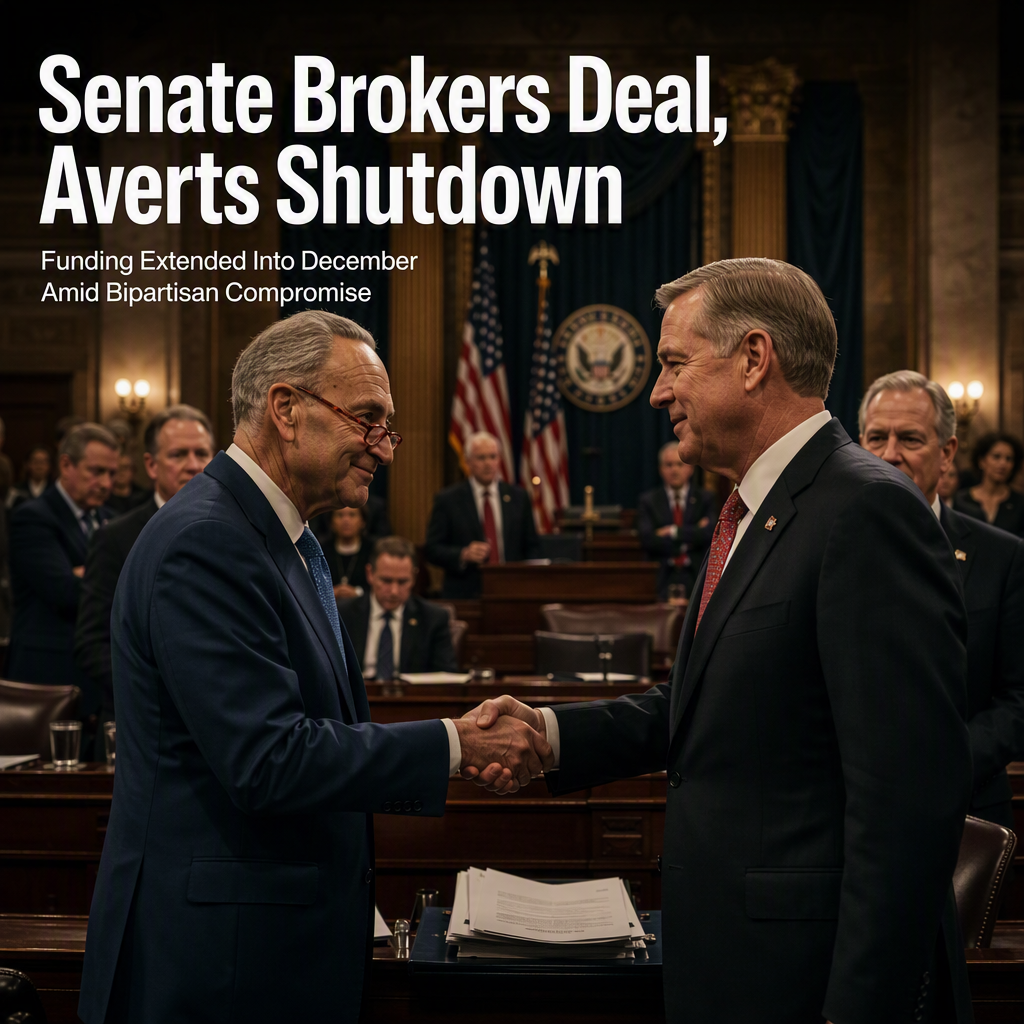
The Senate advanced a bipartisan solution to avert a government shutdown on Saturday, ending several months of uncertainty regarding federal funding and political maneuvering between Democrats and Republicans [1]. Senate Minority Leader Chuck Schumer, D-N.Y., and his caucus agreed to a bargain with Republicans to keep the government funded well past Election Night and into early December [1]. This move was described as an 'about-face' by Senate Majority Leader John Thune, R-S.D., who suggested it was a political calculation by Democrats to avoid defending against Republican attacks over a potential shutdown in the months leading up to the election [1].
Schumer argued that Democrats had consistently aimed to keep the government open and claimed victory by securing key concessions from the Trump administration, specifically regarding a rule change to federal grants included in the bipartisan continuing resolution (CR) [1]. He stated, 'Today, [this] CR gives us the breathing room necessary to work out a budget that helps make life more affordable to working families and reigns in Trump's rampant chaos, his rampant corruption' [1].
Republicans, however, have maintained a narrative that Democrats would not hesitate to allow a shutdown, referencing previous shutdowns lasting 43 and 76 days, and have pushed for measures such as lawmakers foregoing their paychecks in the event of a closure [1]. Thune noted that the political climate did not favor Democrats this time, and that avoiding a shutdown was seen as beneficial for their election prospects [1].
While the Senate has resolved the immediate threat of a shutdown, the issue now moves to the House, where negotiations to fund the government through the appropriations process will continue. If the continuing resolution passes, it will provide lawmakers with additional time to reach a broader funding agreement, though this will occur during the post-midterm election lame duck period, potentially reducing the appetite for a comprehensive deal [1].
CONCLUSION
The Senate's bipartisan agreement to avert a government shutdown extends funding into early December, providing temporary stability and time for further negotiations. While the immediate risk of a shutdown has been avoided, uncertainty remains as the process shifts to the House and the post-election period. Market participants may view the outcome as a short-term positive, but longer-term fiscal clarity is still pending.