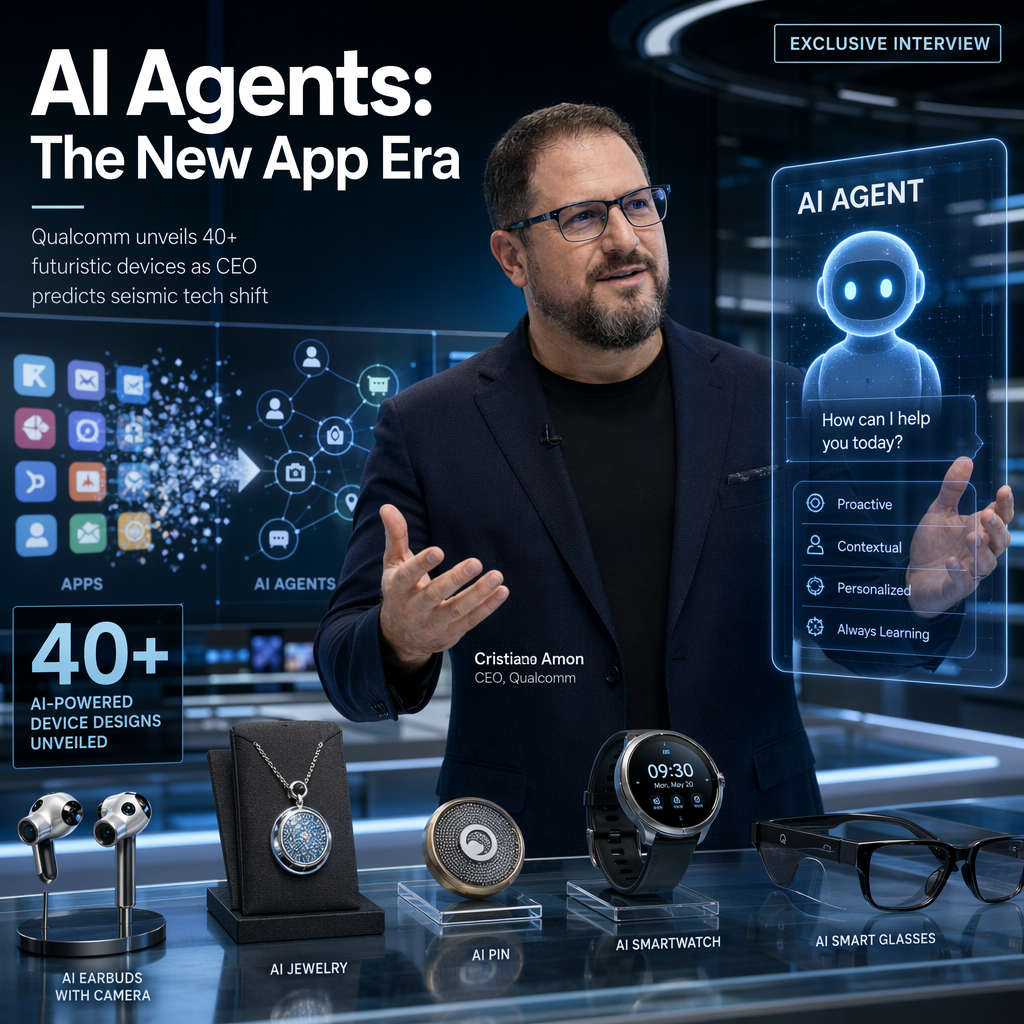
Qualcomm CEO Cristiano Amon announced a major shift in the consumer technology landscape, predicting that AI agents will replace traditional apps as the primary interface for users. In an interview on The Tech Download podcast, Amon stated, 'Apps are going to change,' and emphasized that 'agents are going to be the new app' [1]. Qualcomm is currently developing over 40 different designs of AI-powered gadgets, including wearable devices such as jewelry, earbuds with cameras, pins, and watches [1].
Amon illustrated the future of AI agents with a scenario where a user, wearing smart glasses with a built-in camera and display, can verbally instruct a digital assistant to make a restaurant reservation. The AI agent would coordinate across multiple apps—such as booking, payment, and email services—to complete the task seamlessly [1]. He clarified that while 'apps are not dead,' their role will fundamentally change as agents become the central hub for user interaction [1].
The CEO highlighted that the evolution of digital assistants, powered by advanced AI models, is making them more capable than previous iterations like Apple's Siri or Samsung's Bixby [1]. This technological progress is expected to drive the emergence of new device categories centered around AI agents, potentially reshaping the market for consumer electronics [1].
Amon expressed particular optimism about smart glasses, suggesting they could eventually rival the smartphone market, which saw over 1.2 billion units shipped last year [1]. He also noted that the widespread adoption of AI agents will depend on achieving the right balance between privacy and functionality, given the pervasive nature of these technologies [1].
CONCLUSION
Qualcomm's CEO is positioning the company at the forefront of a paradigm shift from traditional apps to AI agents, with over 40 new AI-powered devices in development. This vision signals significant market implications for device manufacturers and software ecosystems, especially as AI agents become more integrated into daily life. The success of this transition will hinge on consumer acceptance and the industry's ability to address privacy concerns.