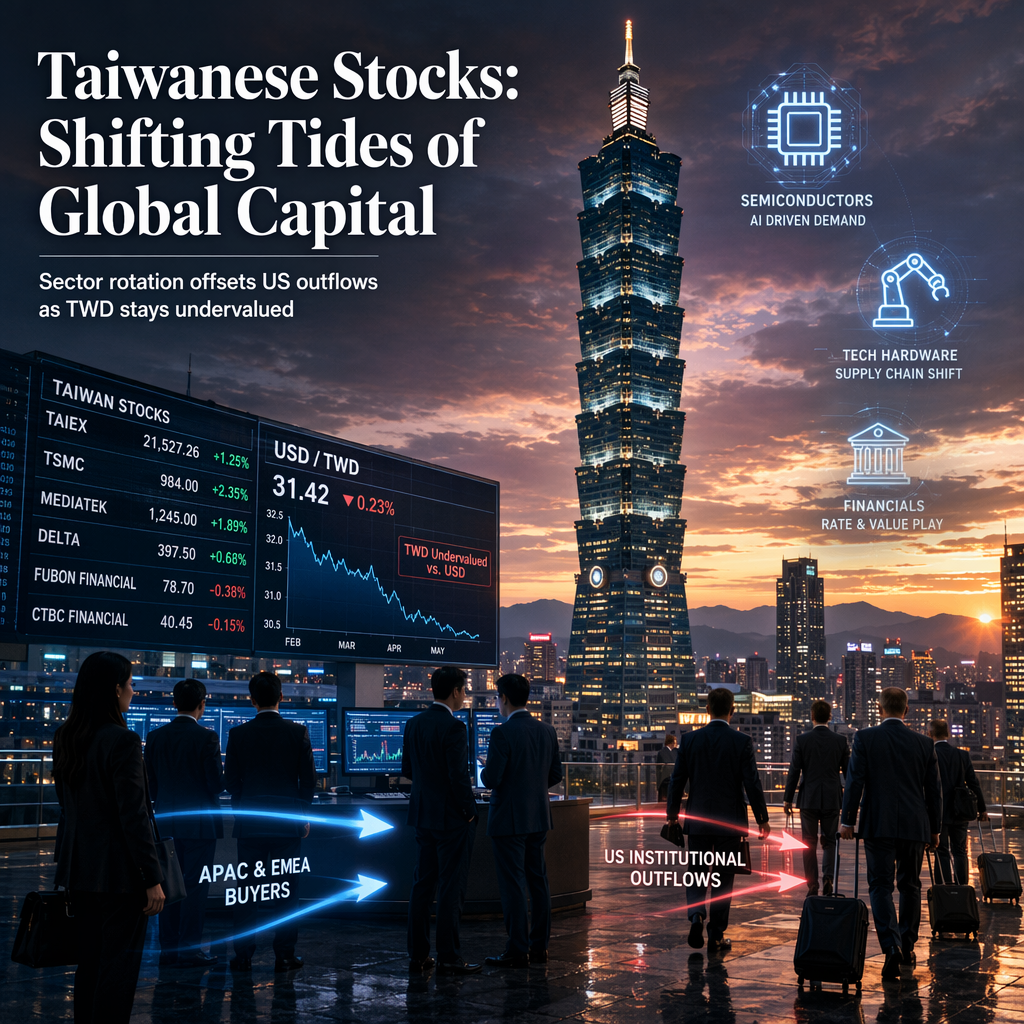
According to Geoff Yu at BNY, Taiwan's strong equity performance in 2026 has coincided with net institutional outflows, primarily from U.S. pension funds and hedge funds, while investors from APAC and EMEA regions have provided support [1]. Year to date, Taiwanese equities experienced $1.73 billion in net institutional outflows, with the Americas accounting for $4.33 billion in net sales. U.S. pension funds and hedge funds contributed nearly 75% of the total selling from the Americas [1].
Despite heavy selling in the semiconductor sector amounting to $5.59 billion, this was offset by buying in Technology Hardware ($3.74 billion), Capital Goods ($232 million), and Banks ($132 million), indicating that investors were rotating their positions rather than exiting the Taiwanese market wholesale [1]. By investor type, pension funds (-$3.12 billion) and hedge funds (-$1.78 billion) were the main sellers, while government and agency accounts bought $906 million. The selling in Taiwan was less driven by mutual funds and more concentrated among pensions and hedge funds compared to South Korea [1].
TWD foreign exchange activity remains subdued and is tied more to periodic rebalancing than outright directional equity demand. Spot volumes, which track equity purchases more directly, are below the rolling one-year average. The TWD continues to screen as fundamentally undervalued, which helps explain why investor interest has persisted even without meaningful FX appreciation [1].
Overall, the market implications suggest rotational flows rather than a wholesale exit, with continued investor interest supported by the undervaluation of the TWD and sector-specific buying offsetting heavy selling in semiconductors [1].
CONCLUSION
Taiwan's equity market is experiencing rotational flows, with significant outflows from U.S. pension funds and hedge funds balanced by sector-specific buying and support from APAC and EMEA investors. The TWD remains undervalued, and subdued FX activity indicates ongoing investor interest despite muted currency appreciation. The market impact is medium, reflecting a nuanced shift rather than a broad exit.