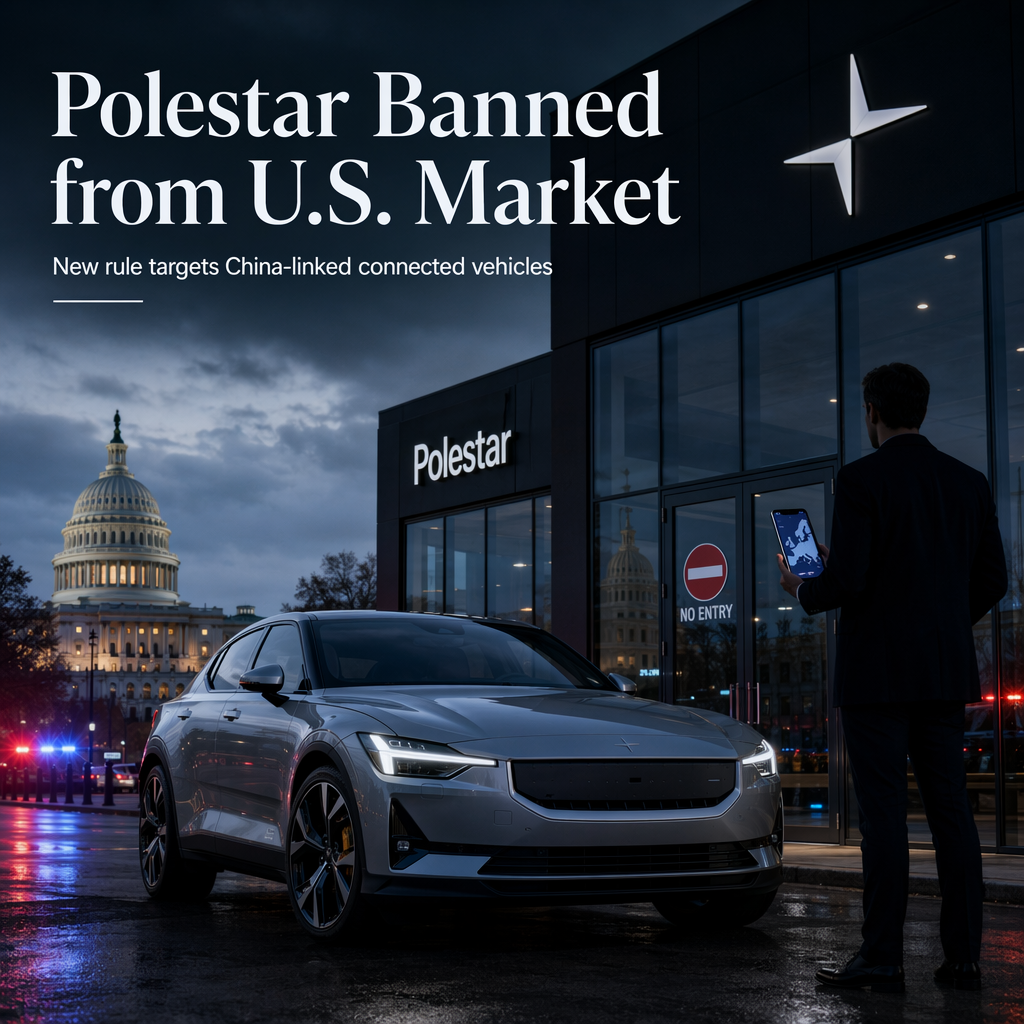
Polestar, the Sweden-based electric vehicle maker majority owned by China's Geely Holding Co., announced it will be banned from selling vehicles in the U.S. starting with the 2027 model year due to a new regulation targeting China-linked connected vehicles [1]. The U.S. Commerce Department's Bureau of Industry and Security (BIS) declined to grant Polestar authorization under the Connected Vehicles Rules, which restrict the importation and sale of cars with connected vehicle technology linked to China, citing national security concerns over the collection of sensitive data on American owners [1]. The rule, which covers technologies such as Bluetooth, wireless internet, cellular connectivity, and some satellite communications, was first adopted in January 2025 before the end of the Biden administration and remains in effect under President Donald Trump [1].
Polestar CEO Michael Lohscheller stated that the company will shift its corporate strategy to focus more on Europe, which accounted for 94% of its retail sales volumes in the first quarter of 2026 [1]. Lohscheller emphasized that Europe is Polestar's largest growth engine and announced plans to manufacture the Polestar 7 in Europe [1]. He also highlighted record sales in 2025 and the first quarter of 2026, with several new market launches in Europe and continued investment in Southeast Asia, Eastern Europe, Latin America, and Canada [1].
Following the Commerce Department's decision, Polestar will continue to sell its existing stock of Polestar 3 and Polestar 4 vehicles in the U.S. and support customers through its service network [1]. The company has faced financial challenges, requiring repeated capital injections from Geely and experiencing a sharp decline in share price, which led to a reverse stock split last year to maintain its Nasdaq listing [1]. On the day of the announcement, Polestar's shares (PSNY) fell 8.12% to $17.43, while Volvo AB (VLVLY), which produces some Polestar cars and is a sister brand, saw its shares decline 1.51% to $33.25 [1].
Volvo, which produces some Polestar vehicles, stated in March that it would consolidate production of the Polestar 3 at its South Carolina plant instead of also building it in China, but noted it was too early to determine the full impact of the new rule [1].
CONCLUSION
Polestar faces a significant setback as it is banned from the U.S. market starting with the 2027 model year due to new regulations targeting China-linked connected vehicles. The company is pivoting its strategy toward Europe and other international markets, but the immediate market reaction was negative, with shares falling sharply. The long-term impact on Polestar's global operations remains to be seen.