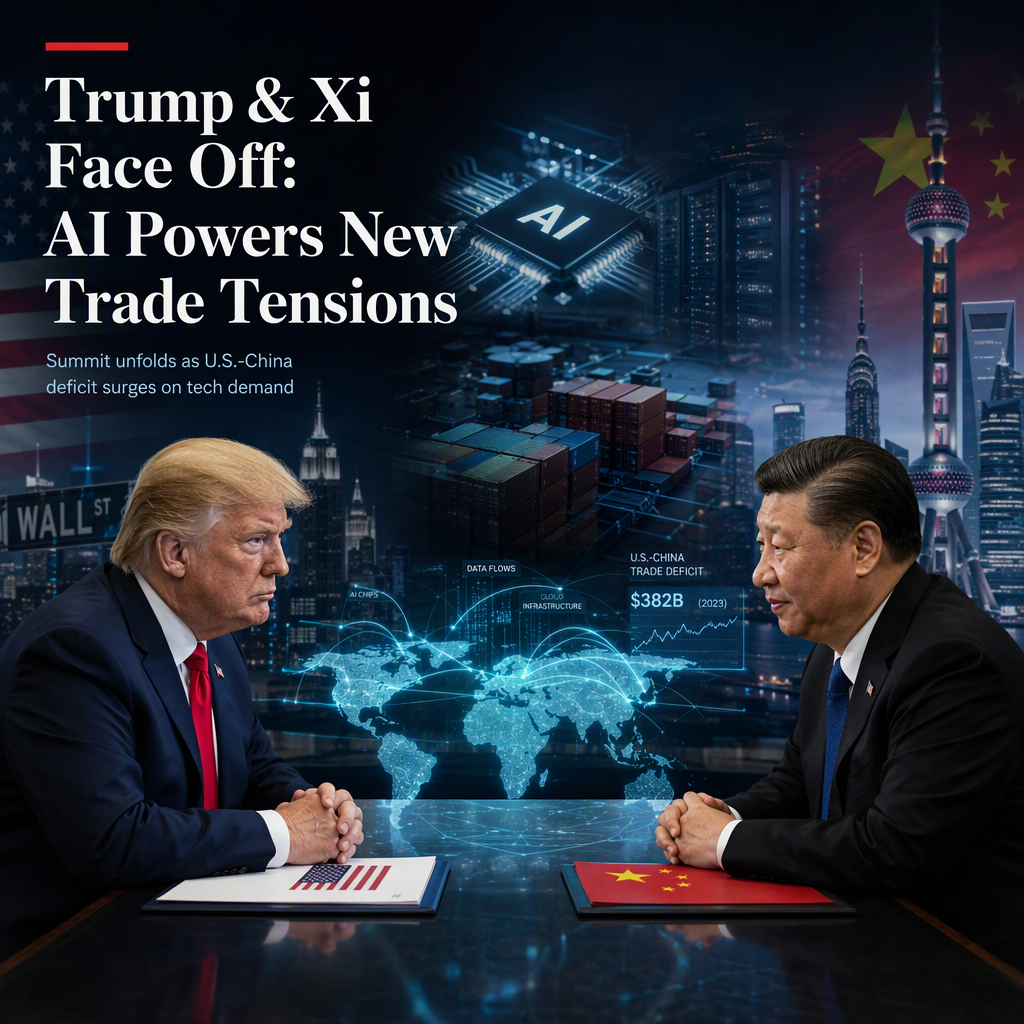
U.S. President Donald Trump and Chinese President Xi Jinping are expected to meet this week for their second in-person summit of the year, with trade relations and artificial intelligence (AI) at the forefront of discussions [1]. Despite a brief dip in the U.S. trade deficit with China to its lowest point since 2017, surging demand for AI-related parts has pushed the deficit higher again this year, according to China Customs data accessed through Wind Information [1]. Tariffs have not significantly reduced America's appetite for Chinese goods, and a domestic economic slowdown in China has not threatened the global reliance on its exports [1].
China's efforts to build up self-sufficiency have lessened the threat to its domestic market from global trade developments, even as the world's second-largest economy faces deep challenges [1]. Jens Eskelund, president of the European Chamber of Commerce in China, noted that Asia still accounts for more than 60% of U.S. imports, unchanged from before "Liberation Day," and estimated that between half and three-quarters of container traffic from China to Southeast Asia is ultimately destined for other regions [1]. Eskelund also stated that China reached 40% of global container exports this summer, a milestone he previously expected by 2030 [1].
The buildout of data centers by U.S. tech companies to power AI has supported demand for Chinese goods, but think tank CF40 estimated that for the first time this year, AI-related exports fell significantly in August from a year ago [1]. China's real estate market downturn, which began in 2022, has dragged down domestic demand, prompting Chinese companies to ramp up global expansion and exports [1]. Eskelund highlighted a direct correlation between the drop in export prices and the acceleration in export volumes [1].
Businesses are hoping for an extension of the trade truce reached last fall, but the articles note that tariffs have done little to curb U.S. demand for Chinese goods [1]. U.S. concerns about artificial intelligence have gained prominence ahead of the summit, reflecting the growing importance of technology in the bilateral relationship [1].
CONCLUSION
The upcoming Trump-Xi summit occurs against a backdrop of rising U.S.-China trade deficits fueled by AI-related demand, persistent global reliance on Chinese exports, and ongoing challenges in China's domestic economy. While businesses seek stability through a trade truce extension, tariffs have proven largely ineffective in reducing U.S. imports from China. The market remains attentive to developments in AI and trade policy as both nations navigate complex economic ties.