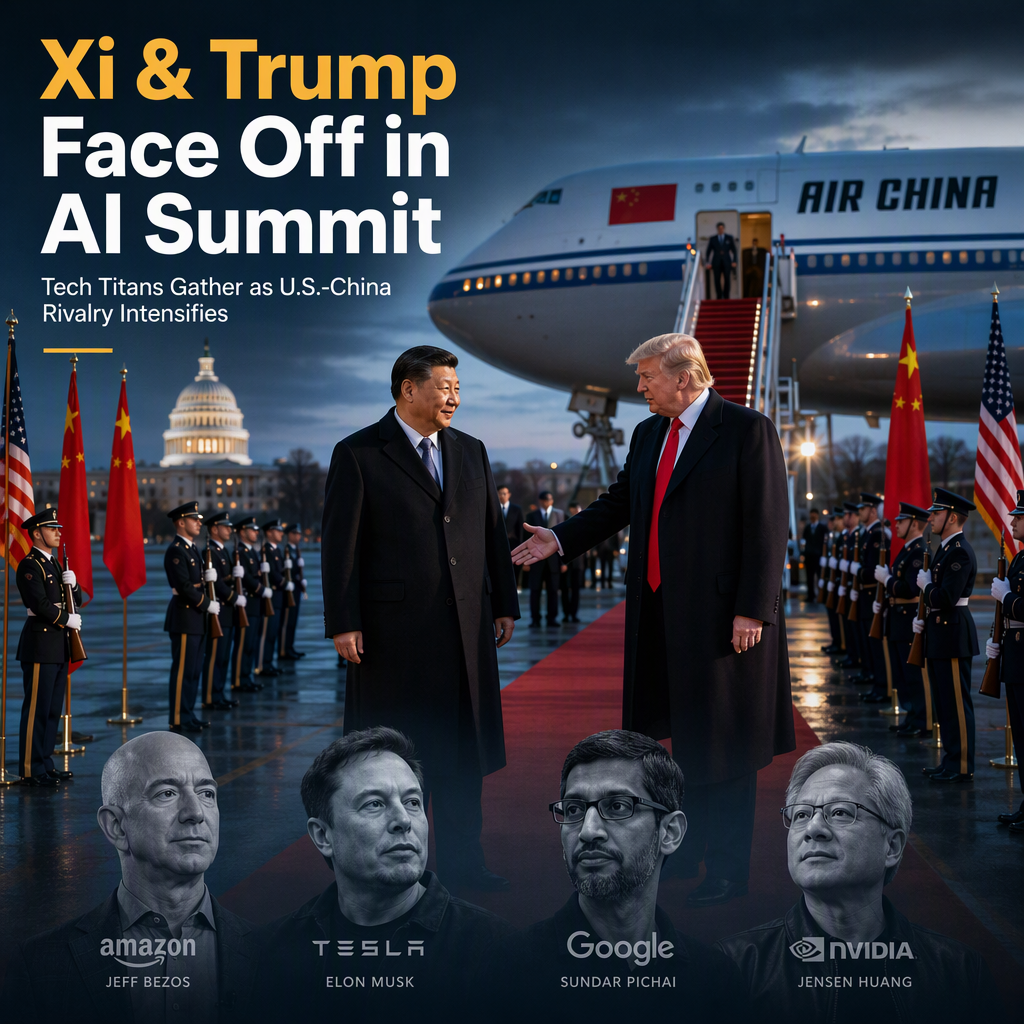
Chinese President Xi Jinping is set to arrive in Washington, D.C., for a highly anticipated summit with U.S. President Donald Trump, marking Xi's first visit to the U.S. capital in over a decade [1]. The summit, which begins Thursday morning and concludes Friday evening, will feature a State Arrival Ceremony with 479 military personnel and a series of high-level discussions [1]. A major focus of the talks will be artificial intelligence, with both leaders expected to address the ongoing competition for AI supremacy. Beijing has announced plans to spend $300 billion on data centers as part of its AI strategy [1].
The summit agenda also includes discussions on intellectual property theft, trade practices, rare-earth minerals, and China's support for Iran during America's military conflict there [1]. A senior administration official indicated that a wide-ranging deal on possible tariff reductions for non-strategic goods is expected to be discussed, alongside rare-earth exports and potential export controls [1]. President Trump is also expected to press China to curb fentanyl precursor chemical exports and to advocate for the release of Gulshan Abbas, an American detained in China for eight years [1].
The event will feature an elaborate state dinner attended by prominent figures from the technology and finance sectors, including Amazon founder Jeff Bezos, SpaceX founder Elon Musk, Google CEO Sundar Pichai, Dell Technologies CEO Michael Dell, Nvidia CEO Jensen Huang, OpenAI CEO Sam Altman, Citigroup CEO Jane Fraser, and Apple board of directors Chairman Tim Cook [1]. Trump emphasized American AI supremacy in a recent address to the United Nations General Assembly, referring to the technology as 'superintelligence' [1].
While the summit is expected to address several contentious issues, including trade and technology, the presence of top tech executives underscores the significance of AI and innovation in the ongoing U.S.-China rivalry [1].
CONCLUSION
The summit between Xi Jinping and Donald Trump is poised to have significant implications for AI, trade, and technology relations between the U.S. and China. With major tech leaders in attendance and high-stakes topics on the agenda, the outcome could influence market sentiment and future policy directions. The event signals heightened attention to AI competition and bilateral economic ties.