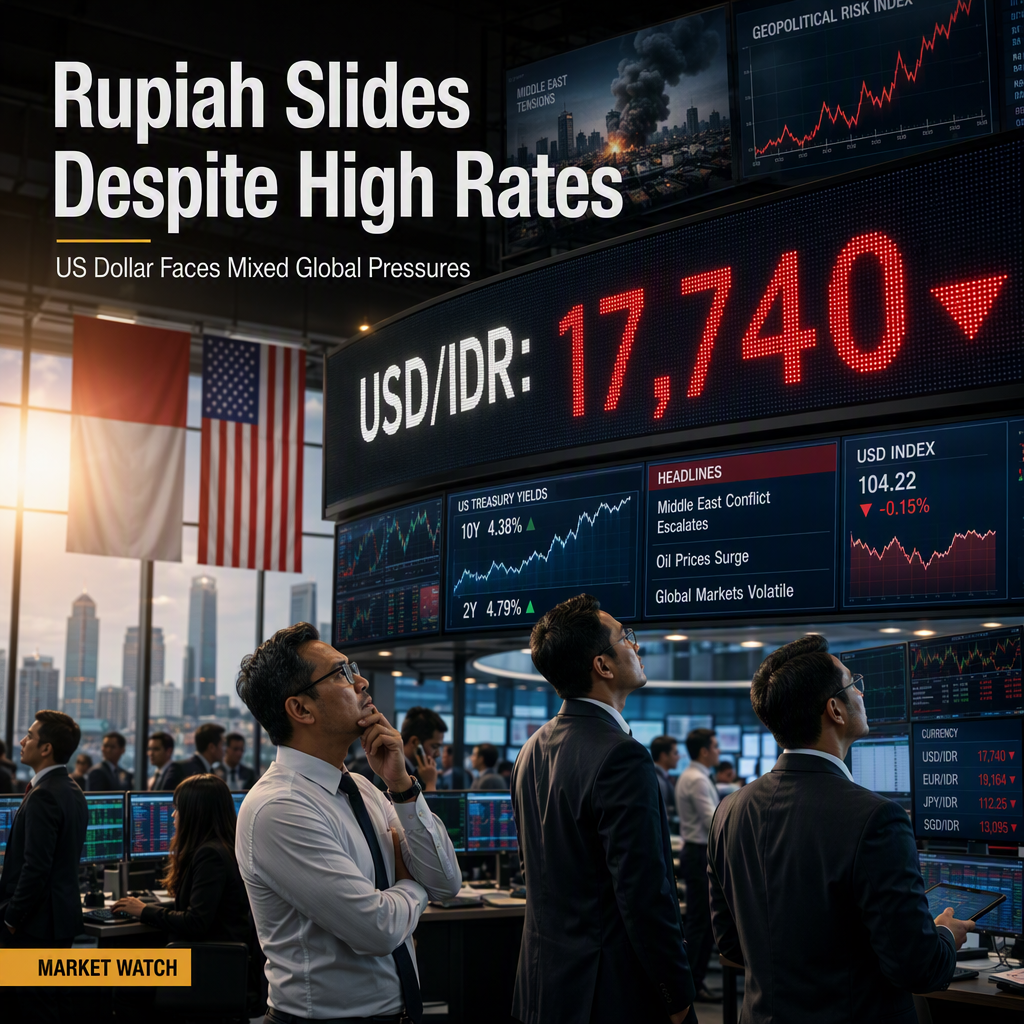
The Indonesian Rupiah (IDR) declined against the US Dollar (USD), with the USD/IDR pair trading around 17,740 during Asian hours on Monday, following three consecutive days of losses for the pair [1]. This movement comes despite the backdrop of high Indonesian interest rates, as Bank Indonesia (BI) recently implemented a cumulative 100-basis-point rate hike between May and June to defend the currency [1]. BI has kept its policy rate unchanged, emphasizing that this pause is part of a broader effort to maintain rupiah stability amid global volatility, particularly due to the ongoing conflict in the Middle East [1].
Commerzbank’s Moses Lim highlighted that BI is closely monitoring the risk environment, with Acting Governor Destry Damayanti warning that rising US Treasury yields could necessitate a stronger policy response in the future, indicating BI's readiness to tighten further if external pressures on the IDR intensify [1].
On the US side, the Dollar is under pressure from new fiscal measures, as the US Treasury Department announced plans to at least double its buybacks of longer-dated government debt to curb rising bond yields. Treasury Secretary Scott Bessent stated that these buybacks could exceed $4 billion, aiming to signal that current elevated yields do not accurately reflect economic fundamentals [1]. However, the downside for the Greenback may be limited by increased safe-haven demand amid escalating geopolitical tensions in the Middle East, with Iranian officials issuing strong warnings against further US actions [1].
Overall, the interplay between Indonesia's high interest rates, BI's policy stance, US fiscal maneuvers, and global geopolitical risks is creating a complex environment for the USD/IDR pair, with both currencies facing significant but opposing pressures [1].
CONCLUSION
The Indonesian Rupiah's recent decline against the US Dollar reflects a tug-of-war between domestic monetary support and external pressures, including US fiscal policy and geopolitical risks. Market participants are closely watching for further actions from Bank Indonesia and the US Treasury, as both sides signal readiness to respond to evolving conditions. The outlook for USD/IDR remains uncertain, with potential for further volatility depending on global developments.